Venus, Jupiter Ignite Sky in Rare Cosmic Dance
Venus and Jupiter are set to put on a stunning celestial show as they align in the night sky. Appearing to draw closer each night, the two planets will reach their closest point in early June 2026. This rare conjunction offers a beautiful visual of planetary motion.

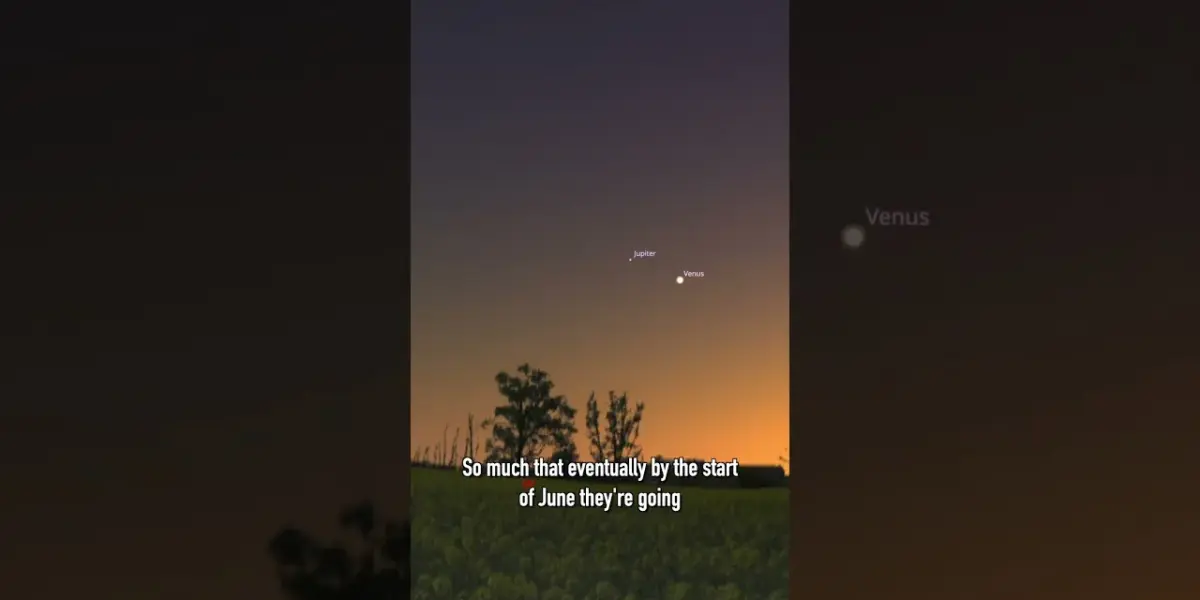
Venus and Jupiter Align in Dazzling Celestial Event
Get ready to witness a spectacular sight as two of our solar system’s brightest planets, Venus and Jupiter, prepare for a close encounter. Over the coming weeks, these celestial neighbors will appear to draw nearer in the night sky, culminating in a stunning conjunction. This cosmic meeting offers a beautiful reminder of the dynamic ballet of our solar system.
Understanding Planetary Conjunctions
A planetary conjunction happens when two or more celestial bodies appear very close to each other in the sky. This closeness is an illusion caused by our perspective from Earth.
The planets are not actually colliding or coming near each other in space; they are simply aligned from our viewpoint. This specific event involves Venus, the second planet from the Sun, and Jupiter, the largest planet in our solar system.
The apparent closeness is measured in degrees. On Earth, we use degrees to measure angles, much like a protractor. The full moon, for example, spans about half a degree in the sky.
This upcoming conjunction will bring Venus and Jupiter within just one degree of each other. This means they will appear about as far apart as two full moons placed side-by-side.
A Cosmic Countdown
Astronomers and skywatchers have been tracking the steady approach of Venus and Jupiter. As they journey along their individual orbits around the Sun, their paths will bring them into this remarkable alignment.
The anticipation builds as the planets visibly move closer each night. This gradual approach can be just as fascinating as the peak of the event itself.
The conjunction will reach its peak in early June 2026. This is the point where Venus and Jupiter will appear closest together in the sky.
Observing this event requires clear skies and a good vantage point away from city lights. Even with the naked eye, the sight of these two bright planets so near each other will be breathtaking.
Historical Context of Planetary Sightings
Throughout history, humans have been captivated by the movements of the planets. Ancient civilizations used celestial events like conjunctions to mark time, predict seasons, and navigate.
These alignments were often seen as omens or divine messages, fueling mythology and early astronomical study. Our fascination with these cosmic meetings continues today, inspiring wonder and scientific curiosity.
Early astronomers like Nicolaus Copernicus and Galileo Galilei meticulously charted planetary movements. Their work laid the foundation for our modern understanding of orbital mechanics.
Understanding how planets move allows us to predict events like this conjunction centuries in advance. It highlights the predictable and orderly nature of our solar system, governed by the laws of physics.
What’s Next for Skywatchers?
Your homework, should you choose to accept it, is to look up. Starting now, and continuing over the next few weeks, make it a point to observe Venus and Jupiter in the evening sky.
Note how their apparent distance decreases each night. This personal observation connects you directly to the grand cosmic clockwork that governs our universe.
This event is a wonderful opportunity for amateur astronomers and casual observers alike. It’s a chance to appreciate the beauty and scale of our solar system without needing complex equipment. Observing these celestial bodies can spark a lifelong interest in space exploration and science.
The next significant conjunction visible from Earth will be announced by astronomical societies. Keep an eye on skywatching calendars for future events. The universe constantly offers new spectacles, inviting us to look up and wonder.
Source: Venus and Jupiter will get closer together in May 2026 #shorts (YouTube)

Related Articles
New Telescope Unlocks Deeper Views of the Cosmos
A new 8-inch Dobsonian telescope is set to enhance public stargazing experiences, while discussions delve into the "Great Filter" theory and our place in cosmic structures. The article also explores the reliability of space technology and upcoming astronomical events, including the potential discovery of Planet Nine.
Dark Energy Drives Universe Expansion, Scientists Confirm
Scientists confirm dark energy, a mysterious force, is accelerating the universe's expansion, counteracting gravity. This discovery, rooted in 1999 observations of distant supernovae, suggests dark energy makes up about 68% of the universe's energy density. Future telescopes aim to unravel its true nature and impact on the cosmos's fate.
Sun’s Cosmic Siblings Found Orbiting Milky Way
Astronomers have identified potential siblings of our Sun, stars born in the same cosmic nursery, by analyzing their movements and chemical makeup. The Sun's stellar family may orbit the Milky Way together. The article also touches on the theoretical possibility of black holes acting as time mirrors, the Sun's future evolution, and the ongoing search for Planet Nine.