UK Astronomy Faces Funding Crisis
Proposed budget cuts by the UK's Science and Technology Facilities Council threaten to reduce funding for astrophysics, particle physics, and nuclear physics by up to 60%. This could cripple research and future opportunities for scientists.

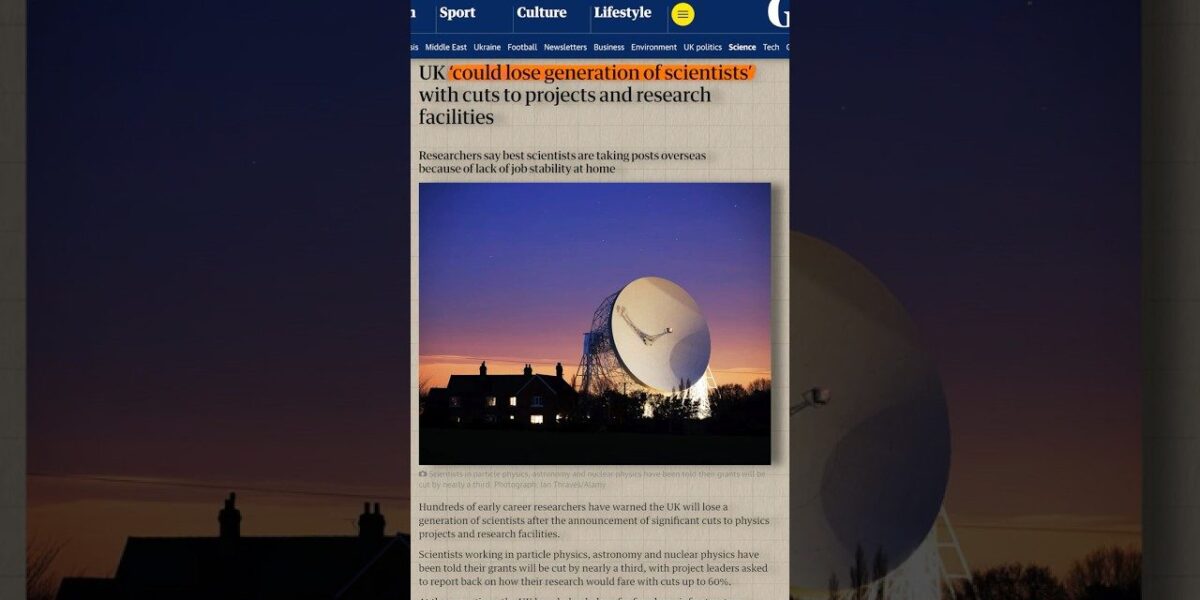
UK Astronomy Faces Potential Funding Crisis Amid Proposed Cuts
The United Kingdom’s vibrant astronomical community is facing an unprecedented challenge as proposed budget cuts threaten to significantly curtail research in astrophysics, particle physics, and nuclear physics. The Science and Technology Facilities Council (STFC), responsible for funding these crucial scientific endeavors, has outlined a drastic reduction in its budget, sparking widespread concern among researchers and advocates for space science.
Deep Cuts Loom for UK’s Cosmic Inquiries
According to proposals from the STFC, the combined budget for astrophysics, particle physics, and nuclear physics is slated to decrease by approximately 30%. However, the situation could be far more severe, with the scientific community being advised to prepare for funding scenarios involving reductions of 20%, 40%, and even 60%. This potential austerity measure comes at a time when the UK has historically excelled in astronomical and space science research, punching well above its weight on the global stage.
Understanding the Financial Strain
The rationale behind these proposed cuts, as explained by UK Research and Innovation (UKRI), centers on a significant increase in the STFC’s operational cost base. This rise is attributed to the management of large-scale facilities and essential services. In essence, the funding available for scientific grants is now in direct competition with the rising operational expenses of these facilities, a challenge exacerbated by increased energy bills—a predicament familiar to many households and industries globally.
A point of contention within the scientific community is that while these facilities serve a broad range of disciplines, including physics and medicine, it is exclusively astrophysics and nuclear physics that are expected to absorb the research budget reductions to offset these rising costs. This targeted approach has led to considerable frustration, as it places a disproportionate burden on fields that are at the forefront of exploring the universe and fundamental particles.
Impact on the Next Generation of Scientists
The implications of these proposed cuts extend far beyond the immediate financial strain. Research budgets are the lifeblood of scientific progress, directly funding the salaries of researchers, including early-career scientists and PhD students. A substantial reduction in funding could translate into fewer job opportunities for the next generation of aspiring scientists, potentially leading to a decline in the pace and scope of research conducted within the UK.
This outlook is particularly disheartening given the UK’s legacy in astronomy. From pioneering work in radio astronomy to significant contributions to space missions and theoretical astrophysics, the nation has a rich history of discovery. The prospect of curtailing this legacy due to funding shortfalls raises serious questions about the UK’s future role in global scientific endeavors.
A Call to Action and Historical Context
Historically, the UK has been a powerhouse in astronomical research. Institutions like the Royal Observatory in Greenwich, established in 1675, played a pivotal role in navigation and the understanding of celestial mechanics. More recently, British contributions to major international collaborations like the James Webb Space Telescope and the development of cutting-edge technologies for ground-based observatories underscore the nation’s ongoing commitment to pushing the boundaries of cosmic knowledge.
The current situation echoes past debates about the importance of fundamental scientific research and the long-term benefits it brings. While immediate economic pressures are undeniable, the scientific community argues that investing in research is an investment in future innovation, technological advancement, and a deeper understanding of our place in the cosmos. Cutting funding now could have ripple effects for decades to come, impacting not only scientific progress but also the UK’s competitiveness in a globalized, knowledge-based economy.
What Lies Ahead?
These proposed cuts are not yet finalized. The STFC has indicated that the community should plan for various funding reduction scenarios, suggesting that the final decision is still under consideration. This period presents a critical window for advocacy and engagement.
For UK residents who oppose these proposed changes, there is a clear avenue for action. A template letter has been made available for individuals to contact their Members of Parliament (MPs) and express their concerns. By raising awareness and making voices heard in the parliamentary arena, the scientific community hopes to influence the final decision and secure the necessary funding to continue its vital work.
The outcome of this budgetary review will have profound consequences for the future of UK astronomy and space science. It is a decision that will shape the research landscape, influence the careers of countless scientists, and ultimately determine the extent to which the UK can continue to contribute to humanity’s grand quest to understand the universe.
Source: Drastic cuts proposed to UK astronomy research funding (YouTube)

Related Articles


Artemis II Astronauts Face Isolation on Moon’s Far Side
The Artemis II mission will see four astronauts travel to the far side of the Moon, experiencing a 40-minute communication blackout. This historic test flight aims to gather crucial data on the lunar south pole and push the boundaries of human space exploration.


Artemis II Astronauts Set New Human Distance Record
The Artemis II mission set a new human distance record, reaching 413,145 km from Earth. The mission also established a record for the greatest distance between two groups of humans, with astronauts on China's Tiangong space station being 419,656 km away from the Artemis II crew.


Hackers Steal $10,000 from Locked iPhone
Cybersecurity experts have demonstrated a sophisticated hack that can steal up to $10,000 from a locked iPhone using a 'Tap to Pay' vulnerability. The exploit bypasses the phone's lock screen and payment verification by tricking the device into thinking a large sum is a small transit fare. This known flaw highlights ongoing security concerns with mobile payment systems.