Moon Missions Race for Resources, Not Just Science
Humanity's return to the Moon is driven by a new space race focused on political competition and the potential for valuable resource extraction, rather than solely scientific discovery. Programs like NASA's Artemis highlight this shift, preparing for long-term lunar bases and future Mars missions by studying human health in space.


Moon Missions Race for Resources, Not Just Science
Humanity’s return to the Moon is not just about scientific discovery; it’s driven by a new space race fueled by political ambition and the lure of valuable resources. While the stunning images from lunar missions captivate us, the primary motivations behind programs like NASA’s Artemis are rooted in competition and economic potential, rather than pure scientific exploration.
The current push to land humans back on the Moon mirrors the Cold War space race, with the United States aiming to outpace China in lunar exploration. Although international treaties prevent nations from claiming ownership of celestial bodies like the Moon, there’s nothing to stop countries or private companies from claiming specific landing sites and exploiting their mineral wealth. This potential for resource extraction is a major factor in securing funding for missions like Artemis.
Artemis: More Than Just Science?
While Artemis missions aim to gather scientific data, the emphasis on human health and the toll of space travel suggests preparation for long-term lunar bases and future Mars expeditions. However, questions arise about whether this focus justifies the significant cost, especially when compared to astrophysics programs that could yield deeper scientific insights. This highlights a distinction between astrophysicists, who study the universe, and rocket scientists, who engineer space travel.
The Artemis program includes missions designed to study the effects of space travel on the human body. Astronauts will undergo rigorous testing to understand how microgravity and radiation impact their health over extended periods.
This research is crucial for planning longer missions, such as establishing a permanent base on the Moon or sending humans to Mars. The data gathered will help develop countermeasures to protect astronauts and ensure mission success.
The Race for Lunar Riches
The Moon is believed to hold significant deposits of valuable resources, including water ice, helium-3, and rare earth metals. Water ice, found in permanently shadowed craters near the lunar poles, can be converted into rocket fuel and drinking water, making it a critical resource for future space exploration. Helium-3 is a potential fuel source for nuclear fusion reactors, which could provide clean energy on Earth.
Companies are already developing technologies to mine these resources. Private entities are partnering with space agencies to test mining equipment and assess the economic viability of lunar resource extraction. The first missions may focus on extracting water ice, which is essential for sustaining human presence on the Moon and enabling further deep space missions.
Historical Context and Future Prospects
The Apollo program in the 1960s and 1970s was driven by a geopolitical imperative to demonstrate American technological superiority during the Cold War. Today, a similar dynamic is at play, with nations vying for prestige and strategic advantage in space. The Artemis Accords, a set of principles for lunar exploration, aim to guide responsible international cooperation while acknowledging the commercial interests involved.
The Artemis missions are planned in stages, with Artemis II set to carry astronauts around the Moon and Artemis III aiming for a lunar landing. Future missions will focus on building infrastructure, including a lunar gateway space station and surface habitats. These developments enable sustained human presence and extensive resource utilization on the Moon.
The next significant milestone for the Artemis program is the Artemis II mission, scheduled for launch in late 2024. This crewed mission will orbit the Moon, testing crucial systems and providing valuable experience for future lunar landings.
Source: Why we're REALLY going back to the Moon (it's not about science…) #shorts (YouTube)

Related Articles

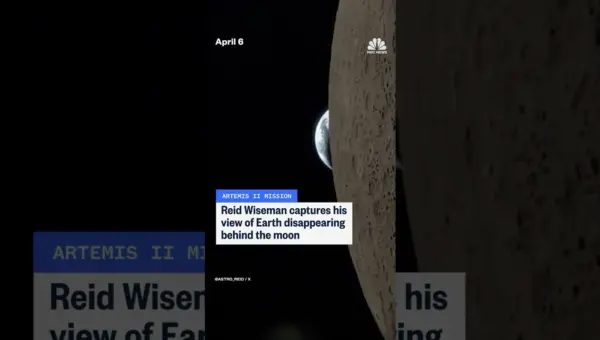
Astronaut’s Moon View Shows Earth Vanish
Astronaut Reid Wiseman shared a stunning image taken during the Artemis II mission, showing Earth vanishing behind the moon. The photograph provides a unique perspective on our planet's place in the cosmos. This visual captures a profound moment of lunar exploration and highlights the ongoing efforts of NASA's Artemis program.


New Telescope Unlocks Deeper Views of the Cosmos
A new 8-inch Dobsonian telescope is set to enhance public stargazing experiences, while discussions delve into the "Great Filter" theory and our place in cosmic structures. The article also explores the reliability of space technology and upcoming astronomical events, including the potential discovery of Planet Nine.


Rocket Lab Expands Reach, Eyes Mars with New Tech
Rocket Lab is powering NASA's Artemis II mission with solar technology and expanding its reach with space laser communications. The company is also developing its Neutron rocket and has ambitions for Mars exploration.