New Glenn Lands Booster, ESCAPADE Mars Mission Launched
Blue Origin's New Glenn rocket successfully launched the ESCAPADE Mars mission and achieved a historic booster landing. The dual spacecraft mission aims to unravel Mars' atmospheric mysteries, while the booster recovery marks a key step in reusable heavy-lift launch capabilities.


New Glenn Achieves Booster Landing Milestone, ESCAPADE Mission Heads to Mars
In a week brimming with significant spaceflight developments, Blue Origin’s New Glenn rocket achieved a monumental feat: the successful landing of its first stage booster. This achievement, alongside the launch of the ESCAPADE mission to study Mars, marks a pivotal moment for both Blue Origin and NASA’s planetary exploration efforts. The successful recovery of the New Glenn booster, named ‘Never Tell Me The Odds,’ signifies a major step forward in making heavy-lift orbital rockets reusable, a critical factor in reducing the cost of space access and enabling more ambitious missions.
New Glenn’s Precision Landing
The second flight of Blue Origin’s New Glenn rocket, which launched on a Wednesday afternoon, was more than just a successful ascent; it was a demonstration of refined orbital booster recovery. After carrying the twin ESCAPADE spacecraft towards their Martian destination, the massive first stage, powered by seven BE-4 engines, performed a series of complex maneuvers. Approximately seven minutes into the flight, the engines reignited for a reentry burn, creating a striking visual of exhaust forming a curved shield. The critical phase was the booster’s return to Earth, where it was targeted to land on Blue Origin’s ‘Jacklyn’ recovery vessel positioned in the ocean. After a nail-biting final minute, the booster successfully landed, marking the second time in history an orbital-class booster has been recovered. This follows SpaceX’s pioneering efforts with the Falcon 9, making Blue Origin the second company to achieve this capability. The patented system employed by Blue Origin instantly welds the booster to the vessel’s deck, ensuring a secure capture.
ESCAPADE Mission: Unraveling Mars’ Mysteries
The primary payload of this historic New Glenn flight was the ESCAPADE (Escape and Plasma Acceleration and Dynamics Explorers) mission. This NASA initiative comprises two identical spacecraft, named ‘Blue’ and ‘Gold,’ designed to study the Martian climate. Mars is believed to have once been a warmer, wetter planet with a substantial atmosphere, but it has since transformed into the dry, barren world we see today. Understanding this transition, particularly the loss of its atmosphere and magnetic field, is crucial for understanding planetary evolution and the potential for life beyond Earth.
The ESCAPADE spacecraft, built on Rocket Lab’s Explorer-class interplanetary buses, will leverage the advantage of having two distinct vantage points simultaneously. This allows for more comprehensive data collection and validation, enabling researchers to observe changes in Mars’ atmosphere over shorter timescales. Instead of waiting for a single satellite to complete its orbit, the twin spacecraft will follow each other, mapping Mars’ magnetic fields, upper atmosphere, and ionosphere in three dimensions. This detailed mapping will provide unprecedented insights into how Mars interacts with space weather, which is vital for future human missions and for improving communication and navigation systems on the planet.
Originally slated for launch during the previous Mars transfer window, the ESCAPADE mission was delayed due to New Glenn’s schedule. However, this delay has led to an innovative orbital strategy. Instead of proceeding directly to Mars, Blue and Gold will first be placed into orbit around Earth’s second Lagrange point (L2) for approximately 11 months. From this stable vantage point, they will await the next optimal Mars transfer window, expected in late 2026. They will then use a gravity assist from Earth to propel them towards Mars, where they are projected to arrive in late 2027 to commence their scientific operations. This mission, part of NASA’s SIMPLEx program, is remarkably cost-effective, with the entire ESCAPADE mission, including launch, costing under $80 million USD.
Space Weather Interruptions and Other Developments
The week was not without its challenges. A significant solar storm, categorized as an X-class solar flare, impacted Earth mid-week, causing widespread auroras and disrupting spaceflight operations. This event, involving coronal mass ejections (CMEs) from the Sun, prompted a G4-level geomagnetic storm warning from NOAA. While predicting such space weather remains difficult, Earth’s magnetosphere and atmosphere provided essential protection from the intense radiation. This solar activity was a factor in some of the launch hold-ups experienced by Blue Origin.
Beyond the New Glenn launch, the week also saw continued progress at SpaceX’s Starbase facility. The demolition of the original launch mount for Starship is well underway, with massive components being removed and prepared for recycling. This extensive overhaul is paving the way for future iterations of the launch infrastructure. New testing hardware, nicknamed ‘Ibeproofin,’ has been deployed at Pad 2 to rigorously test the Super Heavy booster’s hold-down arms and clamps. Meanwhile, at the build site, the Gigabay structure is rapidly being assembled, and the first Version 3 Starship is taking shape. At the Massey’s test site, preparations are advancing for the resumption of testing with Version 3 flight hardware, including the installation of new quick disconnect interfaces and modifications to the engine chill pond to accommodate increased flow rates for potential future Raptor 3 engines or nine-engine Starship configurations.
In other launch news, Rocket Lab has confirmed that its next-generation Neutron rocket’s maiden launch will be delayed to mid-2026. The company is prioritizing a successful orbital insertion on its first flight, foregoing booster recovery for this initial mission. SpaceX continued its high cadence of Starlink launches, deploying multiple batches of satellites from different pads within hours of each other, showcasing the reliability and operational efficiency of their Falcon 9 fleet. ULA’s Atlas V also successfully launched the ViaSat-3 F2 communications satellite, marking another step in the Atlas V’s final missions before its retirement.
Looking Ahead
The successful booster landing by New Glenn is a testament to Blue Origin’s engineering prowess and commitment to reusability. This achievement not only validates their technology but also positions them as a significant player in the heavy-lift launch market. The ESCAPADE mission’s journey to Mars, enabled by this launch, promises to yield invaluable scientific data that will deepen our understanding of the Red Planet’s past and future. As these missions progress, they contribute to humanity’s broader goals of exploring the solar system, searching for life beyond Earth, and ultimately, establishing a sustained human presence beyond our home planet.
Source: Blue Origin’s New Glenn stunned everyone! (YouTube)

Related Articles
AI Robots Lead Humanity’s Martian Exploration Drive
Advanced AI robots are poised to lead humanity's exploration of Mars, acting as intelligent partners to overcome the planet's harsh conditions. This development promises to unlock Martian secrets and drive technological innovation, despite the significant costs involved.

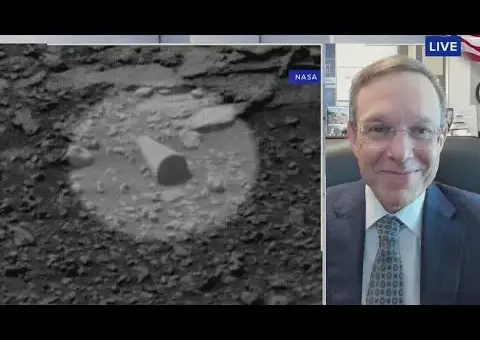
Harvard Professor Challenges NASA on Mars Object
Harvard Professor Avi Loeb is questioning NASA's explanation of a 'party hat'-shaped object on Mars. While NASA calls it a natural rock, Loeb believes it warrants further investigation and highlights the importance of curiosity-driven science.


US Launches Moon Mission, Eyes Mars Future
The US Artemis II mission, carrying astronauts around the Moon, marks a significant step towards a permanent lunar presence and future Mars exploration. The mission tests vital life support systems, building on previous uncrewed flights and aiming to gather knowledge for long-duration space living.