AI Revolutionizes Coding: From Bits to Intelligent Assistants
From binary code to sophisticated compilers and now intelligent AI assistants, programming has undergone a dramatic evolution. Tools like JetBrains' Juny are changing how developers write code, shifting focus from typing to thinking.

AI Revolutionizes Coding: From Bits to Intelligent Assistants
The landscape of software development, a field built on the intricate dance of ones and zeros, is undergoing a seismic shift. For decades, programming has evolved from the rudimentary manipulation of binary code to sophisticated languages that abstract away complexity. Now, artificial intelligence is stepping in, not to replace the programmer, but to fundamentally alter the tools and workflows, heralding an era of intelligent coding assistants.
The Genesis of Code: From “Useless” to Essential
The journey of programming began with the abstract concepts of ‘one’ and ‘zero,’ initially perceived as trivial. The advent of electricity, with its on/off states, provided a physical manifestation for these binary digits. Early computing pioneers, like Alan Turing in 1936, began to formalize the very notion of computability. Following World War II, the practical utility of computing machines became apparent, utilizing vacuum tubes and punch cards to represent binary data. This fundamental unit of information, a ‘bit,’ evolved into the ‘byte’ – an eight-bit grouping that enabled more complex representation.
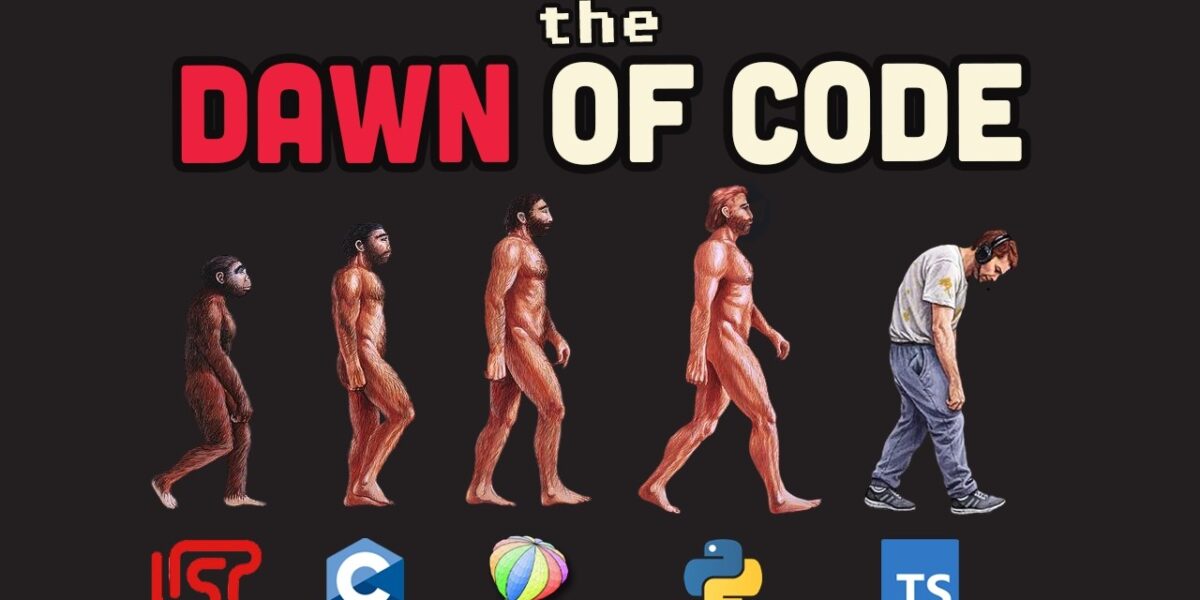
The laborious task of directly manipulating binary sequences quickly proved inefficient. This led to the creation of assembly language, which introduced mnemonics to represent machine instructions, making code slightly more readable. However, the true leap came with the vision of Grace Hopper, who conceived of a way for computers to understand something akin to human language. Her invention, the ‘compiler,’ acted as a translator, converting human-readable source code into machine code (ones and zeros) that computers could execute. This breakthrough paved the way for high-level programming languages like FORTRAN for scientists and COBOL for business and government, a language still underpinning significant portions of global finance.
Evolution of Languages and Paradigms
The mid-20th century also saw the emergence of Lisp, a language characterized by its list-based structure and dynamic interpretation, which introduced novel concepts like automatic memory management, or ‘garbage collection.’ The 1970s brought a focus on structured programming, moving away from unstructured ‘go-to’ statements. Dennis Ritchie’s C language emerged as a powerful and efficient tool, allowing direct memory manipulation, and was famously used with Ken Thompson to create the Unix operating system. The modular, pipe-driven philosophy of Unix influenced subsequent software design profoundly.
The 1980s introduced object-oriented programming (OOP) with languages like C++, which added layers of abstraction, classes, and inheritance. C++ became a dominant force, powering games, browsers, and databases, and remains relevant today. Simultaneously, languages like BASIC gained popularity on home computers, while specialized languages like Ada and Erlang were developed for specific domains. The 1990s witnessed a confluence of philosophies: Python championed readability and simplicity, Java aimed for platform independence with its ‘write once, run anywhere’ mantra and virtual machine, and JavaScript, initially a lightweight browser scripting tool, unexpectedly evolved to power the entire web, from front-end interactivity to back-end servers.
Modern Programming and the AI Incursion
The early 2000s saw a trend towards cleaner, more elegant languages, with Swift addressing Objective-C’s shortcomings, Kotlin improving upon Java, and TypeScript enhancing JavaScript. Languages like Go and Rust offered modern alternatives to C, focusing on performance, safety, and concurrency.
The most recent and perhaps most impactful development is the integration of AI into the coding process. What began as simple code completion and linting tools has rapidly advanced to AI-powered agents capable of generating entire functions, refactoring code, and even constructing full-stack applications. This evolution challenges the traditional definition of programming, shifting the focus from the mechanics of typing code to the higher-level cognitive task of problem-solving and architectural design.
Introducing JetBrains’ Juny: An Intelligent Coding Companion
Tools like JetBrains’ AI coding agent, Juny, exemplify this new wave of AI assistance. Integrated directly into JetBrains’ Integrated Development Environments (IDEs), Juny leverages its understanding of the entire codebase’s structure and history to provide context-aware code generation and suggestions. While it may offer a different speed profile compared to some other generative AI tools, its strength lies in its accuracy and deep contextual understanding, particularly beneficial for complex projects involving specialized data, such as waveform data in a custom voice recorder application.
Juny also features an integrated AI chat interface, allowing developers to ask clarifying questions about the generated code and its underlying logic. The agent supports multiple major AI models, including Grok and Gemini, offering flexibility to developers. This allows programmers to offload repetitive coding tasks and focus on more complex problem-solving, architectural decisions, and creative aspects of software development. The availability of free trials for such tools democratizes access to advanced AI coding assistance, enabling developers to explore and integrate these powerful capabilities into their workflows.
Why This Matters
The integration of AI into programming is not about making programmers obsolete; it’s about augmenting their capabilities. By automating routine tasks, AI assistants free up developers to tackle more challenging and innovative aspects of software creation. This can lead to faster development cycles, improved code quality through AI-driven suggestions and error detection, and the democratization of coding itself, potentially lowering the barrier to entry for new developers. The ability to generate and understand code at a higher level of abstraction allows for more ambitious projects and a faster pace of technological advancement across all industries.
Source: A brief history of programming… (YouTube)

Related Articles


AI Reshapes Economy: New Wealth Opportunities Emerge
Artificial intelligence is set to dramatically reshape the global economy within five years, creating both challenges and significant wealth-building opportunities. Experts emphasize the need to adapt by learning AI skills, drawing parallels to how past technological shifts democratized access to knowledge and investment strategies.


AI Misdiagnoses Medical Cases 80% of the Time
A recent U.S. study reveals that AI chatbots are misdiagnosing medical conditions in 80% of cases, highlighting significant risks in relying on artificial intelligence for health advice. Personal stories shared by individuals demonstrate how online self-diagnoses led to incorrect treatments and prolonged suffering, underscoring the irreplaceable value of human medical professionals.


Magnificent 7 Stocks Surge Amid Market Uncertainty
Tech giants, the 'Magnificent 7,' are surging despite market fears, showing technical breakouts and strong growth potential. Amazon invests heavily for long-term gains, while Google deepens its AI capabilities. Meta refocuses on core strengths, and Apple's services business continues its impressive expansion.