Investing 101: Beat Inflation, Build Wealth
Inflation erodes savings, making investing crucial for wealth preservation and growth. Ben Felix explains why understanding stocks, bonds, and the power of low-cost, diversified index investing is key to achieving financial independence.

Investing 101: Beat Inflation, Build Wealth
In a world where inflation steadily erodes purchasing power, understanding the fundamentals of investing is no longer a luxury but a necessity. Ben Felix, Chief Investment Officer at PWL Capital, recently outlined the core principles of investing, emphasizing its role in combating inflation and achieving long-term financial independence. This primer demystifies key concepts like stocks and bonds, the importance of a sensible approach, and the tools available to implement these strategies.
Why Investing Matters: The Inflation Hurdle
At its most basic level, investing is crucial because of inflation. Inflation, the general increase in prices and fall in the purchasing value of money, means that the same amount of money buys less over time. While central banks aim for low, stable inflation rates, the reality for individuals is that cash held without earning a return will lose purchasing power. “The same number of dollars will be able to buy less stuff in the distant future than they buy today,” Felix explains. The solution lies not in hoarding cash, but in deploying it into assets with positive expected returns.
Even stable investments like treasury bills and high-interest savings accounts are generally expected to keep pace with inflation. However, for substantial wealth creation and the pursuit of financial independence—a state where one’s financial capital supports their lifestyle without the need for active work—investing in riskier assets with higher expected returns becomes essential. Financial independence is achieved by converting human capital (earning potential) into financial capital (ownership of assets).
Consider the impact of investment returns on retirement planning. A 30-year-old saving 10% of their income and achieving a 7% annual return could retire at 65 and replace 60% of their pre-tax income until age 95. In stark contrast, if that same individual earned only a 2% return (closer to the inflation rate), they would need to save over 50% of their income to achieve a similar outcome. This highlights how leveraging financial markets through strategic risk-taking can significantly reduce the lifestyle sacrifices required today.
Understanding the Building Blocks: Stocks and Bonds
When discussing higher expected returns and risk, Felix clarifies that this doesn’t involve speculative stock picking or chasing market trends. Instead, it centers on understanding two fundamental asset classes: stocks and bonds.
Stocks: Ownership and Growth Potential
A stock represents a piece of ownership in a company. Its value is tied to the company’s expected future profits. As a shareholder, investors participate in the company’s successes and failures. Historically, global stocks have delivered annualized returns of slightly over 8% before inflation, and approximately 5% after inflation, over the last 125 years. However, past performance is not indicative of future results, as exemplified by the Japanese stock market’s dramatic boom and subsequent stagnation from 1990 to 2025, where investments lost value after accounting for inflation.
Felix advocates for globally diversified stock portfolios, weighted by market capitalization. Market capitalization weighting means that larger companies, by total market value, have a greater influence on the index. This approach reflects the collective wisdom of the market, assigning value based on expected profits, risk, and relative performance. While the US market currently holds a significant weight, factors like taxes and currency can influence an appropriate home country bias, though excessive concentration is generally ill-advised.
Despite the historical success of diversified stock portfolios, individual stocks remain highly risky, with many failing while a few achieve exceptional gains. The difficulty in identifying these winners beforehand reinforces the strategy of holding a broad, diversified basket of stocks, ideally weighted by market capitalization. Even diversified stock portfolios can experience significant volatility, which is a key reason why not all investors can comfortably hold 100% stocks.
Bonds: Loans and Stability
Bonds are essentially loans made to companies or governments. Unlike stocks, bond values typically do not fluctuate as dramatically with company performance. Bondholders have a contractual claim on future cash flows and may recoup some investment even if the issuing entity defaults. Government bonds are generally even more stable. While bonds are less volatile than stocks, they also offer lower expected returns. This trade-off between risk and expected return is fundamental. Bonds are also sensitive to inflation, which can erode the purchasing power of their fixed payments over time, making stocks generally perform better than bonds over the long term in inflationary environments.
The Case Against Active Management
Felix critiques the common belief that successful investing requires predicting market movements or stock performance—a strategy known as active management. The efficient market hypothesis, formalized by Nobel laureate Eugene Fama, suggests that market prices already reflect all available information. Consequently, consistently outsmarting the market is exceedingly difficult, even for professional fund managers. Research consistently shows that only a small fraction of active managers outperform their benchmarks, and those that do rarely sustain their performance over time.
Furthermore, active management often comes with higher fees. The difference in fees between actively managed funds and their passive, index-tracking counterparts can significantly impact long-term returns. An extra 0.64% in annual fees, the average difference in Canada, could necessitate saving an additional 25% of income to achieve the same retirement outcome, assuming no improvement in returns for the higher fee.
Survivorship bias—where only the successful funds remain to be analyzed, masking the failure rate of others—and the lack of persistence in outperformance further undermine the active management case. Funds that merge or close are typically poor performers, skewing the perception of average active fund success.
Index Investing: A Sensible Alternative
The alternative to active management is index investing, which involves holding a diversified portfolio that mirrors a specific market index, such as the S&P 500 or the S&P/TSX Composite. Index funds aim to capture market returns rather than beat them. They are characterized by low costs and broad diversification.
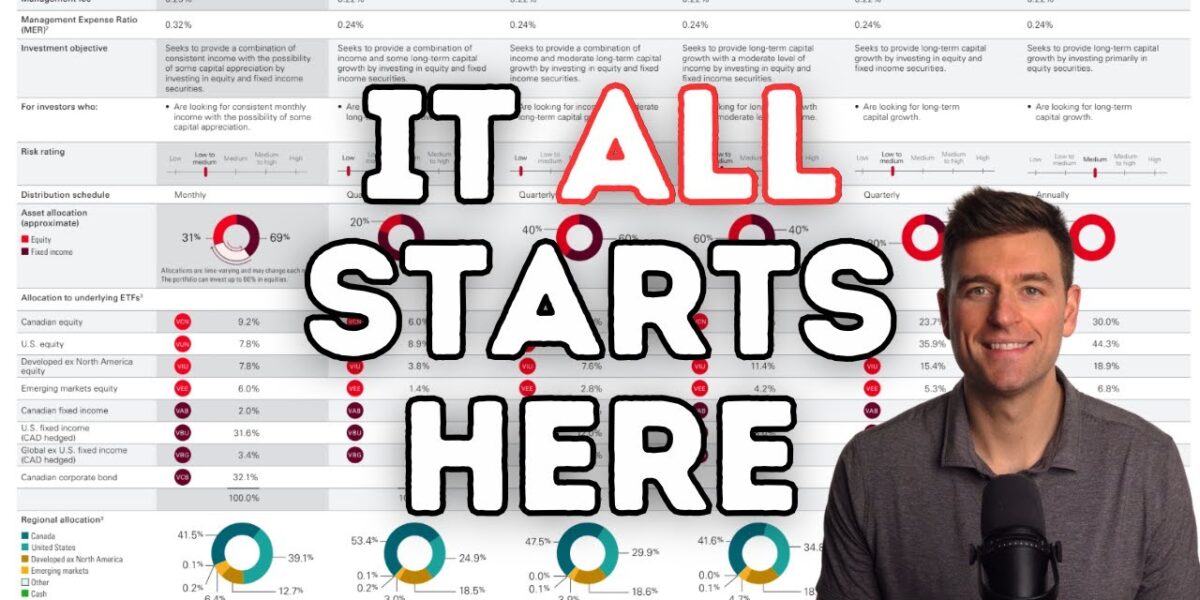
The advent of asset allocation Exchange-Traded Funds (ETFs) has made index investing more accessible. These ETFs, like Vanguard’s VGRO, hold a diversified mix of global stock and bond index ETFs, automatically rebalancing the portfolio to maintain target allocations. VGRO, for example, offers an 80% stock/20% bond mix, with a notable Canadian home country bias. Other providers offer similar products with varying risk profiles.
Market Impact & What Investors Should Know
- Inflation is a constant: Holding cash long-term guarantees a loss of purchasing power. Investing is essential to outpace inflation.
- Stocks offer higher growth potential but more volatility: Historically, stocks have provided returns well above inflation, but with significant price swings.
- Bonds provide stability but lower returns: Bonds are less volatile than stocks and can cushion portfolio declines, but their long-term growth potential is lower.
- Diversification is key: Spreading investments across global stocks and bonds reduces idiosyncratic risk (risk tied to a specific company or country).
- Market capitalization weighting is a strong starting point: Allocating investments based on the relative size of companies and countries in the global market is a sensible default strategy.
- Active management is difficult and costly: Consistently outperforming the market through stock picking or market timing is improbable and often eroded by higher fees.
- Index investing is efficient: Low-cost, diversified index funds or ETFs provide a practical and effective way to capture market returns.
- Asset allocation ETFs simplify implementation: These products offer pre-packaged, diversified, and automatically rebalanced portfolios, making investing more accessible.
- Discipline is paramount: Sticking to a well-reasoned investment plan through market ups and downs is crucial for long-term success.
In conclusion, Felix’s approach to investing 101 emphasizes a strategic, disciplined, and cost-effective methodology. By understanding the corrosive effects of inflation, the distinct roles of stocks and bonds, and the inefficiencies of active management, investors can leverage low-cost, globally diversified index funds and ETFs to build wealth and achieve their long-term financial goals.
Source: Investing 101 (YouTube)

Related Articles


Trump Tax Cuts Failed Working Americans, Ex-Obama Aide Claims
Former Obama official Jim Messina argues that Trump's tax cuts primarily benefited the wealthy, failing to provide relief to average Americans struggling with rising gas and grocery prices. He suggests that while tax-free tips offer some help to specific workers, broader economic issues are more influential for most voters.


High Debt Forces Fed’s Hand, Paving Way for Rate Cuts
Massive U.S. debt is limiting the Federal Reserve's ability to fight inflation, potentially forcing interest rate cuts. This delicate balancing act risks higher inflation and impacts the real estate market, creating both challenges and opportunities.


5 Signs You’re Winning With Money
Achieving financial success involves more than just a high income. Key indicators include having monthly financial margin, maintaining an emergency fund, investing consistently, controlling lifestyle spending, and experiencing financial peace of mind. A solid financial plan ties these elements together.