Investing Wisdom: Timeless Quotes for Smarter Decisions
Renowned financial expert Ben Felix distills decades of investment wisdom into key quotes, emphasizing saving, behavioral finance, disciplined investing, and cost control. These insights offer a roadmap for navigating market volatility and achieving long-term financial success.

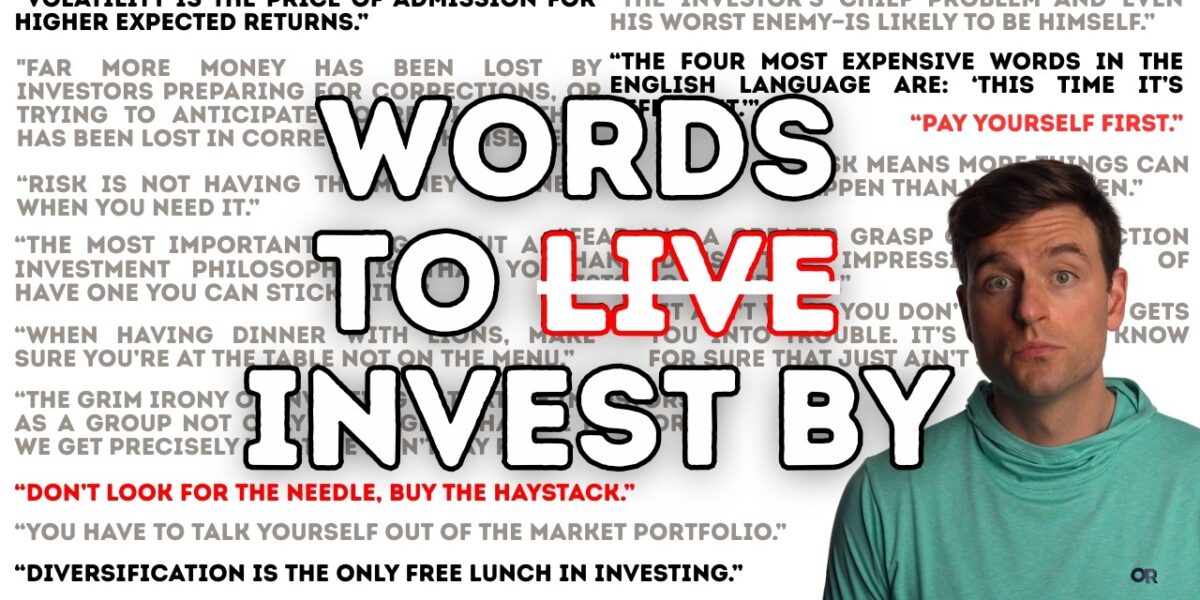
Investing Wisdom: Timeless Quotes for Smarter Decisions
In the realm of finance, some of the most profound insights are often distilled into concise, memorable quotes. These nuggets of wisdom, born from decades of experience and academic rigor, offer invaluable guidance for investors navigating the complexities of the market. Ben Felix, Chief Investment Officer at PWL Capital, highlights several such powerful quotes, emphasizing their practical application in everyday financial decision-making.
The Foundation of Wealth: Saving First
Before delving into investment strategies, Felix underscores the fundamental importance of saving. He references the classic adage, popularized by “The Richest Man in Babylon” and “The Wealthy Barber,” to “Pay yourself first.” This principle suggests prioritizing saving a portion of income before succumbing to spending pressures. Automating savings through payroll deductions or direct bank transfers is presented as an effective method to ensure consistent wealth accumulation. While “The Wealthy Barber” suggests saving 10%, Felix notes that economists often advise lower savings rates early in one’s career, increasing as income grows, provided a clear plan is in place to meet long-term financial objectives.
Mastering the Investor’s Psychology
Investing is as much a psychological battle as a financial one. Ben Graham, a titan of financial analysis, famously stated, “The investor’s chief problem and even his worst enemy is likely to be himself.” This sentiment is echoed by Sir John Templeton’s warning, “The four most expensive words in the English language are, ‘This time is different.'” This quote cautions against the allure of narratives that suggest current market conditions are unprecedented, a phenomenon often observed during speculative bubbles like the dot-com era or the rapid ascent of assets like the ARK Innovation ETF (ARKK). Investors, swayed by euphoria, may justify historically high valuations with the belief that existing paradigms have shifted.
Conversely, during market downturns, fear can override rational analysis. As economist Jeremy Siegel observed, “Fear has a greater grasp on human action than does the impressive weight of historical evidence.” Despite historical data demonstrating market recoveries, fear can lead investors to believe that this time, the market will not bounce back. Felix emphasizes that while the specific causes and narratives surrounding market events are unique, the underlying principles of positive expected returns for risky assets and the eventual importance of valuations remain constant. Investors must mentally and financially prepare for volatility and resist the urge to panic sell.
The Power of a Convicted Investment Philosophy
Having a well-defined investment philosophy that one can adhere to is crucial. David Booth, co-founder of Dimensional Fund Advisors, asserts, “The most important thing about an investment philosophy is that you have one that you can stick with.” This is because financial markets tend to reward long-term discipline, while many investors undermine their returns by switching strategies at inopportune moments. Even a seemingly suboptimal philosophy, like a dividend-focused approach, can be effective if it fosters discipline. The challenge lies in the fact that any strategy, however sound, can underperform for extended periods. The speaker cites the example of ARK Innovation ETF (ARKK), whose manager, Cathie Wood, argued against index funds, suggesting they were misallocating capital. While ARKK experienced a significant run-up, it eventually declined, leaving investors who chased its performance with losses. However, those who maintained conviction in their chosen philosophy, even through the downturn, were better positioned.
Navigating Market Corrections and Asset Allocation
Market downturns can be particularly unnerving. Legendary fund manager Peter Lynch advised, “Far more money has been lost by investors preparing for corrections or trying to anticipate corrections than has been lost in corrections themselves.” This highlights the significant opportunity cost associated with sitting on the sidelines or attempting to time the market. Investing inherently involves risk, which is the price for potentially higher long-term returns. However, investors often exhibit myopia, focusing on short-term volatility rather than long-term goals, and are loss-averse. This can lead to decisions that impair their ability to achieve future financial objectives.
When it comes to portfolio construction, Eugene Fama, a Nobel laureate in economics, suggests questioning the “market portfolio” – a theoretical capitalization-weighted portfolio of all investable assets. State Street estimates this global market portfolio comprises approximately 45% public stocks, 21% government bonds, and 9% investment-grade corporate bonds, with other assets making up the remainder. While replicating this precisely may not be feasible or desirable for everyone, Fama’s point is that deviations from the market portfolio should be deliberate and well-reasoned, based on individual circumstances, risk tolerance, and cost/tax efficiencies. For instance, younger investors might hold more stocks due to their longer time horizon and greater capacity for risk.
Understanding and Managing Risk
Charles Ellis, author of “Winning the Losers Game,” redefines risk not as volatility, but as “not having the money you need when you need it.” This perspective underscores the importance of aligning investments with liquidity needs. Risk can manifest as an inability to meet short-term obligations or a failure to fund long-term consumption goals. Ironically, avoiding the short-term volatility of assets like stocks, which offers higher expected returns, can expose investors to greater long-term risk of not meeting their goals. Morgan Housel, author of “The Psychology of Money,” aptly states, “Volatility is the price of admission for higher expected returns.” Framing risk as the probability of running out of money shifts focus to the ultimate objective of long-term investing.
The future remains inherently uncertain, and even the best-laid plans can be disrupted. Economist Elroy Dimson noted, “Risk means more things can happen than will happen.” This necessitates building financial plans that account for a wide range of potential future outcomes, acknowledging that things may not always unfold as expected. Investors must maintain a healthy respect for this uncertainty.
Beware of Fees and Overconfidence
In an environment fraught with uncertainty, financial product manufacturers often prey on investor fears and biases, offering complex solutions at high fees. Economist John Cochrane warns, “When having dinner with lions, make sure you’re at the table, not on the menu.” Investors must critically assess why a product is being offered and what the seller stands to gain. High fees, often embedded in complex products like structured notes, can significantly erode returns. John Bogle, founder of Vanguard, highlighted this grim reality: “The grim irony of investing is that we investors as a group not only don’t get what we pay for, we get precisely what we don’t pay for.” Aggregate data shows that investors, on average, underperform market indexes by the amount they pay in fees to active managers. This is a fundamental aspect of the “arithmetic of active management,” where higher costs inherently lead to lower net returns for the group.
Overconfidence is another significant pitfall. The adage, “It ain’t what you don’t know that gets you into trouble. It’s what you know for sure that just ain’t so,” attributed to Mark Twain, serves as a stark reminder. Assumptions like “real estate always goes up” or “this crypto token is going to the moon” can lead to disastrous outcomes. Humility and skepticism are essential. Diversification is presented as a tangible expression of humility. While a single stock can plummet by 60% or more and never recover, a broadly diversified portfolio significantly reduces the risk of permanent capital impairment. As Harry Markowitz, the father of modern portfolio theory, is paraphrased to say, “Diversification is the only free lunch in investing.” It allows for the possibility of increasing expected returns without increasing risk, or decreasing risk without sacrificing expected returns. Although diversification may lessen the chance of hitting a “grand slam” home run, it greatly reduces the likelihood of striking out by picking predominantly losing stocks, given that a few exceptional performers typically drive most market returns.
Key Takeaways for Investors
- Save Consistently: Prioritize saving a portion of your income before spending.
- Control Psychology: Recognize and manage behavioral biases like fear and overconfidence.
- Maintain Discipline: Stick to a well-defined investment philosophy and asset allocation.
- Avoid Market Timing: Do not attempt to predict market corrections; focus on long-term investing.
- Understand Risk: Define risk as the inability to meet financial needs, not just short-term volatility.
- Minimize Costs: Be acutely aware of and control investment fees and expenses.
- Embrace Diversification: Spread investments across various asset classes to mitigate risk.
- Stay Humble: Acknowledge the inherent uncertainty of financial markets and avoid overconfidence.
By internalizing these timeless quotes and the principles they represent, investors can foster greater discipline, manage their expectations, and ultimately improve their chances of achieving their long-term financial goals.
Source: The Most Important Quotes in Investing (YouTube)

Related Articles


Wall Street Landlords Slash Rents Amid Oversupply
Wall Street landlords are cutting rents by up to 10% in cities like Atlanta due to a surge in accidental landlords and market oversupply. This trend is leading to significant discounts on homes, impacting both renters and sellers.


5 Signs You’re Winning With Money
Achieving financial success involves more than just a high income. Key indicators include having monthly financial margin, maintaining an emergency fund, investing consistently, controlling lifestyle spending, and experiencing financial peace of mind. A solid financial plan ties these elements together.


Retirees Scramble as Old Plans Fail
Many older adults who followed traditional financial advice are now facing financial panic. They saved diligently but found their money insufficient for retirement. This highlights the need for personal financial responsibility and adapting to current economic realities.