$2.8 Million Retirement Lost to Car Payments
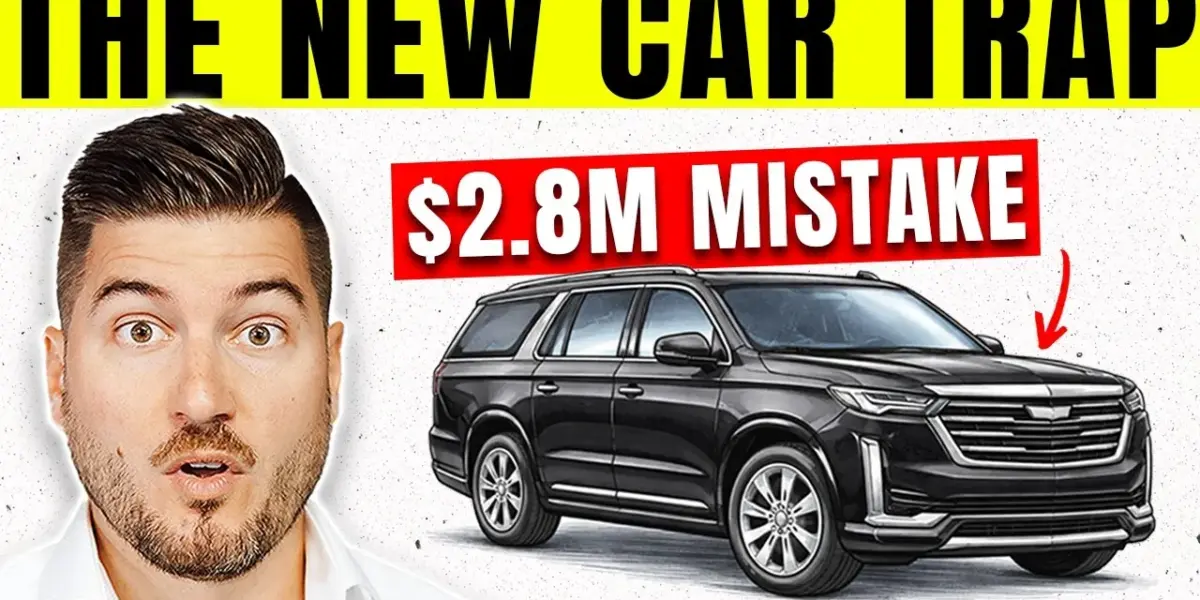
The typical American car payment of around $800 per month, when foregone and invested, could accumulate to nearly $2.8 million by retirement. This article breaks down the rapid depreciation of new vehicles, the true cost of ownership beyond the sticker price, and the significant opportunity cost associated with car loans, urging a shift towards more financially prudent transportation choices.

New Car Purchases Erode Retirement Savings: The Hidden Cost of Monthly Payments
Americans are meticulously cutting back on small expenses like daily lattes and streaming services, yet a significant, often overlooked financial decision is quietly jeopardizing long-term wealth: the purchase of a new car. While consumers scrutinize a $3 coffee, they readily commit to monthly car payments of $700, $800, or even $1,000 for seven years, a practice widely accepted as normal but mathematically detrimental to financial futures.
The True Nature of a Car: A Depreciating Liability
While a car is technically an asset as it appears on a balance sheet and can be sold, its classification as a depreciating asset is where the financial peril lies. Unlike appreciating assets such as real estate or index funds that grow in value over time, a car experiences rapid and predictable value loss. “Typically to the tune of about 25% in year 1,” the moment a new vehicle is driven off the lot, its value plummets.
By the end of the first year, it can lose approximately 25% of its purchase price, and within five years, this depreciation can reach 50% to 60%. This starkly contrasts with historical average annual returns of around 8% for broad market index funds. The speaker emphasizes, “One is building your future, one is consuming it.”
A car is not a passive depreciating asset. It actively demands ongoing resources, including insurance, fuel, maintenance, registration, and eventual repairs.
This creates a “financial black hole” where an asset that is shrinking in value simultaneously drains finances. Shifting the perspective from “which car can I afford?” to “how much depreciation am I willing to absorb and for how long?” is crucial for altering financial outcomes.
The Immediate Value Evaporation
The financial hit begins the moment a new car leaves the dealership. “Literally the moment the tires leave the dealership property, that vehicle has already lost somewhere between 10 and 20% of its purchase price.” On a $50,000 vehicle, this translates to an immediate loss of $5,000 to $15,000. This immediate loss is compared to walking into a casino, placing $50,000 on the table, and having the dealer take $8,000 before any game even begins – a scenario most would immediately abandon.
By year three, a new car has typically absorbed the steepest part of its depreciation curve, being worth only 50% to 60% of its original price. After this initial period, the depreciation rate slows down, a phenomenon that the majority of Americans miss. This creates an arbitrage opportunity where buyers of three-to-five-year-old used cars can acquire vehicles at a significant discount, avoiding the substantial initial depreciation costs borne by the first owner.
The Myth of New Cars for Reliability
A common justification for purchasing new cars is the need for reliability and dependability. However, the belief that new cars are inherently more reliable than used ones is presented as a profitable myth perpetuated by the auto industry. Data from sources like Consumer Reports, based on extensive owner surveys, indicates that many three-to-five-year-old vehicles are highly dependable.
Brand new vehicles are, by definition, unproven. Early production runs, especially during the first year of a new generation, often contain bugs that are later identified and fixed through recalls and technical service bulletins. By year three, these issues have typically been resolved.
Older models, particularly those from reputable brands like Toyota and Honda (though the speaker notes recent concerns about Toyota’s quality), have been road-tested in real-world conditions, providing evidence of their reliability. A three-year-old car with 40,000 miles may, in many cases, be more reliable than a brand-new model because its durability has already been proven.
Unveiling the True Cost of Ownership
The sticker price of a vehicle is merely the entry fee. The true cost of ownership involves numerous additional expenses that are often overlooked. For a $40,000 vehicle, these can include:
- Sales Tax: Approximately 7.5% ($3,000 on a $40,000 car).
- Finance Charges: Around 7% interest, potentially costing $9,000 over a 72-month loan.
- Insurance: Financed vehicles require comprehensive and collision coverage. New cars are significantly more expensive to insure, potentially costing $2,000 more per year, or $12,000 over five years.
- Fuel: At 15,000 miles per year, 25 MPG, and $3.50 per gallon, fuel costs can be around $2,000 annually, totaling $10,000 over five years.
- Maintenance and Repairs: Conservatively estimated at $5,000 over five years.
Cumulatively, these expenses can push the total cost of a $40,000 vehicle to nearly $79,000 over five years. After accounting for the resale value (estimated at $15,000), the net cost of using the vehicle for five years could be around $64,000, or nearly $13,000 per year.
The Negative Equity Trap and Payment Manipulation
The cycle of debt is further perpetuated by trading in vehicles before loans are paid off. When a car is traded in after three years with little money down on a 60-month loan, owners often owe more than the car is worth.
This “negative equity” is rolled into the next loan, causing buyers to start their next purchase already in debt. This can lead to a situation where individuals are paying for vehicles they no longer own, sometimes even after they have been totaled.
Dealerships often focus solely on the monthly payment, a tactic that enables them to extend loan terms to 72, 84, or even longer months. This makes expensive vehicles appear affordable on a monthly basis.
However, extending a $60,000 loan over 84 months at 7% interest can result in paying back approximately $76,000, with $16,000 going purely to interest. By the time the loan is paid off, the vehicle is often entering its expensive repair phase.
The “238 Rule” for Prudent Financing
For those who must finance a vehicle, a strict guideline known as the “238 rule” is proposed:
- 20% Minimum Down Payment
- 36 Months Maximum Loan Term
- 8% of Gross Monthly Income Maximum for Total Monthly Payment
Adhering to this rule can prevent individuals from taking on unaffordable debt and protect their long-term financial health.
The Opportunity Cost: $2.8 Million in Lost Wealth
The most significant financial damage caused by car payments is not the direct spending, but the “opportunity cost” – the wealth that could have been built by investing that money instead. The average new car payment hovers around $800 per month. If a 25-year-old consistently invested this amount in an S&P 500 index fund, historically returning 8% annually, they could accumulate approximately $2.8 million by age 65.
This starkly illustrates that choosing a new car payment over investing means forfeiting substantial future financial freedom. This “ghost wealth” represents the potential for early retirement, funding education, or achieving other significant life goals. The ability to build this wealth does not require a high income or complex financial strategies, but rather consistent, early decisions.
Conclusion: A Shift in Transportation Philosophy
The current norm of financing depreciating assets at inflated prices, often over extended loan terms and frequently rolling over debt, is a primary reason many hardworking individuals feel financially stuck. The solution lies not in earning more, but in making smarter, compounding decisions.
The recommended strategy involves buying three-to-five-year-old used cars, paying them off quickly if financed (using the 238 rule), and driving them for a minimum of ten years. The money saved from car payments and reduced ownership costs should then be invested. This seemingly “boring” approach, the speaker notes, has been one of the most impactful financial decisions for his own household, freeing up cash flow for investments in real estate and the stock market.
Source: Your Car Payment Is Stealing Your Retirement (The Math They Don't Show You) (YouTube)

Related Articles


Comedian Bobby Lee Avoids His Finances; What Investors Should Know
Comedian Bobby Lee admits he doesn't know how much money he makes, relying entirely on a financial manager. While this works for him, financial experts stress that for most people, understanding personal income and expenses is crucial for sound investing and financial stability.


$0 to $96K: Millionaire Reveals Simple Investing Plan
A millionaire investor shared a strategy to build wealth from $0, emphasizing the importance of starting early and investing in low-cost index funds. The plan prioritizes paying off high-interest debt and building an emergency fund before investing. Key recommendations include broad market ETFs like VTI for long-term growth and diversification.

Unlock $0 Tax Bracket: 3 Legal Wealth-Building Strategies
The U.S. tax code allows for legal strategies to significantly reduce or eliminate tax liabilities. Three key methods include deducting ordinary and necessary business expenses, utilizing real estate depreciation, and taking advantage of the 0% capital gains tax bracket. These approaches can lead to substantial tax savings for individuals who structure their finances strategically.