Market Plunge Signals Shift to Deflationary ‘New World Order’
A synchronized market sell-off across silver, Bitcoin, gold, and tech stocks signals a potential shift to a deflationary 'new world order.' The appointment of a deflation-focused Federal Reserve nominee appears to be a key catalyst, prompting investors to re-evaluate risk assets and consider strategies for a deleveraging environment.


Market Plunge Signals Shift to Deflationary ‘New World Order’
A synchronized sell-off across major asset classes, including silver, Bitcoin, gold, Microsoft, and the NASDAQ 100, in just the past six days underscores a potential paradigm shift in the global economy. Data reveals significant declines: silver plunged nearly 50%, Bitcoin was down a quarter, gold fell 12%, Microsoft declined 9%, and the NASDAQ 100 dropped 5%. This broad market downturn suggests a coordinated economic transition, potentially ushering in a deflationary ‘new world order’ where risk assets decline, leverage becomes toxic, and bonds may begin to outperform.
The Trigger: A New Federal Reserve Appointee
The catalyst for this market turmoil appears to be the appointment of Kevin W., a Federal Reserve nominee with a known inclination towards deflationary policies. Unlike previous Fed chairs who might have employed quantitative easing (money printing) to support asset prices during economic downturns, W. has a reputation for being a ‘deflation hawk.’ This suggests a departure from the inflationary environment that has historically supported risk assets like stocks and cryptocurrencies.
The core principle is that dropping interest rates does not save you from market downturns. What saves you when you are exposed to stocks or Bitcoin or leveraged ETFs is money printing. If you don’t like money printing, then you’re not going to like stocks and you’re not going to like debt.
The market’s reaction was swift. On the very day of Trump’s appointment of Kevin W., gold, silver, Bitcoin, and stocks experienced a sharp reversal, indicating a market preemptively positioning itself for a deflationary regime. This move away from traditional risk assets and into assets that perform better in deflationary environments is a critical signal for investors.
Understanding Deflationary Regimes
Deflation, characterized by falling prices, can be beneficial for consumers through technological advancements, as seen with the dramatic price drops in flat-screen televisions over the past two decades. However, for those holding debt, deflation can be devastating. Each dollar of deflation increases the real burden of debt, making it harder to repay. In contrast, inflation benefits debtors as the value of their debt erodes over time.
The current market dynamic is described as a ‘leverage doom loop.’ As the realization sets in that debt will be a significant liability in a deflationary environment, investors rush to exit leveraged positions. This deleveraging process can create a cascading effect, forcing sales of underlying assets and driving prices down further.
The Role of Leveraged ETFs and Margin Debt
Leveraged Exchange Traded Funds (ETFs), designed to amplify market movements, are particularly vulnerable. Funds like TQQQ (a triple-leveraged ETF tracking the NASDAQ 100) use debt to achieve their exposure. When the underlying market falls, these funds must sell assets to maintain their leverage ratios, exacerbating the downward pressure. The transcript highlights instances like a 2x leveraged silver ETF (AGQ) losing over 60% of its market value in just six days, illustrating the amplified losses in leveraged products.
Furthermore, individual investors’ exposure to margin debt has reached all-time highs, with margin debt surging 36.3% over the last year to $1.225 trillion as of December 2025. The impending deleveraging cycle could force significant liquidations of these margin positions, adding further selling pressure to the market.
Impact on Corporate Spending and AI Investments
The shift towards deleveraging also casts a shadow over corporate capital expenditures, particularly in high-growth sectors like Artificial Intelligence (AI). Companies like Amazon, despite beating earnings expectations, saw their stock plummet after announcing a significant increase in capital expenditures. The concern is that companies may be overextending themselves with ambitious spending plans, especially if access to capital, including private credit, becomes more difficult in a deleveraging environment.
Private credit funds, which often finance these capital expenditures, are already showing signs of strain. Funds backing data center projects for AI have experienced significant declines, with some seeing their value drop by over 50%. This is compounded by concerns that AI adoption and productivity growth may be flattening, creating a challenging environment for companies heavily invested in the sector.
When software cracks, credit feels it.
This quote from Barclays encapsulates the interconnectedness of the technology sector and credit markets. A downturn in software and AI spending can directly impact the creditworthiness of the companies involved, creating a vicious cycle where falling stock prices make lending harder, and reduced lending further depresses stock prices.
Navigating the ‘New World Order’: A Playbook for Investors
In this evolving economic landscape, preparation is key. The primary signal to watch is not just falling interest rates, but the Federal Reserve’s re-engagement with quantitative easing (QE) – the ‘money printer.’ While zero interest rates are an early indicator, they do not signify the market bottom. Historically, significant market bottoms have coincided with the Fed initiating QE to combat deflationary pressures.
The playbook for this ‘new world order’ involves several strategic considerations:
- Focus on Income and Debt Reduction: Prioritize increasing income and aggressively paying down debt. Being debt-free provides a crucial buffer in a deflationary environment.
- Wait for the Money Printer: Understand that the optimal time to take on debt and invest aggressively in risk assets will be when the Federal Reserve signals a return to quantitative easing. This indicates they are actively fighting deflation.
- Real Estate as a Potential Hedge: While risk assets face pressure, real estate may offer a more stable alternative. The strategy involves focusing on specific niches: high-end, exclusive real estate outside of high-tax states like California, and middle- to lower-income ‘fixer-upper’ properties within California that cater to the desire for lifestyle over homeownership burdens.
- Anticipate a Refinancing Boom: As interest rates are cut to zero, a significant refinancing wave is anticipated. Companies involved in mortgage lending and origination could benefit once the initial market shock subsides.
Long-Term Implications
The transition to a deflationary regime, driven by deleveraging and potentially a shift in monetary policy, presents both challenges and opportunities. Investors are advised to de-risk, reduce leverage, and carefully assess assets that are resilient to falling prices. The long-term outlook suggests a market environment that rewards those who are not burdened by debt and can capitalize on strategic investments once the Federal Reserve signals its intent to stimulate the economy through monetary expansion.
Source: COLLAPSE BEGINS: The New World Order is STARTING (YouTube)

Related Articles
High Debt Forces Fed’s Hand, Paving Way for Rate Cuts
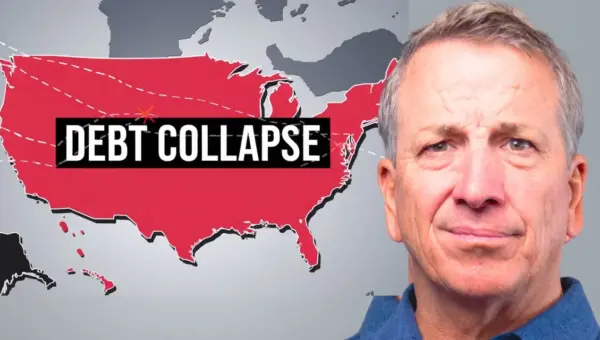
Massive U.S. debt is limiting the Federal Reserve's ability to fight inflation, potentially forcing interest rate cuts. This delicate balancing act risks higher inflation and impacts the real estate market, creating both challenges and opportunities.


Trump Threatens Fed Chair Powell, Faces Nomination Blockade
President Trump is threatening to fire Fed Chair Jerome Powell over a renovation probe, creating a political stalemate. Senator Tom Tillis is blocking Trump's nominee, Kevin Warsh, until the investigation concludes. Warsh himself faces scrutiny over his vast personal wealth, estimated between $135-226 million, raising conflict of interest concerns.
Trump Threatens to Fire Fed Chair Powell Over Building Project
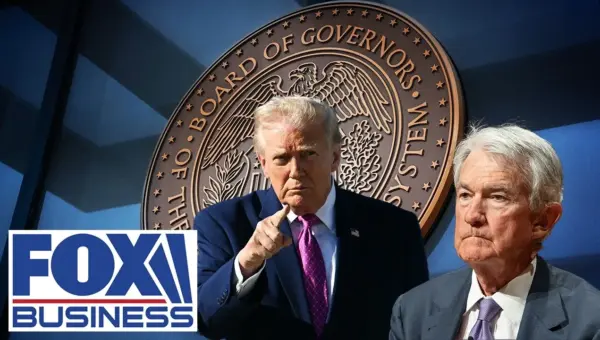
Former President Donald Trump issued a strong ultimatum to Federal Reserve Chair Jerome Powell, threatening to fire him over perceived incompetence and excessive spending on a building project. Trump also expressed support for lowering interest rates and the confirmation of Kevin Warsh.