DeepMind’s AI Reconstructs Moving Worlds in 4D
Google DeepMind's new AI, D4RT, can reconstruct dynamic 3D scenes in four dimensions (including time) with unprecedented speed and accuracy. This breakthrough uses a single transformer model to handle motion, depth, and camera pose simultaneously, even tracking objects through occlusion.

DeepMind’s AI Reconstructs Moving Worlds in 4D
Google DeepMind has unveiled a groundbreaking AI system, D4RT (Dynamic 4D Reconstruction Transformer), capable of reconstructing dynamic 3D scenes in four dimensions – three spatial dimensions plus time. This advanced technology can capture the movement and evolution of objects within a scene, offering a level of detail and speed previously thought impossible.
From Static Scenes to Dynamic Worlds
Traditionally, creating a 3D representation of a scene involved capturing static environments. However, the real world is in constant motion. DeepMind’s D4RT tackles this challenge by processing a video input and generating a dynamic, four-dimensional reconstruction.
This means the AI not only understands the spatial layout of a scene but also how objects within it move and change over time. The output is a point cloud, a collection of data points representing the 3D space, where each point’s position can evolve through time.
Breaking Down the 4D Reconstruction Process
The concept of 4D reconstruction involves understanding three spatial dimensions (length, width, height) and the dimension of time. Imagine trying to assemble IKEA furniture, but the pieces are constantly moving – that’s the complexity D4RT aims to manage.
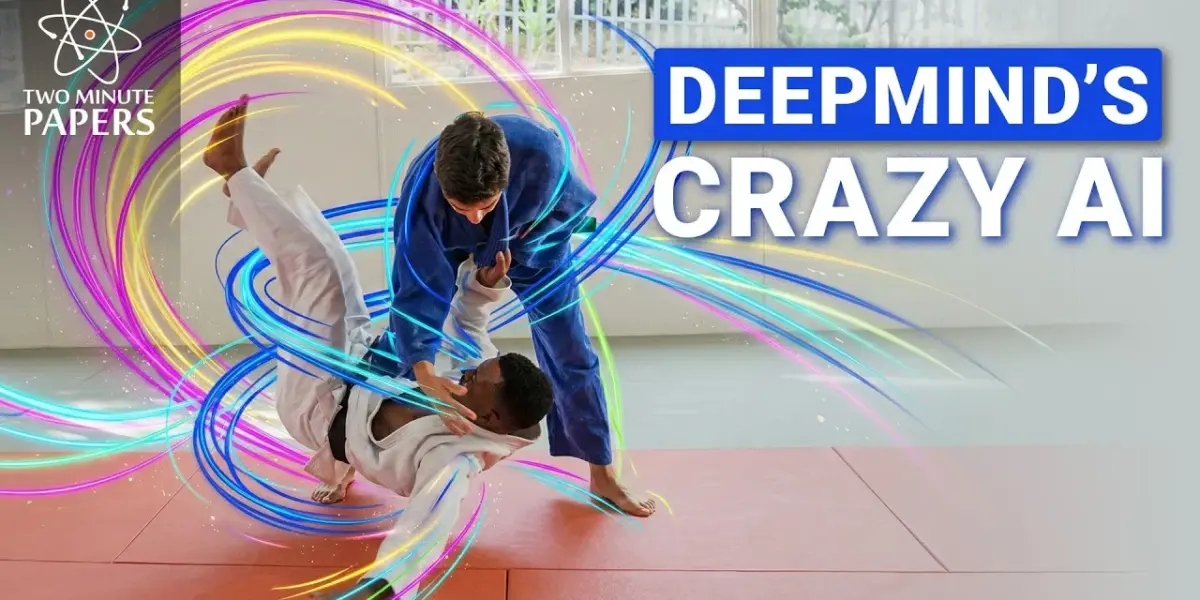
The AI takes a video of a scene and outputs a virtual, dynamic version represented as a point cloud. This allows for the tracking of highly dynamic actions, such as in judo scenes, with remarkable accuracy.
The Power of a Single Transformer
Previous methods for 4D reconstruction often required a complex pipeline of specialized AI models. One model might handle depth estimation, another motion tracking, and a third camera pose.
These disparate models then needed to be painstakingly integrated, often referred to as creating an “abomination” of code. This integration process also necessitated a technique called “test-time optimization,” where the system would spend minutes on a computer, essentially “sweating” to make the different models agree and prevent the geometry from falling apart.
D4RT, however, simplifies this dramatically. It utilizes a single, unified AI technique – a transformer model.
This single architecture is capable of handling depth, motion, and camera pose simultaneously, eliminating the need for separate models and the complex integration process. This unified approach is a significant leap forward in efficiency and performance.
Tracking Through Occlusion and Unprecedented Speed
One of the most impressive capabilities of D4RT is its ability to track objects even when they are temporarily hidden from view – a phenomenon known as occlusion. The AI can infer the position of these occluded points by leveraging its understanding of their past movements and predicting their future locations. This allows for a continuous and complete reconstruction of the scene, even with intermittent visibility.
The speed at which D4RT operates is another major breakthrough. DeepMind reports that D4RT can be up to 300 times faster than previous techniques.
This dramatic speed increase is largely attributed to its single-model architecture and its ability to bypass slow, iterative optimization loops common in other methods. This efficiency makes it practical for a wider range of real-time applications.
D4RT vs. Meshes and Gaussian Splats
While D4RT excels in dynamic scene reconstruction, it’s important to understand its place relative to other 3D representation methods like 3D meshes and Gaussian Splats:
- Motion Handling: D4RT is superior at handling motion. Unlike meshes and splats, which can suffer from “ghosting” or artifacts as objects move, D4RT integrates movement as a fundamental aspect of its mathematical model.
- Speed: As mentioned, D4RT is significantly faster, up to 300x, due to its streamlined architecture and avoidance of optimization loops.
- Simultaneous Parameter Recovery: D4RT recovers depth, tracks, and camera parameters concurrently, a key advantage for dynamic scenes.
However, D4RT has limitations:
- Output Format: D4RT outputs a point cloud, which is essentially a collection of “dots.” This format is not directly suitable for applications like 3D printing or physics simulations, requiring an additional meshing step.
- Photorealism: For visually stunning, photorealistic reflections, meshes and Gaussian Splats remain the preferred choice. D4RT prioritizes geometric accuracy over aesthetic rendering.
- Editability: Editing a point cloud is more challenging than editing a structured mesh. Artists cannot easily sculpt or manipulate the geometry in the same way they would with traditional 3D models.
How D4RT Works: The Encoder-Decoder Architecture
The underlying mechanism of D4RT involves an encoder-decoder architecture:
- The Encoder (Global Scene Representation): This component acts like a “master carpenter” that analyzes the input video to understand the past and present context of the scene. It builds a comprehensive understanding of the entire scene’s state.
- The Decoder (Dynamic Point Generation): This part, likened to “magic elves,” is responsible for generating the 4D point cloud. Instead of trying to construct the entire scene at once, the decoder focuses on specific queries. For instance, it might be asked to pinpoint the location of a particular “screw” (a point in the scene) at a specific “timestamp” (time).
The genius of the decoder lies in its parallelizability. Each “elf” (a part of the decoder) can work independently without needing to communicate with others. This drastically reduces computational overhead and contributes to the system’s speed.
To enhance detail, the decoder is fed back the original, high-resolution video pixels. This “magic glasses” effect allows the AI to reconstruct details finer than its own internal representation, bridging the gap between the AI’s processing and the real-world visual fidelity.
To handle moving objects, the encoder’s comprehensive understanding of the entire video is crucial. When an object or part of it disappears (occlusion), the decoder can query the encoder for information from earlier or later in the video, allowing it to infer the object’s position and continue the reconstruction seamlessly.
Why This Matters
DeepMind’s D4RT represents a significant advancement in AI’s ability to understand and reconstruct dynamic environments. The implications are vast:
- Robotics and Autonomous Systems: Enhanced scene understanding is critical for robots navigating complex, moving environments and for autonomous vehicles processing real-time traffic.
- Virtual and Augmented Reality: Creating more immersive and realistic VR/AR experiences by capturing and rendering dynamic environments with greater fidelity.
- Content Creation: Streamlining the process of creating 3D assets for games, films, and simulations, especially those involving motion.
- Scientific Research: Analyzing and reconstructing dynamic phenomena in fields like physics, biology, and engineering.
This research, a collaboration between Google DeepMind, University College London, and the University of Oxford, highlights the ongoing push towards more sophisticated AI that can interpret and interact with the complexities of the real world.
Source: DeepMind’s New AI Tracks Objects Faster Than Your Brain (YouTube)

Related Articles

OpenAI Hints at GPT-5.5’s Smarter, Faster AI Future
OpenAI's upcoming AI model, possibly GPT-5.5 "Spud," is set to offer significant improvements in understanding, speed, and problem-solving after a two-year development cycle. Early previews suggest enhanced capabilities in coding, reasoning, and native multimodality, aiming to make AI a more autonomous digital worker.


Iran’s AI-Powered ‘Slopaganda’ War Targets Americans Online
Iran is employing advanced AI to create and spread 'slopaganda,' using internet culture to influence American views on global conflicts. This digital strategy bypasses traditional media, reaching younger audiences directly through memes and fake videos. Experts warn that this approach exploits information gaps and highlights a need for better U.S. online communication strategies.

Robot Runner Beats Human Champion in Half Marathon
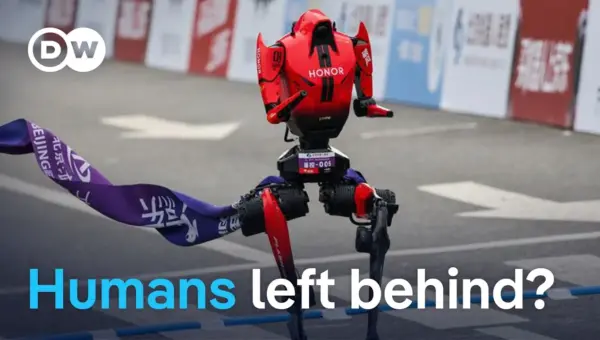
A recent half marathon in Beijing saw a robot named 'Lightning' shatter human records, finishing the 21km race nearly seven minutes faster than the men's world record. Experts highlight this as a significant milestone in robotics, driven by advances in hardware, control, and AI, while also cautioning against overstating current capabilities in areas like independent thought and home integration.