Iran War Threat Halts Oil Flow Through Strait of Hormuz
The Strait of Hormuz, a critical global oil chokepoint, is effectively closed due to fears of attacks from Iran, disrupting 20% of the world's oil supply. This has already led to higher gas prices and increased inflation expectations, impacting economies worldwide. While the U.S. is less vulnerable due to its net exporter status, global price pressures remain.

Global Energy Shaken as Iran Tensions Halt Key Oil Chokepoint
Fears of a protracted conflict in Iran have effectively stalled oil shipments through the Strait of Hormuz, the world’s most critical chokepoint for global energy supplies. The heightened threat of attacks from Iran has deterred vessels from traversing the vital waterway, creating significant ripples in international energy markets and impacting prices at the pump for consumers worldwide.
Understanding the Strait of Hormuz’s Key role
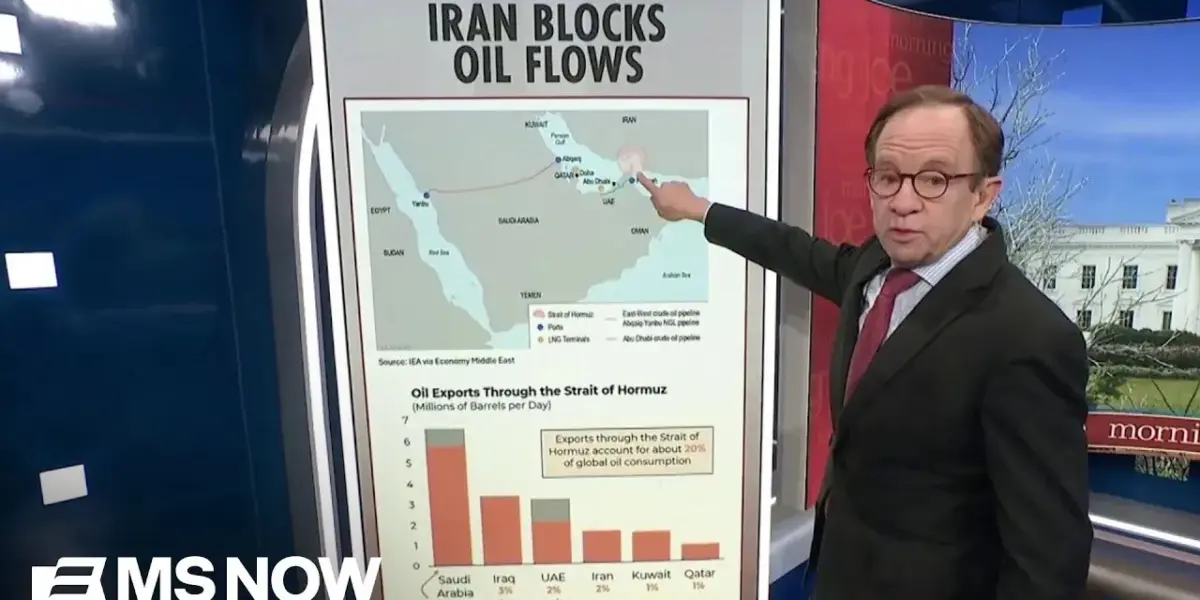
The Strait of Hormuz, a narrow waterway just 22 miles wide with only two shipping lanes of approximately two miles each, lies strategically positioned between Iran and the Arabian Peninsula. Its proximity to major oil-producing nations like Saudi Arabia, Kuwait, Qatar, and the United Arab Emirates makes it indispensable for the region’s energy exports. “Iran is right here so they can obviously control the Straits if they want to,” explained former Treasury official and economic analyst Steve Rattner.
“Here all the big oil producing countries in the region… And so these Straits are effectively closed at the moment because it’s too dangerous and because insurance companies won’t ensure tankers going through.”
Disruption to 20% of World’s Oil
The implications of this closure are profound, as approximately 20% of the world’s oil passes through the Strait of Hormuz. This includes the vast majority of Saudi Arabia’s oil exports, as well as significant volumes from Iraq, the UAE, Iran (currently selling to China due to U.S. Embargoes), Kuwait, and Qatar. While pipelines exist to bypass the Strait, they lack the capacity to compensate for the halted seaborne trade, leading to oil accumulation within the producing nations.
Impact on Global Oil and Gas Prices
The immediate consequence of this supply disruption is a noticeable impact on oil prices. Brent crude, a global benchmark, has seen fluctuations, and this tension has already translated into higher gasoline prices for consumers. “It’s already having an impact on what people pay at the pump so you can see here oil prices were actually rising a bit already for a variety of reasons including the tensions in the Middle East that scared the markets,” Rattner noted.
“But then of course you had this big jump… And that has already turned into higher gas prices.” In the last four days alone, national average gas prices have climbed from $2.98 to $3.11.
US Supply Remains Stable, but Prices Feel the Pinch
Despite the global supply concerns, the United States is in a more resilient position due to its shift from a net oil importer to a net exporter. “The good news for us is that we’re not going to see gas lines again like in 1973 because we have gone from being a huge importer of oil, net importer of oil, to actually being a net exporter of oil,” Rattner stated.
“So supply is not our problem. But because oil is a worldwide commodity, it trades at a worldwide price, we do feel the impact on prices, but we shouldn’t feel the impact on supply.” This means while U.S. Consumers won’t face shortages, they will continue to experience the inflationary pressure of higher global oil prices.
Broader Economic Consequences: Inflation and Interest Rates
The impact extends beyond gasoline. Petroleum is a key component in numerous products, including jet fuel, home heating oil, and petrochemicals, meaning price increases will be felt across a wider spectrum of goods. This exacerbates existing inflationary pressures.
“It’s also not just gasoline that goes up in price. It’s everything else that comes from petroleum, which includes jet fuel, home heating oil, things that go into petrochemicals that are made from petroleum. So there could be a significant inflationary impact,” Rattner warned.
Market expectations for inflation have consequently risen, with a notable increase of about 0.15% in recent days. This uptick in inflation expectations directly influences interest rate predictions.
“The bigger impact of that or a big impact of that is on expectations for interest rates because the Fed has a 2% inflation target when it goes up like that people expect… Interest rates have moved up.”
Stock Market Volatility and Future Uncertainty
The current geopolitical climate has also contributed to volatility in the stock market. “Wall Street clearly does not like unpredictability or uncertainty. No one does,” Rattner observed.
The market’s reaction has been relatively muted thus far, but the potential for significant disruption remains if the conflict widens or unforeseen negative events occur. Higher interest rates, a consequence of rising inflation, also negatively impact stock prices by offering alternative investment avenues. “Higher interest rates are the enemy of stock prices because they provide other places for people to put their money beside stocks which then puts pressure on stocks.”
The Risk of a Prolonged Conflict
The duration of the U.S. Involvement in potential conflict in the region remains a significant unknown. “There’s no way of telling how long we will be actively involved on a daily basis in a war in Iran,” Rattner stated. A prolonged conflict could lead to further spikes in oil prices, increased inflation, and sustained pressure for higher interest rates, all of which pose risks to economic stability and the stock market.
“A lot of bad things, Mike. A lot of bad things. The oil prices could spike some more…
You get more inflation, you get the potential for higher interest rates, you get the uncertainty and the fear. That is a bad for the stock market.” While the market’s reaction has been described as “benign” so far, the “potential for a much bigger stock market disruption is certainly right there if this war were to widen out.”
Looking Ahead
As tensions persist in the Middle East, the global market will be closely monitoring developments in the Strait of Hormuz and the broader regional conflict. The interplay between geopolitical events, oil supply, consumer prices, inflation, and interest rate policy will be critical to watch in the coming weeks and months. Any escalation or de-escalation will undoubtedly have further repercussions on the global economy.
Source: Steve Rattner: How the war in Iran could impact global energy supplies (YouTube)

Related Articles


US Imposes Naval Blockade on Iran Amid ‘Operation Epic Fury’
The U.S. has implemented a naval blockade against Iran as part of 'Operation Epic Fury,' aiming to pressure the Iranian regime while maintaining combat readiness. Officials revealed the operation includes an 'ironclad blockade' and a direct message to Iran's leadership about dwindling military capabilities. The U.S. Navy is enforcing the blockade on all ships entering or leaving Iranian ports, with escalating force options available.


US Warns Iran: Choose Deal or Face Blockade and Bombs
The U.S. military has issued a stark warning to Iran, urging the regime to choose a diplomatic deal or face a combination of naval blockade and targeted strikes. Admiral Bradley Cooper detailed Operation Epic Fury, highlighting U.S. military superiority and intelligence capabilities. The U.S. also criticized negative media coverage, praising troops' achievements.


Trump’s Desperate Bid for a Win Amidst Global Tensions
President Trump is seeking a decisive win amidst a public feeling of unease and a complex foreign policy challenge with Iran. The Strait of Hormuz standoff and China's role add significant global tension. Analysts debate perception versus reality, while the upcoming midterms loom.