Senator Shaheen Questions US Control of Foreign Policy Amid Iran Strikes
Senator Jeanne Shaheen expressed deep concern over U.S. foreign policy control following recent Iran strikes, questioning whether President Trump or Prime Minister Netanyahu dictates American actions. The briefing revealed conflicting rationales for the preemptive military action, raising alarms about the administration's strategy and diplomatic preparedness.


US Foreign Policy Control Questioned After Iran Strikes
WASHINGTON D.C. – A closed-door briefing for congressional leadership yesterday has ignited serious concerns among lawmakers regarding the control and clarity of America’s foreign policy, particularly in the wake of preemptive strikes on Iran. Senator Jeanne Shaheen (D-NH), Ranking Member of the Senate Foreign Relations Committee, voiced significant apprehension following the meeting with Secretary of State Marco Rubio, stating, “I think it’s fair to say there is real concern about who is really controlling America’s foreign policy. Is it President Trump or is it Prime Minister Netanyahu?”
Conflicting Rationales for Military Action
The briefing reportedly revealed a contentious rationale behind the U.S. Decision to launch preemptive strikes. According to Senator Shaheen, Secretary Rubio suggested that Israel’s stated determination to attack Iran, coupled with the certainty that U.S. Troops would be targeted in an Iranian response, compelled the White House to act. This reasoning, however, drew divided responses from Democratic leaders present.
“The reality is there was no response to the question about whether we tried to dissuade Israel from making those attacks into Iran,” Senator Shaheen stated. She acknowledged that removing Ayatollah Khamenei, whom she described as a “promoter of terrorism across the Middle East” and responsible for repressing his own people, could be viewed positively. However, she emphasized that the administration’s strategy, end game, and the timing of the attacks remain unclear.
Adding to the confusion, President Trump himself has offered differing motivations for authorizing the strikes in calls with reporters, leading to a perception of mixed messages emanating from the administration. “What we heard yesterday in the press conference from Secretary Hegseth was the military goals of this.
These strikes. What the President has said has been something different, so we’ve heard mixed messages again coming out of this administration,” Senator Shaheen observed.
Concerns Over Diplomatic Presence and Evacuations
Further complicating the situation is the State Department’s advisory for Americans to evacuate 14 countries in the region. Senator Shaheen highlighted a critical diplomatic deficit, noting that the U.S. Has confirmed ambassadors in only four of these countries.
“We’re over a year into we have four confirmed ambassadors to be able to tell us what’s happening as the result of these strikes,” she said. The situation is particularly dire in three of the hardest-hit countries, where ambassadors were appointed late last year.
This lack of diplomatic representation leaves approximately 40,000 American military personnel in the region without adequate information. “So we’re really flying blind in a number of these countries and the 40,000 Americans who Secretary Rubio says are in the region, our military Americans who are in those countries have no one who can provide them with any real information about what’s going on,” Senator Shaheen expressed.
Debate Over War Powers and “Boots on the Ground”
The discussion also touched upon the potential for U.S. “boots on the ground” in Iran, a possibility acknowledged by President Trump and Secretary of Defense Pete Hegseth. This has galvanized opposition among some Democratic colleagues who plan to vote against a War Powers Resolution. Senator Shaheen clarified that these votes are intended to assert congressional authority over declarations of war, rather than to grant the president a free pass.
“I think the plan, what you’re hearing from them is that they’re going to vote for the control that Congress should have on whether to declare war or not,” she explained. However, she cautioned against any action that could be perceived as enabling the president to send troops without full congressional deliberation.
“I hope not. I think it would be a mistake for us to put boots on the ground in Iran. We’ve lived through what happened in Afghanistan, what happened in Iraq, the number of lives lost, the failure of that regime change and the effort to impose on the people of those countries what America THE FUTURE OF IRAN NEEDS TO BE DETERMINED BY THE IRANIAN PEOPLE.”
Senator Shaheen strongly advocated for the principle that the future of Iran should be determined by its own people. She reiterated her skepticism about the efficacy of airstrikes in achieving regime change, citing historical precedent. “Sadly, air strikes have not had a history of being able to adequately produce regime change,” she noted.
Reasserting Congressional Authority
The Senator emphasized the foundational role of Congress in decisions regarding war, as envisioned by the Founding Fathers. “I think the Founding Fathers set up the Congress as the body that should determine whether to declare war or not, because they didn’t want the leader of this country to turn into a despot or an autocrat who was going to make decisions without the will of the people,” she argued.
“And that’s why I think it’s important for Congress IT IS A POSSIBILITY FOR THE UNITED STATES TO RESUME ITS AUTHORITY OVER DECLARING WAR,” Senator Shaheen concluded, highlighting the need for legislative oversight in matters of international conflict.
Looking Ahead
As the situation in the Middle East continues to evolve, attention will remain fixed on the administration’s communication strategy, the diplomatic response to the ongoing evacuations, and the upcoming congressional debates on the War Powers Resolution. The clarity and consistency of U.S. Foreign policy, especially concerning its relationship with key allies and its long-term objectives in the region, will be under intense scrutiny in the coming weeks.
Source: Sen. Shaheen: There's real concern over who's controlling America's foreign policy (YouTube)

Related Articles
US F-15 Jet Downed Over Iran; Rescue Mission Underway
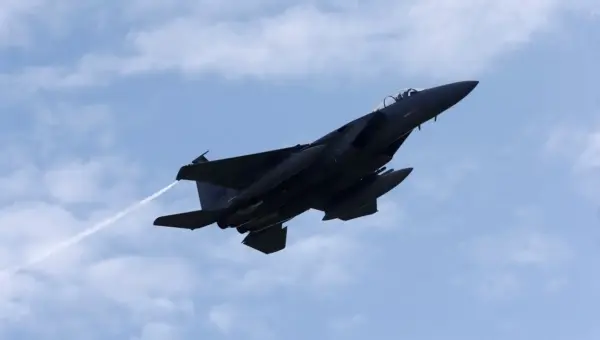
An American F-15 fighter jet has crashed in Iran, prompting an urgent search and rescue mission. U.S. officials confirmed the incident, while Iranian state media reported a reward for capturing the crew alive. The event raises questions about Iran's remaining military capabilities amid ongoing conflict.


Trump’s Foreign Policy Lacks Clear Doctrine, Analysts Say
Analysts argue that the U.S. foreign policy under President Trump lacks a consistent doctrine, with actions driven more by personal interests than a strategic plan. This absence of a clear guiding principle creates global uncertainty and challenges the existing world order.


Trump’s Iran Speech: Key Exit Strategy Missing, Analysts Say
President Donald Trump addressed the nation on the Iran conflict, claiming military success and nearing completion of operations. However, critics noted a significant lack of detail regarding the U.S. exit strategy and the potential for a ground invasion.