UK’s Iran Stance Defended Amidst Trump Tensions
Former Foreign Secretary William Hague defended the UK's response to US-Israel strikes on Iran, arguing the government's actions were broadly correct despite imperfect presentation. He highlighted historical precedents for US-UK disagreements and questioned current diplomatic strategies.

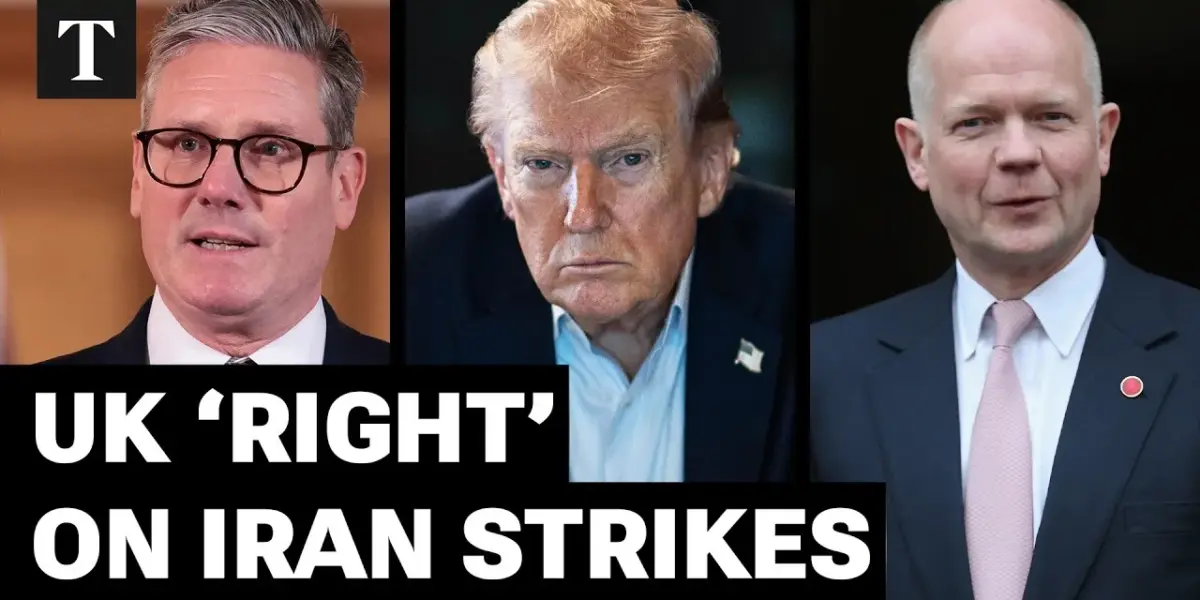
UK’s Iran Stance Defended Amidst Trump Tensions
In the wake of recent US-Israel strikes on Iran, former Foreign Secretary William Hague has asserted that the UK’s response, while imperfectly presented, was broadly correct. Speaking on a recent broadcast, Hague addressed the complex geopolitical situation, particularly the nuanced approach taken by the British government regarding the use of its military bases and the differing objectives between the UK and the United States under President Trump.
Navigating Diplomatic Waters: The UK’s Dual Stance
Hague outlined his view that the UK’s decision to withhold its own forces from offensive operations against Iran while subsequently allowing its bases to be used for defensive purposes was the right course of action. However, he criticized the presentation of this policy, suggesting it appeared as a U-turn due to its piecemeal announcement. “It would have been better if the prime minister had made all that clear in one go to the Americans,” Hague stated, proposing a unified message: “Look, we won’t be joining you with the bombing of Iran.
We don’t agree with that or see what the objective is, but um the Iranians are bound to hit back and then we will help you out. You can use our bases to help you out.” He argued that framing this as a single decision, rather than two separate announcements, would have avoided the perception of indecision.
Historical Precedents and US-UK Disagreements
The former Foreign Secretary emphasized that disagreements between the US and the UK are not unprecedented. He recalled instances such as the Vietnam War, where the UK did not participate, and Margaret Thatcher’s falling out with Ronald Reagan over the invasion of Grenada.
“It’s not unprecedented for there to be disagreements over these things,” Hague noted. However, he cautioned that President Trump’s “vengeful attitude to people who cross him” could potentially escalate the seriousness of such disagreements.
Critique of Starmer’s Strategy and Trump’s Approach
Hague also questioned the strategic rationale behind the Labour Party’s approach to President Trump, particularly the idea that cultivating a close relationship with him had been a major success. He suggested that if the primary aim was to maintain favor with Trump, then supporting his actions, even minimally, would have been consistent. “If that’s the case, he should have supported Trump because he doesn’t actually involve much more than allowing bases for for for the the Americans to to use in their own activity,” Hague remarked.
He posited that Trump respects strength and leaders who can maintain their own distinct approach while engaging with him, citing Mark Carney of Canada as a positive example. Hague anticipates more divergences between the US and UK as Trump’s presidency progresses, especially if faced with a divided Congress, leading to potentially more unpredictable actions.
International Law: A Flexible Framework?
The discussion also touched upon the role and efficacy of international law in geopolitical conflicts. While one participant expressed skepticism, calling it a “fantasy” used instrumentally, Hague defended its importance. Recalling the UK’s intervention in Libya, he highlighted the crucial step of securing United Nations authority.
“If we hadn’t got that resolution, we would not have bombed Libya. So international law can count for a lot,” he asserted.
He acknowledged that international law’s influence has weakened, with nations like Russia and potentially China disregarding it. However, he stressed the necessity of upholding legal structures to prevent a descent into a “lawless world where all countries are at each other’s throats.” Hague concluded that maintaining these frameworks is vital for future stability and rebuilding international order.
Advanced Intelligence and Future Capabilities
The conversation shifted to the sophisticated intelligence operations reportedly behind recent actions, including the alleged use of hacked traffic cameras in Tehran to track targets. Hague expressed a lack of surprise regarding the effectiveness of intelligence gathering, noting its integration with traditional human sources and advanced data analytics, possibly AI-assisted. “Leaders can now be picked off and assassinated, and it’s another reason why we have to be to defend ourselves against that sort of thing in the future,” he warned.
While impressed by the capabilities, Hague expressed surprise at the revelation of specific methods like hacking traffic cameras, suggesting it could lead to countermeasures. He concluded by emphasizing the critical need for the UK to invest in its own defense and intelligence capabilities to navigate the evolving global landscape.
Looking Ahead
As geopolitical tensions continue to simmer in the Middle East and the US political landscape remains dynamic, the relationship between the UK and the United States is likely to face further scrutiny. Observers will be watching to see if the UK can maintain a clear and consistent foreign policy that balances its alliance with the US with its own strategic interests and adherence to international norms, particularly in the face of an increasingly unpredictable US presidency.
Source: William Hague: UK Response To US–Israel Strikes On Iran Was ‘Broadly’ Correct (YouTube)

Related Articles
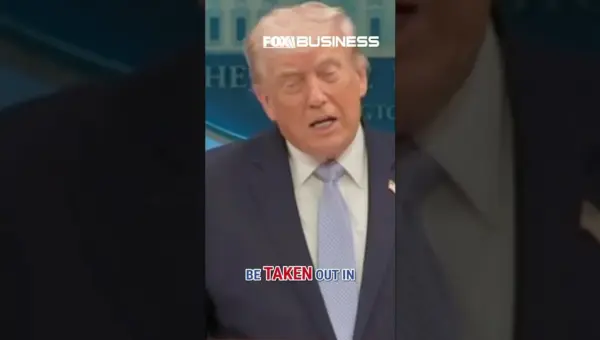
Trump Warns Iran: “Entire Country Can Be Taken Out”
Former President Donald Trump issued a strong warning to Iran, stating the entire country could be taken out in one night. The declaration followed the crash of an American F-15 jet in Iranian territory and the successful rescue of its crew. This geopolitical tension could influence market sentiment and specific industry sectors.

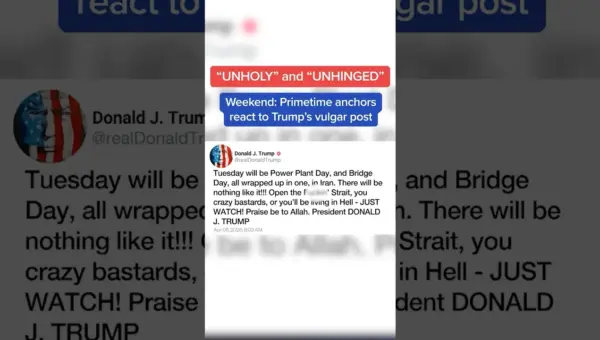
Trump’s Vulgar Easter Post Sparks Anchor Outrage
Primetime news anchors reacted with alarm to a vulgar and threatening social media post by former President Donald Trump directed at Iran on Easter Sunday. Journalists described the language as 'unholy' and 'unhinged,' questioning the appropriateness of such rhetoric on a religious holiday and its broader implications for political discourse and foreign policy.
Kidnapped Reporter Slams Trump’s Iran Threat as Misguided
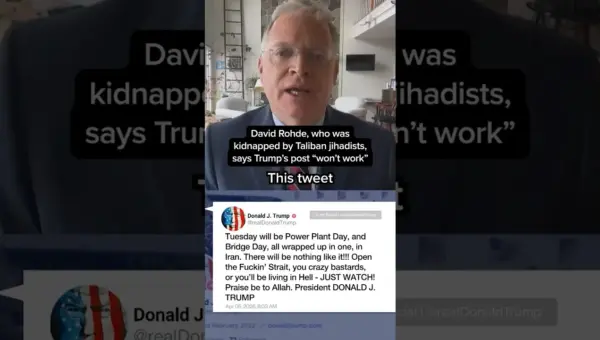
Journalist David Rohde, a former Taliban hostage, has criticized Donald Trump's warning to Iran about the Strait of Hormuz. Rohde stated that Trump's aggressive language shows a deep misunderstanding of Islam and the region. His comments highlight the potential pitfalls of confrontational rhetoric in complex international diplomacy.