EV Range Reality Check: Which Electric Car Delivers Most Miles?
Our in-depth analysis reveals a significant gap between advertised and real-world driving range for several popular electric SUVs. While all promise long distances, only some deliver close to their claimed figures.


EVs Deliver Less Range Than Advertised, But Some Are Better Than Others
Many electric cars promise a lot of miles on a single charge, enough for most daily driving. However, our tests show a significant gap between advertised and real-world driving range for several popular models. This difference matters for drivers planning longer trips or simply wanting peace of mind.
We looked at five different electric vehicles, comparing their official claimed range to a calculated real-world range. This calculation used the car’s battery size and its average energy use as reported by the car’s own computer. This gives us a practical idea of how far you can actually go before needing to recharge.
Real-World Range Results Revealed
The Kia EV6 showed the biggest difference between its claimed and real-world range. It claims 313 miles, but our test suggests a real-world range of only 202 miles. That’s a substantial drop of over 100 miles.
Next, the BMW iX, advertised with an impressive 403 miles, ended up with an estimated real-world range of 251 miles. This means drivers might get about 150 miles less than the sticker price suggests.
The Volvo XC40 Recharge, rated for 375 miles, performed slightly better but still fell short. Our calculations put its real-world range at 255 miles. This is a shortfall of nearly 120 miles compared to its official rating.
The Hyundai Ioniq 5 achieved a claimed range of 372 miles. However, in real-world conditions, it delivered an estimated 276 miles. This gap is around 96 miles, which is better than some others but still noticeable.
Leading the pack in our test was the Polestar 2. It boasts a claimed range of 438 miles, and our real-world calculation came in at 317 miles. While still a drop, it’s the smallest percentage difference among the cars tested.
Understanding the Range Discrepancy
It’s important to remember these calculated numbers likely represent a worst-case scenario. The figures come from trip computers that are probably set to be quite conservative. This is because the cars were driven by automotive journalists who may not have prioritized maximum energy saving.
To illustrate this point, one of our team members previously conducted a full range test on a Polestar 3, similar to the one tested here. Driving from a full battery to empty, the car achieved an impressive 390 miles. This test was done in the summer, when electric car batteries are more efficient, but the driver was actively trying to conserve energy.
Who Should Buy These EVs?
These electric SUVs are designed for families and individuals looking for a premium, tech-filled driving experience. They offer spacious interiors, advanced safety features, and the smooth, quiet operation characteristic of EVs. Their suitability for longer journeys depends heavily on charging infrastructure availability and individual driving habits.
Value Proposition
The value of these EVs depends on their price point and the actual range they deliver. While they all offer substantial claimed ranges, the real-world figures suggest potential buyers should factor in a buffer for charging stops on longer trips. The Polestar 2 appears to offer the best value in terms of range efficiency relative to its claims.
The Verdict on Real-World EV Range
While advertised ranges can be optimistic, our testing shows that electric cars still offer practical driving distances for most users. The Polestar 2 stands out for getting closest to its impressive claimed range. Drivers concerned about range should consider their typical journeys and charging opportunities.
For those planning extensive travel, it’s wise to research specific model real-world tests and charging network coverage. The gap between claimed and actual range is shrinking as battery technology improves. Future tests will reveal how these numbers continue to evolve.
Source: EXPOSED: The truth about real-world range! (YouTube)

Related Articles

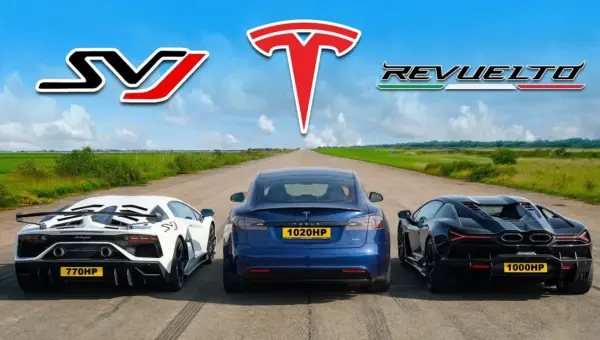
Electric Powerhouse Dominates Supercars in Thrilling Drag Race
In a thrilling series of drag races, the Tesla Model S Plaid proved that electric cars can outperform even the most potent Italian supercars. The electric sedan consistently delivered brutal acceleration, outclassing Lamborghinis like the Huracan Performante, Aventador SVJ, and even the hybrid Revuelto in most head-to-head matchups.
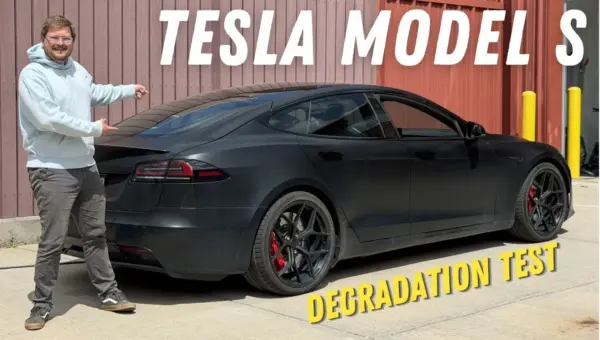
Tesla Model S Battery Loses Significant Range After 4 Years
A four-year-old Tesla Model S Plaid has lost a significant portion of its battery capacity, resulting in a substantial reduction in driving range. The owner's testing revealed a nearly 28% decrease in usable energy, impacting the car's long-term practicality.


Insane Tesla Model S Deals: 200K Miles for $9K, Ludicrous for $12K!
Two 2019 Tesla Model S sedans, one with 200,000 miles and FSD for $9,000, and a Performance model with Ludicrous Plus for $12,000, are redefining used EV value. These high-mileage Teslas offer incredible performance and features at a fraction of their original cost.