Blue Origin’s New Glenn Roars to Life, Aims for Mars Payload
Blue Origin's massive New Glenn rocket has successfully launched, carrying NASA's Escapade mission to Mars. The flight marks a significant step for the company, aiming to demonstrate booster recovery and pave the way for future heavy-lift missions.

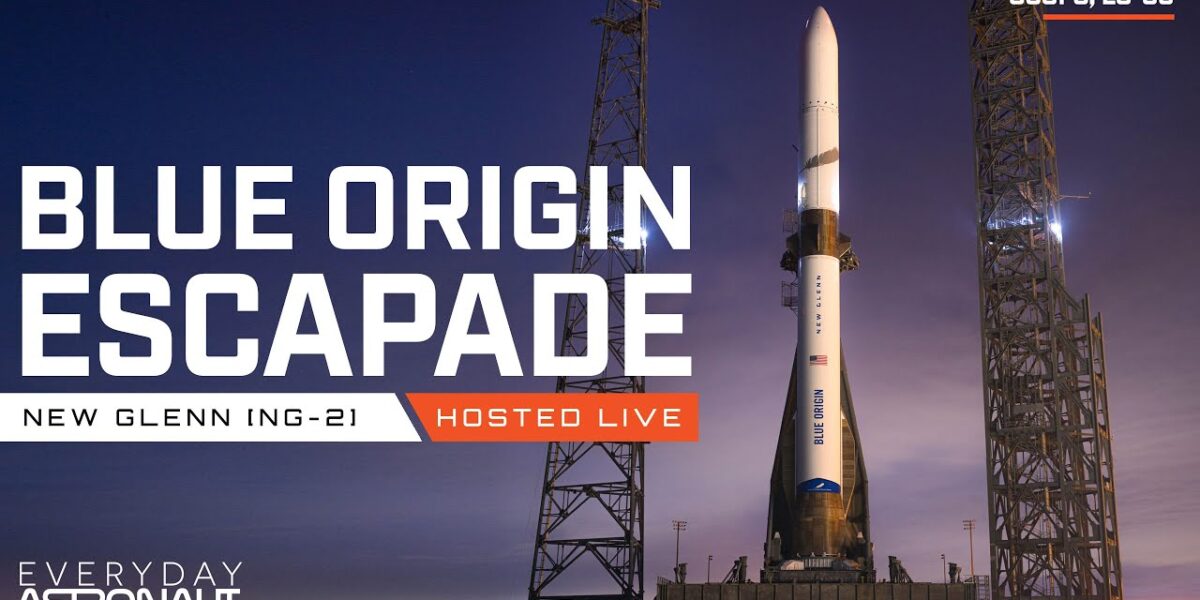
New Glenn’s Maiden Voyage: A Giant Leap for Blue Origin
The skies above Florida have witnessed a monumental event: the second launch attempt of Blue Origin’s New Glenn rocket. This colossal vehicle, designed for super heavy-lift missions, finally took to the heavens, carrying NASA’s Escapade payload destined for Mars. This launch marks a critical milestone for Blue Origin, demonstrating their ambition beyond suborbital tourism and firmly establishing them in the heavy-lift launch market.
A Titan Among Rockets
Standing an imposing 95 meters tall, New Glenn rivals the legendary Saturn V in sheer scale. Its reusable first stage is a testament to Blue Origin’s commitment to efficient spaceflight. While often associated with the smaller New Shepard suborbital vehicle, New Glenn represents a quantum leap in capability. The sheer size of New Glenn is hard to overstate; its payload bay is vast enough to swallow multiple New Shepard rockets whole.
The rocket’s design prioritizes reusability, with the first stage engineered for propulsive landing. This was a key objective for the second flight, aiming to recover the booster for future missions. The success of this landing, if achieved, would be a significant validation of Blue Origin’s technology and operational capabilities.
Payload with a Purpose: Escapade to Mars
The primary payload for this inaugural flight is NASA’s Escapade mission, a twin-spacecraft endeavor that will study Mars’s unique magnetosphere. Escapade’s primary scientific objective is to understand how Mars lost most of its atmosphere and water, a process driven by the interaction of its magnetic field with the solar wind. By flying closer to Mars than any previous spacecraft, Escapade aims to provide unprecedented data on this complex interaction.
The mission’s success hinges on New Glenn’s ability to deliver the payload precisely into its intended trajectory. The launch window for this mission was set to open at 2:57 p.m. Eastern time and conclude around 4:25 p.m. Eastern time, providing a crucial period for a successful liftoff.
Technical Prowess: Propellants and Performance
New Glenn distinguishes itself with its unique propellant combination. The first stage utilizes liquid methane and liquid oxygen (methalox), a choice that aligns with future deep-space exploration aspirations, similar to SpaceX’s Starship. This combination offers advantages in terms of performance and potential for in-situ resource utilization.
The second stage, however, employs liquid hydrogen and liquid oxygen (hydrolox). Hydrolox is renowned for its high specific impulse, meaning it is incredibly efficient at generating thrust for the amount of propellant consumed. While New Glenn’s second stage engine, a bleed expander cycle, is slightly less efficient than the most advanced hydrolox engines (around 445 seconds of specific impulse compared to over 460), its higher thrust is crucial for maneuvering such a massive vehicle.
In terms of payload capacity, New Glenn is rated to deliver approximately 45 tons to low Earth orbit with its booster landing. This figure is competitive with other heavy-lift rockets and underscores its potential for ambitious missions, including the deployment of large satellites and components for deep-space exploration.
The Road Ahead: Reusability and Future Missions
The recovery of the New Glenn booster is paramount for Blue Origin’s long-term strategy. While the first flight faced challenges, including engine relight issues during re-entry, the team has had time to refine their systems. The ability to land and reuse the first stage significantly reduces the cost per launch, a critical factor for enabling more frequent and ambitious space missions.
Beyond the Escapade mission, New Glenn is slated to support a variety of future endeavors. This includes launching elements for NASA’s Artemis program, deploying commercial satellites, and potentially facilitating future human spaceflight missions. Blue Origin’s investment in a dedicated launch complex, including massive infrastructure like water towers and lightning arresting towers, signals their long-term commitment to this powerful launch system.
Historical Context and Future Implications
The development of New Glenn places Blue Origin in direct competition with established players like SpaceX and ULA. While SpaceX has achieved remarkable success with its Falcon 9 and Falcon Heavy rockets, and ULA continues to fly its reliable Atlas and Delta vehicles, New Glenn’s sheer size and payload capacity offer unique capabilities.
The success of this launch and the subsequent booster landing will be closely watched by the space industry. It represents not just a triumph for Blue Origin but a significant step forward in humanity’s capacity to access space. As we aim for the Moon, Mars, and beyond, vehicles like New Glenn will be essential tools in our cosmic exploration.
The journey to launch a rocket of this magnitude is fraught with challenges, as evidenced by the scrubbed attempt due to weather. However, the persistence and dedication displayed by the Blue Origin team, coupled with the scientific promise of the Escapade mission, make this a truly exciting moment for space exploration.
Source: Watch Blue Origin Launch New Glenn to Mars! (YouTube)

Related Articles


NASA’s Artemis Success Fuels Mars Ambitions
NASA's successful Artemis 2 mission, returning four astronauts safely to Earth, marks a major leap in space exploration. This triumph in human spaceflight not only paves the way for future lunar missions but also reignites ambitions for eventual human journeys to Mars, showcasing technological prowess and inspiring a new generation.

NASA’s Moon Return: Rockets Blaze, Shields Glow, Risks Loom
NASA's Artemis 2 mission prepares to launch the most powerful rocket ever built, the Space Launch System (SLS), sending astronauts back to the Moon after 50 years. This complex journey involves a powerful liftoff, a critical lunar injection burn, a gravitational slingshot maneuver around the Moon, and a dangerous re-entry through Earth's atmosphere. The mission highlights both incredible engineering achievements and the inherent risks of space travel.


Artemis II Paves Way for Lunar Base, Mars Missions
The Artemis II mission is a critical test for future space travel, paving the way for a lunar base and missions to Mars. Astronauts are gaining unique perspectives and testing systems for long-duration spaceflight. Establishing a Moon base will require overcoming extreme environmental challenges and developing new technologies.