Cosmic Clocks Pinpoint Universe’s Accelerating Expansion
New observations using the warped light of quasars and supernovae through gravitational lensing are helping to refine measurements of the universe's expansion rate. This technique, time-delay cosmography, is crucial for understanding the accelerating expansion and potentially solving the 'Hubble tension'.

Cosmic Clocks Pinpoint Universe’s Accelerating Expansion
For nearly a century, astronomers have known that the universe is expanding. But since 1998, a more perplexing discovery has haunted cosmology: this expansion is not slowing down, but is, in fact, accelerating. The mysterious force driving this cosmic acceleration has been dubbed “dark energy,” a placeholder for an unknown phenomenon that constitutes about 68% of the universe’s total energy density. Now, a revolutionary technique using the warped light of distant celestial objects, known as time-delay cosmography, is providing crucial new insights, potentially resolving a major tension in our understanding of the universe’s expansion rate.
The Hubble Tension: A Cosmic Discrepancy
Our current standard model of cosmology, known as Lambda-CDM, assumes that dark energy has a constant density, meaning its outward-pushing effect per unit of space remains unchanged over time. However, this assumption, when combined with observational data, leads to a puzzling discrepancy known as the “Hubble tension.”
Two primary methods are used to measure the universe’s expansion rate, characterized by the Hubble constant (H₀). The first involves studying the Cosmic Microwave Background (CMB), the faint afterglow of the Big Bang. By analyzing this ancient light, scientists can predict the universe’s expansion rate today based on its state shortly after its birth. This method, when extrapolated to the present day, yields a Hubble constant value of approximately 67.4 kilometers per second per megaparsec (km/s/Mpc).
The second method relies on observing Type Ia supernovae – the explosive deaths of white dwarf stars. These supernovae have a remarkably consistent intrinsic brightness, allowing astronomers to calculate their distance based on how faint they appear. By measuring the redshift of their light (indicating how much the universe has stretched since the light left the supernova) and their distance, scientists can track the expansion history of the relatively recent universe. This method consistently yields a higher Hubble constant, around 73 km/s/Mpc.
This disagreement, a few percent difference in the expansion rate, might seem small, but in cosmology, such discrepancies can signal the need for new physics. The fact that these two independent measurements, using vastly different cosmic epochs and phenomena, do not align suggests either a flaw in our measurements, our understanding of the objects observed, or, most intriguingly, a fundamental problem with our cosmological model – perhaps dark energy is not constant after all.
Gravitational Lensing: Bending Spacetime
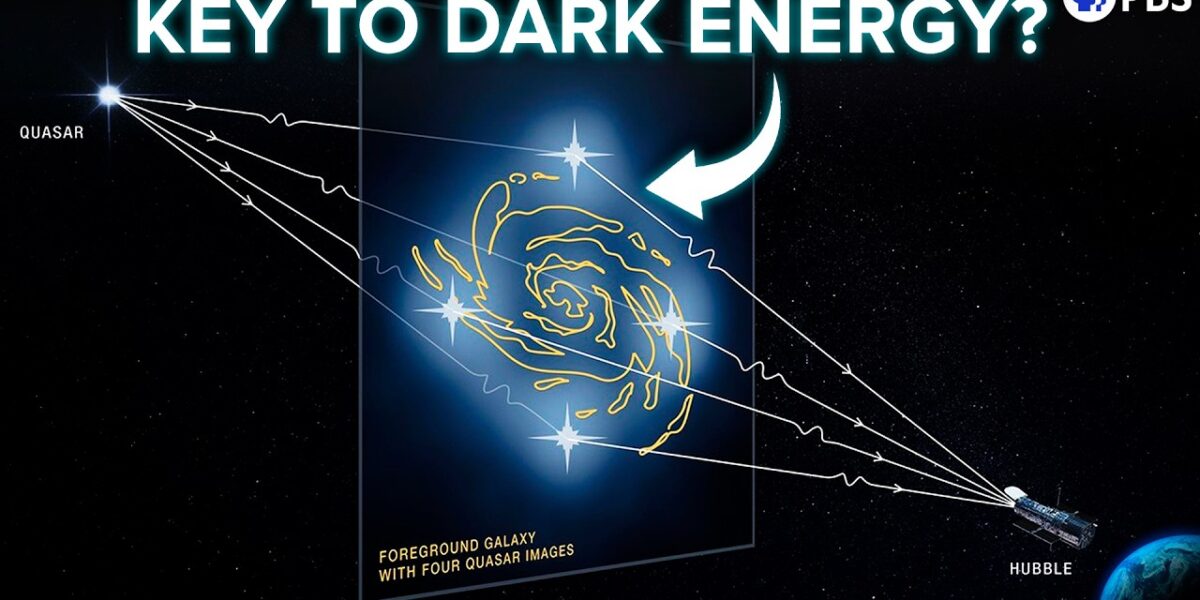
To break this deadlock, scientists are turning to independent methods. One of the most promising is time-delay cosmography, a technique first proposed by Sjur Refsdal in 1964. Refsdal theorized that the time delays between multiple images of the same gravitationally lensed supernova could be used to measure the universe’s expansion rate. This is because light, as described by Einstein’s theory of general relativity, does not travel in straight lines through the cosmos. Massive objects, like galaxies, warp the fabric of spacetime, causing light that passes nearby to bend.
In rare instances, a massive object acts as a “gravitational lens” situated precisely between us and a distant light source. This alignment causes the light from the source to travel along multiple paths to reach Earth, creating duplicate images of the same object. The most dramatic examples of this phenomenon involve quasars – the incredibly luminous centers of active galaxies powered by supermassive black holes in a feeding frenzy. These quasars flicker and vary in brightness over time due to the chaotic accretion of matter.
Time-Delay Cosmography: A Cosmic Clockwork
The core principle of time-delay cosmography is elegantly simple: the light traveling along each of these multiple paths takes a different amount of time to reach us. This difference in travel time, known as the time delay, is directly related to the distances involved and the rate at which the universe is expanding. By observing the flickering light curve of a lensed quasar, astronomers can identify the same pattern of variability in each of its multiple images. The time difference between when these patterns appear in each image is the time delay.
“The time delay goes straight to a Hubble constant measurement,” explains the research, highlighting that this method bypasses the need for the step-by-step calibration required by supernova distance measurements, which can introduce systematic errors.
Challenges and Triumphs
However, applying this technique is far from easy. The rarity of perfectly aligned gravitational lenses, the complex gravitational fields of galaxies (including the invisible dark matter component), and the difficulty in modeling these fields are significant hurdles. Galaxies are not perfect lenses; they are lumpy and irregular. Accurately mapping their gravitational influence, accounting for nearby objects and the subtle “mass-sheet degeneracy” (where the bending effect of a distant mass sheet can mimic that of a closer galaxy), requires sophisticated modeling and often additional observational data, such as the motions of stars within the lensing galaxy.
Observing the lensed images, which are often very close together and faint, also presents challenges. Professional telescopes must monitor these systems for years to build precise light curves, and even then, gaps in observation (due to daytime or the Sun’s position) introduce uncertainties. These uncertainties, when combined with the complexities of lens modeling, lead to significant error bars in the resulting Hubble constant measurements from any single lensed system.
Promising Results and Future Prospects
Despite these challenges, the results from time-delay cosmography are beginning to align with the supernova measurements, thus strengthening the Hubble tension. Collaborations like HOLiCOW and its successor TDCOSMO have used multiple lensed quasars to derive Hubble constant values that are more consistent with the “late universe” measurements than the CMB predictions. While the error bars are still larger than those from supernova studies, the combined data from these lensed quasars suggest a very low probability (less than one in ten million) that the observed discrepancy is due to random chance.
The technique has also been applied to lensed supernovae, including the eponymous Supernova Refsdal and SN H0pe. While these individual measurements also suffer from large uncertainties, they generally align with the modern expansion rate estimates.
The future of time-delay cosmography is incredibly bright. The Vera C. Rubin Observatory’s Legacy Survey of Space and Time (LSST), set to begin its full survey in early 2026, will image the entire southern sky repeatedly for a decade. This will likely uncover thousands of new lensed quasars and hundreds of lensed supernovae. Combined with data from missions like the Euclid space telescope, astronomers anticipate a dramatic reduction in the uncertainty of Hubble constant measurements, potentially to within 1%.
Such precision could finally resolve the Hubble tension. More importantly, by accumulating enough lensed objects, cosmographers may be able to map the universe’s expansion history with unprecedented detail. This could reveal whether dark energy’s density has truly changed over cosmic time, as suggested by recent results from the Dark Energy Spectroscopic Instrument (DESI) using baryon acoustic oscillations. If dark energy’s strength has indeed weakened, it would point towards new physics and help us finally understand the true nature of this enigmatic cosmic force. Time-delay cosmography, by precisely measuring the flickering echoes of ancient cosmic cataclysms, may very well be the key to unlocking one of the universe’s greatest mysteries.
Source: The Universe Is Racing Apart. We May Finally Know Why. (YouTube)

Related Articles


Universe’s End Time Shrinks Dramatically
New research suggests the universe's end may arrive much sooner than previously thought, with a revised timeline of 10 to the power of 78 years. This 'heat death' theory posits that all matter will decay, not just black holes. While still an immense duration, it's a significant shift from earlier predictions.


Distant Galaxy Appears to Break Light Speed Limit
A distant galaxy, GN-z11, appears to be moving away from Earth faster than the speed of light due to the expansion of space. This phenomenon, while seemingly violating Einstein's laws, is a key indicator of the universe's dynamic growth and offers insights into its early history.
Universe’s Expansion Outpaces Light Speed: A Cosmic Loophole
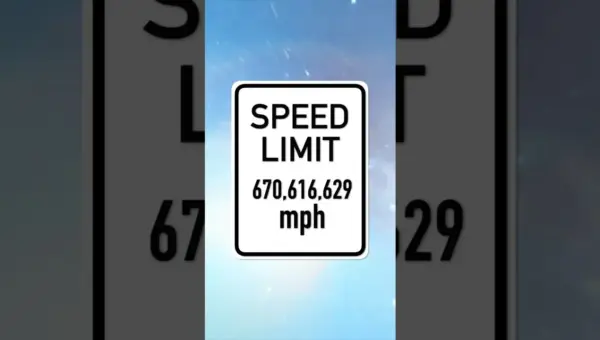
The universe's expansion appears to exceed the speed of light, but this doesn't violate Einstein's laws. It's the stretching of space itself, not objects moving through space, that causes distant galaxies to recede faster than light. The expansion rate, unlike speed, doesn't have a universal limit.