SpaceX Eyes AI Data Centers in Orbit: A Leap for Civilization?
Elon Musk's SpaceX is exploring the ambitious deployment of AI data centers in orbit and on the Moon. Despite initial skepticism, experts suggest SpaceX's launch capabilities and the economics of AI compute could make this venture viable, potentially accelerating humanity's expansion into the solar system.


SpaceX Charts Bold Course for Orbital AI Data Centers
In a significant pivot, SpaceX, under the leadership of Elon Musk, is reportedly shifting its long-term focus from Mars colonization to establishing a city on the Moon. However, this strategic reorientation is accompanied by an even more ambitious and, to many, surprising initiative: the development of AI data centers in space, with a subsequent plan to deploy them on the lunar surface. This bold vision, unveiled by Musk, has sparked widespread skepticism within the tech and space communities, yet a deeper examination, particularly through the insights of Dr. Casey Hammer, suggests it might be a more feasible and even essential step towards a solar system-spanning civilization.
Challenging Conventional Wisdom
The immediate reaction to the idea of space-based AI data centers has been one of doubt. Critics point to formidable challenges, including the immense heat generated by AI processors, the harsh realities of the space environment, and the exorbitant costs associated with launching anything into orbit. These concerns are valid, especially when compared to the readily available infrastructure on Earth.
Dr. Casey Hammer, founder of Terraform Industries and a former NASA JPL software systems architect with a PhD in theoretical physics, has long been a voice of reason, tempering enthusiasm for grand space ventures with pragmatic analysis. He has previously dismantled the feasibility of asteroid mining and space-based power, earning a reputation as a ‘space realist.’ Yet, in a recent conversation, Hammer offered a nuanced perspective on Musk’s AI data center proposal, suggesting that it might not be as far-fetched as it initially appears.
The SpaceX Advantage: Launch Capacity and Market Dynamics
Hammer identifies several key factors that could make SpaceX’s ambitious plan viable. Firstly, SpaceX’s unparalleled success in developing reusable rocket technology, particularly with the Starship program, drastically reduces launch costs. Musk’s vision for Starship aims for a million tons of payload to low Earth orbit annually, a capacity that far exceeds current market demands for satellite internet alone. To absorb this immense launch capability, SpaceX needs new, large-scale markets. AI compute, Hammer argues, could be that market.
Secondly, the economics of AI compute are currently booming. Nvidia’s recent financial results underscore that the bottleneck is not in demand but in production. AI tokens are highly valuable, and the market is structured to allow for multiple layers of profitability, from chip manufacturers like Nvidia to satellite integrators like Starlink. Even if space-based compute is marginally more expensive than ground-based solutions, the immense value generated by AI applications means that a slightly higher operational cost for SpaceX might be negligible.
Furthermore, GPUs, the workhorses of AI computation, are expensive per kilogram. This makes their launch cost, even with ancillary satellite infrastructure, a relatively smaller fraction of the overall expense compared to less dense payloads. In essence, the high value-to-weight ratio of GPUs makes them prime candidates for space deployment.
Addressing the Thermals: Rethinking Space Data Centers
One of the most significant hurdles for space-based data centers is thermal management. Traditional ground-based data centers rely on extensive cooling systems, often consuming vast amounts of energy. However, Hammer suggests that the design of Starlink satellites already offers clues to overcoming this challenge in space. Solar arrays, while efficient at generating power, also produce significant heat. Satellites manage this by radiating heat into space.
Hammer proposes a modular approach: integrating GPUs and their associated radiators directly with solar array modules. This distributed design would spread the heat load across a larger surface area, making thermal management more manageable. A single solar module could potentially power and cool a single GPU. By assembling these modules into larger satellite structures or even constellations, SpaceX could scale its compute capacity without creating insurmountable thermal issues.
The concept of ‘bit flips’ caused by cosmic radiation is another concern. However, Hammer notes that AI computations, particularly those involving matrix multiplications, are inherently robust to noise. While pure logic operations are more susceptible, the nature of neural network processing allows for a degree of error tolerance, meaning a few bit flips might not significantly impact overall performance.
The Regulatory and Land Use Advantage
Beyond the technical and economic arguments, Hammer highlights a critical advantage of space-based infrastructure: regulatory simplicity. Deploying data centers on Earth involves navigating a complex web of local zoning laws, environmental permits, and utility regulations for each individual facility. This process is time-consuming, expensive, and often fraught with delays.
In contrast, once a satellite is launched, it operates within a single regulatory framework. This ‘one-and-done’ approach to regulation for each unit, coupled with the ability to mass-produce satellites, offers a significant advantage in scaling compute capacity rapidly. This becomes particularly relevant as ground-based AI data center expansion faces increasing pressure on land availability and energy resources.
Hammer also touches upon the broader implications for Earth’s environment. He argues that dedicating vast tracts of land to solar farms for AI compute, while necessary, could compete with land needed for agriculture. By moving compute to space, humanity could potentially alleviate pressure on terrestrial ecosystems, allowing Earth to remain a haven for life while industrial-scale computation occurs beyond the atmosphere.
The Path Forward: Moon Bases and Starship Synergy
The plan extends to establishing AI data centers on the Moon, utilizing mass drivers for efficient off-world deployment. This lunar infrastructure could serve as a crucial stepping stone for further solar system expansion. The ability to leverage lunar resources and the reduced gravity well of the Moon could make such operations more efficient than direct Earth-to-orbit launches for certain applications.
The synergy between Starship’s massive launch capacity and the burgeoning demand for AI compute is central to SpaceX’s strategy. By providing an internal market for its launch services, SpaceX can ensure the economic viability of its ambitious Starship program, which requires significant operational funding. Even if these space-based data centers operate at break-even initially, they provide a crucial demand driver that prevents the Starship program from becoming a financial drain.
Conclusion: A Calculated Risk for a Cosmic Future
While skepticism surrounding SpaceX’s AI data center initiative is understandable, Dr. Casey Hammer’s analysis reveals a compelling case for its potential success. By leveraging its unique launch capabilities, capitalizing on the high-value AI market, and employing innovative engineering solutions for thermal management, SpaceX may be charting a course not just for commercial success, but for a fundamental shift in humanity’s presence in the solar system. The idea of AI compute in orbit, once dismissed as science fiction, might just be the pragmatic, albeit audacious, next step towards building a truly spacefaring civilization.
Source: SpaceX's AI Data Centres Might Actually Be A Good Idea. Here's Why (YouTube)

Related Articles

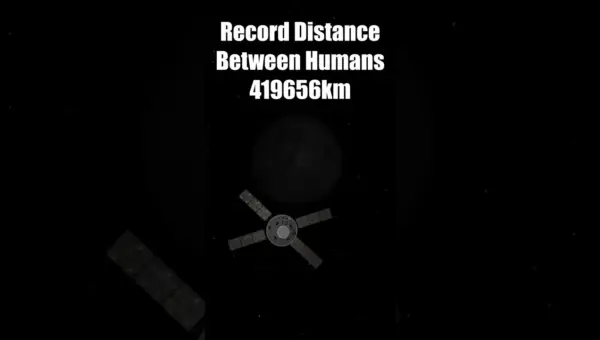
Artemis II Astronauts Set New Human Distance Record
The Artemis II mission set a new human distance record, reaching 413,145 km from Earth. The mission also established a record for the greatest distance between two groups of humans, with astronauts on China's Tiangong space station being 419,656 km away from the Artemis II crew.


Mars Rover Detects Mysterious Lightning Signals
NASA's Perseverance rover has detected mysterious crackling sounds, providing the first tantalizing evidence of lightning on Mars. This discovery, along with a faint whistler wave detected by the MAVEN spacecraft, suggests that electrical discharges occur in Martian dust storms, impacting atmospheric chemistry and posing new challenges for future human exploration.


Artemis II: Humanity Reaches for the Moon Again
Artemis II marks humanity's return to lunar exploration, sparking public excitement and practical questions. The mission signifies progress and inspires future generations. It's a crucial step toward deeper space exploration.