Dirac’s Equation: The Accidental Discovery of Antimatter
In 1928, Paul Dirac's relativistic electron equation unexpectedly predicted the existence of antimatter. Initially met with skepticism, the discovery of the positron in 1932 confirmed this groundbreaking concept, revolutionizing our understanding of the universe.


Dirac’s Equation: The Accidental Discovery of Antimatter
In 1928, a young physicist named Paul Dirac presented a theory that initially baffled and troubled the leading minds of quantum mechanics. His work, aiming to reconcile Einstein’s theory of relativity with quantum mechanics, unexpectedly led to the prediction of a revolutionary concept: antimatter.
The Unification Challenge
For decades, physicists grappled with the fundamental challenge of unifying two pillars of modern physics: Einstein’s theory of special relativity, which describes the universe at high speeds and large scales, and quantum mechanics, which governs the realm of subatomic particles. Einstein’s groundbreaking work in 1905 established the famous equation E=mc², revealing the equivalence of mass and energy. However, when applied to particles, the relativistic energy-momentum relationship, when squared, yields both positive and negative energy solutions. Classical physics, and even early quantum mechanics, simply discarded the negative energy solutions as physically nonsensical.
The Klein-Gordon Equation: A Step, But Not Enough
By 1926, physicists like Oskar Klein, Walter Gordon, and Vladimir Fock attempted to create a relativistic wave equation. They started with the relativistic energy-momentum relation and applied quantum mechanical operators, leading to the Klein-Gordon equation. While this equation was a step towards a relativistic quantum theory, it presented significant problems. One major issue was the presence of a second-order time derivative, meaning the equation’s solutions depended on both the initial state and the initial rate of change of the wave function. This complexity made it difficult to interpret probabilities, and crucially, the probability density could become negative, a concept that deeply troubled physicists.
Dirac’s Quest for Elegance
Paul Dirac, a uniquely brilliant and reserved physicist, was driven by a profound belief in the mathematical beauty and elegance of physical theories. He found the Klein-Gordon equation unsatisfactory due to its second-order time derivative and the resulting issues with probability. Dirac sought an equation that was not only relativistic but also mathematically simpler and more elegant, specifically one that was first-order in both time and spatial derivatives.
His approach involved rewriting the relativistic energy-momentum relation in a linear form. This required introducing new mathematical entities, which Dirac eventually identified as matrices. After considerable effort, Dirac realized that to satisfy the mathematical constraints, he needed to use 4×4 matrices rather than the 2×2 matrices he initially considered. This led to his famous relativistic wave equation for the electron, published in 1928.
The Equation and Its Astonishing Implications
Dirac’s equation was a masterpiece of theoretical physics. It successfully incorporated relativity and quantum mechanics, correctly predicted the electron’s magnetic moment, and even accounted for phenomena like electron spin, which had been experimentally observed but not theoretically explained. The equation’s elegance lay in its symmetry between space and time and its first-order derivatives, resolving the issues of the Klein-Gordon equation.
However, the equation also retained the problematic positive and negative energy solutions derived from the relativistic energy-momentum relation. For a particle at rest, Dirac’s equation yielded two positive energy solutions (corresponding to an electron with energy +mc²) and two negative energy solutions (with energy -mc²). This was deeply disconcerting. If negative energy states were possible, electrons could theoretically cascade infinitely into these lower energy states, radiating away energy and rendering the universe unstable.
The Birth of Antimatter
Faced with this paradox, Dirac initially struggled for three years to interpret his findings. In 1931, he proposed a radical solution: the existence of a new, yet undiscovered particle. He hypothesized that the negative energy solutions corresponded to a particle with the same mass as the electron but with an opposite, positive charge. He called this hypothetical particle the “anti-electron.” Dirac suggested that the vacuum of space might be filled with these anti-electrons, forming a “Dirac sea,” with electrons occupying the positive energy states above this sea.
Experimental Confirmation
Dirac’s prediction was met with skepticism. Many prominent physicists, including Werner Heisenberg, found the concept of negative energy and anti-electrons to be nonsensical. However, in 1932, Carl Anderson, working at Caltech, was studying cosmic rays using a cloud chamber. He observed tracks of particles that behaved like electrons but curved in the opposite direction in a magnetic field, indicating a positive charge. Crucially, the particle’s trajectory and energy loss suggested it had the same mass as an electron. Anderson named this particle the “positron,” and its discovery provided the first experimental confirmation of antimatter, vindicating Dirac’s bold theoretical leap.
The Legacy of Dirac’s Equation
The discovery of the positron marked a profound shift in our understanding of matter and energy. It revealed that for every fundamental particle, there exists a corresponding antiparticle. This concept has since been extended to all known fundamental particles, from protons (antiprotons) to quarks (antiquarks). Antimatter particles annihilate upon contact with their matter counterparts, releasing immense amounts of energy, a principle that has found applications in medical imaging (PET scans) and holds potential for future propulsion systems.
Dirac’s journey from a seemingly absurd mathematical outcome to the prediction of antimatter underscores the power of theoretical physics and the importance of pursuing mathematical elegance. His equation, initially perceived by some as “the saddest chapter in modern physics,” ultimately opened a new frontier in our exploration of the universe, revealing a hidden symmetry between matter and antimatter that continues to inspire scientific inquiry.
Source: The Man Who Accidentally Discovered Antimatter (YouTube)

Related Articles


Universe’s Expansion Outpaces Light Speed: A Cosmic Loophole
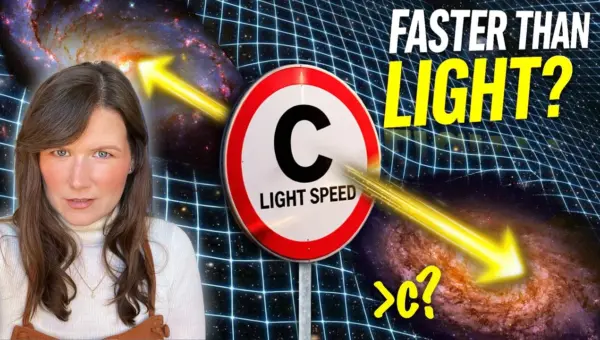
The universe's expansion appears to exceed the speed of light, but this doesn't violate Einstein's laws. It's the stretching of space itself, not objects moving through space, that causes distant galaxies to recede faster than light. The expansion rate, unlike speed, doesn't have a universal limit.

Universe Expands Faster Than Light, Defying Physics Laws
The universe appears to be expanding faster than the speed of light, a phenomenon that seems to contradict Einstein's laws. However, this cosmic speedster doesn't break physics rules because it's space itself expanding, not galaxies moving through space. This mind-bending concept reveals the universe's true scale and dynamics.


Matter-Antimatter Mystery: CERN Unlocks Secrets of Universe’s Imbalance
Scientists at CERN are producing and studying antimatter to solve the cosmic mystery of why the universe is dominated by matter. This elusive substance, created in a specialized factory, could reveal the fundamental imbalance that allowed matter to prevail over antimatter in the early universe.