The Elusive Graviton: Physics’ Missing Link to a Unified Universe
Physicists are pursuing the elusive graviton, the hypothetical quantum particle of gravity, to unify quantum mechanics and general relativity. Despite theoretical predictions, direct detection remains a challenge, with non-renormalizability in standard quantum gravity approaches posing a significant hurdle. Alternative theories like string theory offer potential solutions, as the search for evidence of this fundamental particle continues.

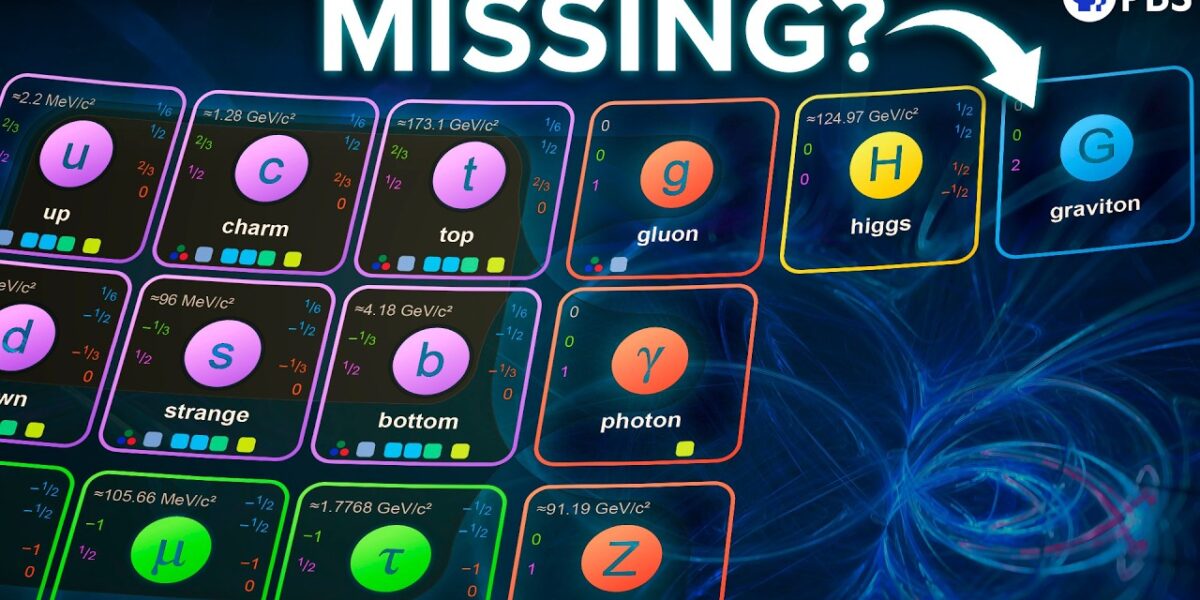
The Quantum Enigma: Searching for the Graviton
Physics stands on the precipice of understanding the universe in its entirety, yet a crucial piece of the puzzle remains elusive: the graviton. This hypothetical quantum particle, believed to mediate the force of gravity, holds the key to stitching together our two most profound theories of nature—quantum mechanics and general relativity—into a single, elegant master theory. The quest for the graviton is a century-long pursuit, a central pillar in the grand ambition of a ‘theory of everything.’ But does this fundamental particle truly exist, or has the path of quantum gravity led physicists astray?
Two Pillars of Reality: Quantum Mechanics and General Relativity
Our current understanding of the cosmos is built upon two monumental frameworks. Quantum mechanics, born from Max Planck’s groundbreaking ideas and Albert Einstein’s photoelectric effect, describes the universe at its smallest scales. It paints a picture of fields permeating all of space, whose excitations manifest as the particles that constitute matter and mediate three of the four fundamental forces: the electromagnetic, weak nuclear, and strong nuclear forces. These quantum fields are inherently discrete and probabilistic, meaning their properties and the particles they comprise can never be precisely pinned down.
In stark contrast, general relativity, Einstein’s magnum opus, describes gravity not as a force mediated by particles, but as a geometric property of spacetime itself. It posits that space and time are interwoven into a single, dynamic fabric that warps and curves in response to the presence of matter and energy. This curvature dictates how objects move, which we perceive as the force of gravity. General relativity is continuous and deterministic, a stark departure from the quantum realm.
The Unification Imperative
These two theories, while remarkably successful in their respective domains, present a fundamental dichotomy. Quantum mechanics governs the ‘stuff’ of the universe, while general relativity describes the ‘container.’ The Standard Model of particle physics, a triumph of quantum field theory, elegantly explains all known particles and three fundamental forces through the exchange of force-carrying particles called bosons. It would be deeply unsatisfying, physicists argue, if the most fundamental layer of reality were comprised of two entirely unrelated and fundamentally different descriptions—one discrete and probabilistic, the other continuous and deterministic.
Beyond aesthetics, there’s a pressing scientific need for these theories to reconcile. In extreme environments like the heart of a black hole or the moments after the Big Bang, general relativity and quantum mechanics clash, generating paradoxes and contradictions. A unified theory is essential to resolve these inconsistencies and provide a complete picture of the universe’s most energetic and enigmatic phenomena.
The Particle Path: Quantizing Gravity
The prevailing approach to bridging this gap involves ‘quantizing’ gravity—treating it as a quantum field in a manner analogous to how electromagnetism was quantized. This endeavor hinges on the existence of the graviton. Just as photons mediate the electromagnetic force, the graviton is hypothesized to carry the gravitational force. If gravity is quantized, it must have a mediating particle; if it has a mediating particle, gravity must be quantum.
The process of quantization involves taking a classical field and breaking it down into discrete energy packets, or quanta. For electromagnetism, this led to the discovery of the photon. Applying similar principles to the gravitational field, which in general relativity is represented by the metric tensor describing the curvature of spacetime, physicists theorize the existence of the graviton. This hypothetical particle is predicted to be a massless, spin-2 boson, traveling at the speed of light.
The Challenge of Non-Renormalizability
While this perturbative approach, treating the gravitational field as small fluctuations on a background spacetime, successfully reproduces classical gravity and even predicts phenomena like Hawking radiation from black holes, it encounters a critical roadblock. When physicists attempt to apply the full force of quantum field theory to gravity, particularly in scenarios of strong gravitational fields, the calculations yield infinities. These infinities arise because, unlike photons, gravitons interact with themselves, leading to an infinite number of self-interaction loops that cannot be tamed by the process of renormalization.
Renormalization is a mathematical technique used in quantum field theory to handle infinities that arise in calculations. It works by absorbing these infinities into a finite number of measured physical quantities, such as the mass or charge of a particle. However, the infinite number of infinities generated by self-interacting gravitons makes this approach non-renormalizable, rendering the theory meaningless at high energies or strong gravitational fields.
Alternative Avenues: String Theory and Beyond
The failure of the straightforward quantization approach does not necessarily spell the end for the graviton or quantum gravity. Instead, it suggests that our current methods may be insufficient or that gravity is fundamentally different from other forces at the quantum level.
One of the most promising avenues is string theory. This framework proposes that fundamental particles are not point-like entities but rather tiny, vibrating strings. In string theory, a massless, spin-2 boson—precisely the predicted properties of the graviton—emerges naturally from the mathematical structure of the theory. Furthermore, string theory avoids the infinities of non-renormalizable quantum gravity because the extended nature of strings smooths out interactions at the smallest scales.
Other approaches, such as loop quantum gravity, also aim to quantize spacetime but may offer different perspectives on the graviton’s role. The fundamental question remains: is gravity inherently quantum, or is spacetime a continuous, fundamental entity as suggested by some number theories and proponents like Roger Penrose?
The Future Hunt for the Graviton
Directly detecting a graviton is an immense technological challenge, likely requiring particle accelerators the size of solar systems. However, indirect methods offer a glimmer of hope. Scientists are exploring ways to observe the subtle quantum effects of gravity, such as detecting the mediation of quantum entanglement by gravitational fields or conducting extremely sensitive experiments with minuscule masses, akin to a Cavendish experiment scaled down to quantum precision.
The discovery of the graviton, or definitive evidence that it does not exist, would profoundly reshape our understanding of the universe. It would either confirm the quantum nature of gravity, solidifying the path toward a unified theory, or force us to reconsider the very fabric of spacetime. The search continues, a testament to humanity’s unyielding curiosity and its drive to unravel the universe’s deepest secrets.
Source: The Gravity Particle Should Exist. So Where Is It? (YouTube)

Related Articles


Wind-Powered Car Defies Limits, Exceeds Wind Speed
A new cart design demonstrates how an object can travel faster than the wind pushing it, using a clever wheel and spool system. This principle, similar to the Blackbird land yacht, challenges our understanding of motion and energy transfer.

Cosmic Blueprint: Science Meets Faith in Universe’s Origins
Astrophysicist Michio Kaku draws parallels between the Big Bang theory and biblical creation accounts. He also discusses the potential for future technology to preserve human consciousness and shares his personal belief in a "God of creation."
Astronaut Spots Cosmic Flip: The Tennis Racket Mystery
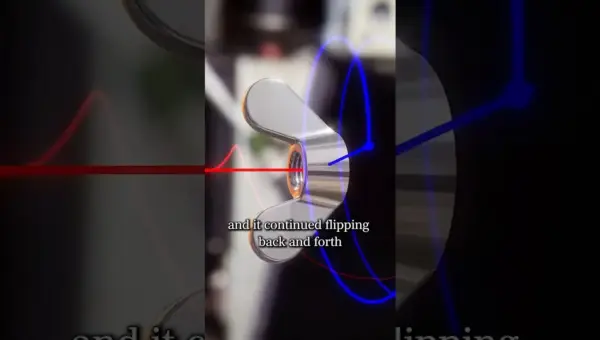
A Soviet cosmonaut's accidental discovery of a spinning wing nut revealed the bizarre Janabbeckov effect. This phenomenon, also known as the tennis racket theorem, explains why some spinning objects inexplicably flip, a quirk now understood through physics.