Iran: The Geopolitical Lever in the US-China Tech Race
Geopolitical insights reveal Iran's pivotal role in the US-China tech race, acting as a lever that challenges China's influence. A historical memo outlining targeted countries underscores the strategic depth of this competition.


Iran: The Geopolitical Lever in the US-China Tech Race
While the global narrative often focuses on the direct competition between the United States and China in the technological sphere, a deeper geopolitical analysis reveals a complex web of influence where nations like Iran play a surprisingly key role. Recent insights suggest that Iran’s position is not merely a regional concern but a critical factor in the broader strategic struggle for technological supremacy, particularly in its potential to challenge China’s growing influence.
A Strategic Memo and its Echoes
The current geopolitical landscape, viewed through the lens of technological competition, can be traced back to significant strategic discussions held in the aftermath of the September 11th attacks. In 2007, General Wesley Clark, a former NATO Supreme Commander, revealed a startling memo he had seen at the Pentagon. This document outlined a plan to target seven countries within a five-year timeframe, commencing with Iraq and Syria, and eventually encompassing Lebanon, Libya, Somalia, Sudan, and concluding with Iran.
“I guess if the only tool you have is a hammer, every problem has to look like a nail.”
– General Wesley Clark, reflecting on strategic decision-making.
The fact that the United States has been involved in conflicts or significant diplomatic and military engagements in all of these nations, with Iran being the final country on the original list, highlights the long-term strategic thinking that has guided US foreign policy. The implication for the current tech race is that any move impacting Iran’s geopolitical standing or its technological development is viewed through the prism of its potential effect on China.
Iran’s Role in the Tech Competition
The strategic importance of Iran in the context of the US-China tech race is complex. Firstly, Iran represents a significant bloc of population and resources in a strategically vital region.
Its alignment, or lack thereof, with either the US or Chinese sphere of influence can tilt regional power dynamics. For China, securing or maintaining influence in countries like Iran is crucial for its Belt and Road Initiative and its broader strategy to expand economic and technological partnerships globally, often as an alternative to Western-led systems.
Secondly, Iran’s own technological capabilities, though perhaps not on par with global leaders, are a growing concern. As nations increasingly rely on digital infrastructure, cybersecurity, and advanced manufacturing, the potential for Iran to develop or acquire critical technologies, or to become a hub for certain types of technological activities, is a strategic consideration. The US, in its efforts to contain China’s technological rise, may view Iran as a potential disruptor or, conversely, as a pawn whose strategic positioning can be leveraged against Chinese interests.
Sectoral and Index Implications
The geopolitical tensions involving Iran can indirectly influence various technology sectors. For instance, disruptions in the Middle East can affect global energy markets, which in turn can impact the cost of production for semiconductors and other hardware components.
The ongoing decoupling efforts between the US and China are leading to the formation of distinct technological ecosystems. If Iran were to align more closely with China’s technological standards or supply chains, it could represent a further fragmentation of the global tech landscape.
Major technology indices, which often include global tech giants, could see volatility based on geopolitical developments. Companies heavily reliant on global supply chains or with significant market exposure in regions affected by Middle Eastern instability might experience fluctuations in their stock prices. The semiconductor industry, in particular, is highly sensitive to geopolitical risks due to its complex and geographically concentrated manufacturing processes.
What Investors Should Know
For investors, understanding the geopolitical underpinnings of the US-China tech race is crucial for navigating market uncertainties. While direct investment in Iranian technology may be limited or non-existent for many international investors due to sanctions and political risks, the country’s strategic position has broader implications:
- Supply Chain Resilience: Geopolitical instability can disrupt global supply chains, impacting the availability and cost of technology components. Investors should assess the supply chain diversification of companies they hold.
- Regional Economic Impact: Conflicts or political shifts in the Middle East can affect regional economies, influencing demand for technology products and services.
- Technological Alliances: The formation of new technological alliances or the strengthening of existing ones between countries like China and Iran can shape future market access and competitive advantages for technology firms.
- Cybersecurity Risks: State-sponsored cyber activities, often linked to geopolitical rivalries, can pose significant risks to businesses and critical infrastructure.
Long-Term Implications
The long-term implications of Iran’s role in the tech race are tied to the broader trajectory of US-China relations. If the competition continues to intensify, countries like Iran could become more sought-after partners, leading to increased investment and technological transfer, potentially from China. This could further entrench regional technological blocs and accelerate the fragmentation of the global tech industry.
Conversely, shifts in geopolitical alliances or a de-escalation of tensions could alter Iran’s strategic value. However, given the depth of the US-China rivalry and the established strategic considerations involving Iran, its position as a key geopolitical factor in the global technological competition is likely to persist for the foreseeable future. Investors need to remain aware that geopolitical events, even those seemingly distant, can have tangible impacts on the technology sector and the broader investment landscape.
Source: Iran’s Connection to Tech Race With China (YouTube)

Related Articles

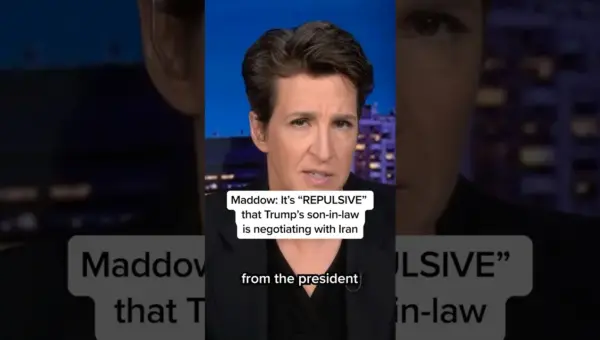
Kushner’s Iran Talks Draw ‘Repulsive’ Criticism
Rachel Maddow of MSNBC has voiced strong disapproval of Jared Kushner's reported involvement in negotiating with Iran. She described the situation as 'repulsive,' citing concerns over Kushner's business interests and lack of traditional diplomatic experience. This raises questions about potential conflicts of interest and the effectiveness of such sensitive talks.


Ukraine Strikes Cripple Russian Oil; US Goes Global
Ukraine's drone attacks are crippling Russian oil exports and production, forcing significant output reductions. Simultaneously, the U.S. Navy is expanding its reach globally, seizing Iranian oil tankers far from the Persian Gulf. This dual pressure signals a potential breakdown of global trade in energy, agriculture, and manufacturing.


Russia’s Economy Crumbles Under Sanctions, Dissent Grows
New intelligence reports indicate Russia's economy is collapsing under sanctions, with falling oil revenues and rampant inflation. Dissent is growing, with prominent figures and even pro-Kremlin bloggers openly criticizing the government and President Putin.