Earth Gains and Loses Tons of Mass Daily
Earth is a dynamic planet, constantly gaining about 100 tons of mass daily from space dust while losing atmospheric gases. This delicate balance maintains Earth's stability. Meanwhile, astronomers study cosmic phenomena like Betelgeuse's companion star and ponder the possibility of simulated universes.

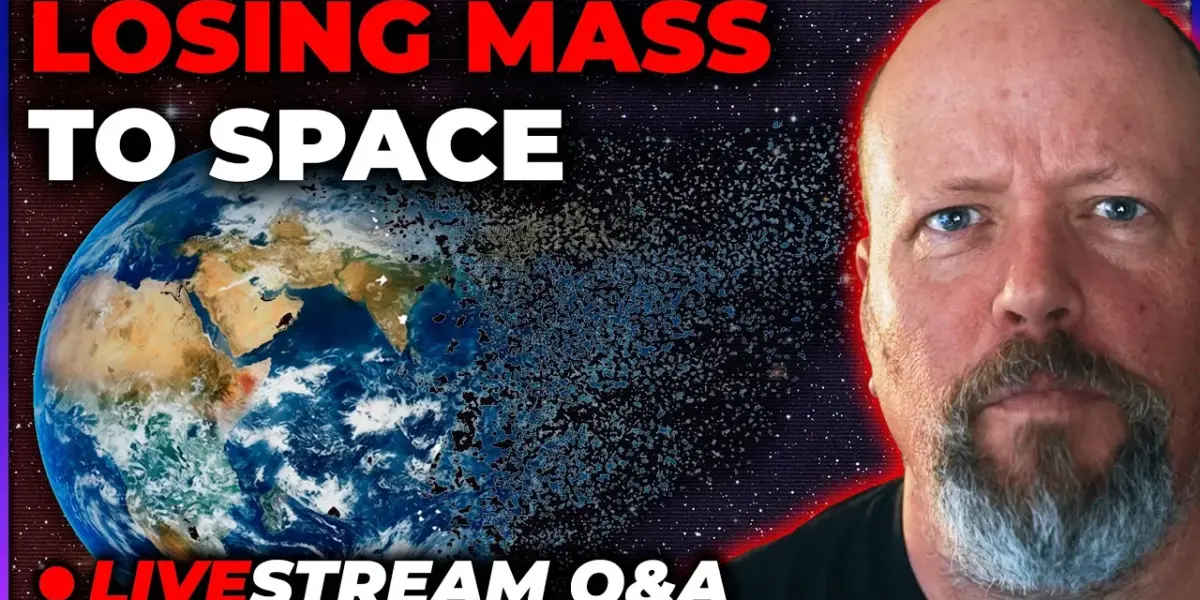
Earth is a Dynamic Planet, Constantly Gaining and Losing Mass
Our home planet, Earth, is not a static sphere. It’s a dynamic world that is constantly gaining and losing mass, a subtle but continuous process. While these changes might seem insignificant on a global scale, they highlight the ongoing interactions between Earth and its cosmic environment.
Every day, our planet gains about 100 tons of material from space. This mass comes from tiny particles of space dust, remnants of asteroids and comets, that continuously rain down upon us. Imagine a constant, gentle snowfall of cosmic grit, accumulating over time.
Atmospheric Escape: Earth’s Subtle Mass Loss
However, Earth also loses mass, primarily through the escape of its atmosphere. The solar wind, a stream of charged particles from the Sun, can strip away lighter atmospheric gases. This process, known as atmospheric escape, is a slow but steady loss of Earth’s gaseous envelope.
While we are losing atmospheric mass, the amount gained from space dust is roughly equivalent. This means Earth’s overall mass remains relatively stable, with neither significant gains nor losses that would impact our planet’s fundamental characteristics.
Understanding the Forces at Play
The universe is a complex interplay of forces. In the early universe, the sheer momentum from the Big Bang propelled matter apart. Gravity, however, worked to pull this matter together, forming the large-scale structures we observe today.
This cosmic tug-of-war led to the formation of vast galaxy walls and immense voids. In our local neighborhood, gravity still dominates, pulling galaxies like Andromeda towards us. Yet, on larger scales, the accelerating expansion driven by dark energy is overcoming gravity, pushing galaxies further apart.
Betelgeuse’s Mysterious Companion
Astronomers are also studying the red supergiant star Betelgeuse. Recent observations suggest it may have a companion star. This companion, orbiting just outside Betelgeuse’s outer layers, could be influencing the red giant’s dimming and behavior.
The exact nature of this interaction is still being investigated. Scientists are closely monitoring Betelgeuse to understand how this close proximity affects both stars and what it reveals about stellar evolution.
The Quest for Extraterrestrial Life and Simulated Universes
The question of whether we are alone in the universe remains a profound one. While some believe life must be abundant, others, including this journalist, lean towards the possibility that we might be unique.
This perspective is partly informed by the Fermi Paradox, which questions why, if extraterrestrial life is common, we haven’t detected any signs of it. One intriguing possibility is that advanced civilizations might turn inward, focusing on creating complex virtual realities rather than exploring the cosmos.
Simulating Reality: A New Frontier?
As our computing power grows, so does our ability to simulate complex systems, including aspects of the universe. Projects like the Dark Energy Spectroscopic Instrument (DESI) and the Euclid mission are mapping the universe’s composition, providing data to refine these simulations.
These simulations, while powerful, do not yet replicate life itself. The creation of life, or consciousness, within a simulation remains a theoretical frontier. It raises questions about the nature of reality and our place within it.
Science Fiction: Inspiring Minds for Generations
Science fiction has long captured the human imagination, inspiring countless individuals to explore the wonders of space and science. Authors like Isaac Asimov, Robert Heinlein, and Ursula K. Le Guin have shaped our understanding and dreams of the future.
Introducing young minds to science fiction can be done through engaging books, movies, and television shows. Fostering curiosity about space, dinosaurs, or the natural world can lead to a lifelong passion for scientific discovery.
The Future of Exploration and Understanding
Upcoming observatories like the Vera C. Rubin Telescope and the Nancy Grace Roman Space Telescope promise to further unravel the universe’s mysteries. They will provide unprecedented data on dark matter, dark energy, and the evolution of cosmic structures.
As we continue to explore the cosmos, both physically and through our understanding, we gain a deeper appreciation for our place in the vastness of space. The journey of scientific discovery is ongoing, with new revelations waiting to be uncovered.
Source: How Fast Is The Earth Disintegrating to Space? [Q&A Livestream] (YouTube)

Related Articles

NASA Eyes Moon Return, Inspired by Sci-Fi Dreams
NASA officials are drawing inspiration from science fiction like 'Star Wars' to fuel the upcoming Artemis II mission. This mission aims to send astronauts around the Moon, pushing human exploration further than ever before. The effort seeks to inspire a new generation to pursue dreams in STEM fields.


Hollywood’s Alien Threat: A Storytelling Choice?
Hollywood frequently portrays aliens as threats, a trend driven by the need for conflict in storytelling and proven box office success. While some films explore benevolent encounters, the alien invasion narrative offers high stakes that resonate with audiences. This recurring theme taps into ancient fears and modern anxieties, shaping public perception of the unknown.


Project Hail Mary’s Science: Is It Real?
The movie Project Hail Mary dives deep into real astrophysics and biology. It explores concepts like solar dimming, relativity, and alien life. While much is fiction, the film grounds its narrative in actual scientific principles, sparking curiosity about the universe.