Trump’s Gas Price Claims Face Scrutiny Amid Shifting Statements
Donald Trump's recent statements on gas prices have shown inconsistency, raising questions amid global market influences. Separately, an AI-generated image depicting Trump as Jesus has sparked outrage among supporters and religious groups, prompting debate about faith, politics, and the candidate's messaging.

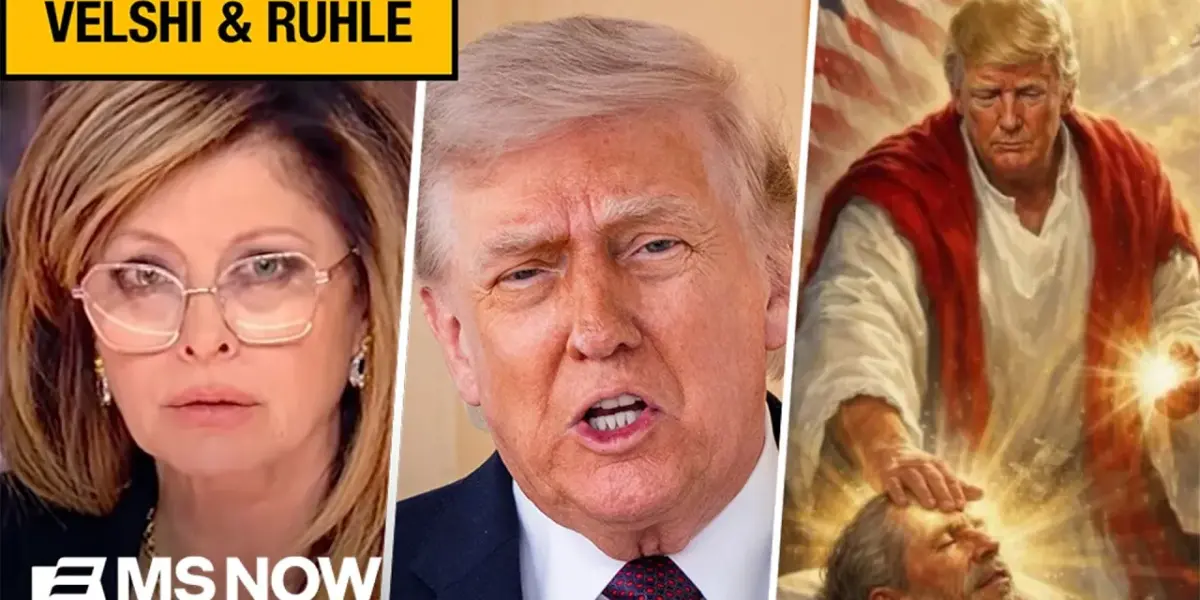
Gas Prices and Global Markets: Understanding the Complexity
Many Americans wonder why gas prices remain high when the U.S. produces its own oil. This question is common, especially since Donald Trump has often stated the United States is largely oil independent.
While the U.S. does produce enough oil to meet its own needs, the price of oil is not set domestically. Instead, it is determined by a global market, similar to other major commodities like gold and wheat.
Oil prices are set centrally on a worldwide scale. Even U.S. oil can be more expensive for domestic buyers if it is ready for faster delivery.
This global pricing means a country cannot simply set its own oil price, even with high production levels. To do so would require cutting off all international trade, which is not feasible for the U.S. The nation exports a significant amount of its oil, and it also imports different types of crude oil that are better suited for its refineries.
U.S. Oil vs. World Oil: Different Crudes, Different Prices
The specific type of oil used in the United States is called West Texas Intermediate (WTI) light sweet crude. “Light” refers to its low density, and “sweet” means it contains very little sulfur. In contrast, the rest of the world primarily uses a heavier crude oil known as Brent crude, which sets the global price standard.
This distinction is crucial: unless the U.S. completely isolates itself from global trade, it will continue to buy and sell commodities like oil, gold, and fertilizer based on international prices. This is a key difference from past events like the Arab oil embargo, which caused actual shortages and long lines at gas stations due to a lack of gasoline. Today, there is no shortage of gasoline; the issue is the higher cost consumers face at the pump.
Trump’s Shifting Statements on Gas Prices
Donald Trump has made several public statements about the future of gas prices, particularly in relation to upcoming midterm elections. In interviews, he expressed hope that prices would decrease. However, his predictions have shown some inconsistency.
On one occasion, when asked if gas prices would be lower before the midterms, Trump initially responded, “I hope so. I mean, I think so.” Later, in the same or a closely following interview, he stated more confidently, “gasoline’s coming down very soon and very big.” He further emphasized, “I think they’ll be much lower before midterm.
Much lower. Yes.” This fluctuation in his statements over a short period raises questions about the certainty of his predictions.
Political Implications of Gas Price Predictions
The changing nature of Trump’s comments on gas prices is significant, particularly for political campaigns. These statements can be used effectively in campaign advertisements by opposing parties. However, some Republican campaign strategists believe that the time between April and the November elections is a long period in politics, offering ample opportunity for conditions to change.
Political analysts suggest that if the current administration manages to resolve the conflict in Iran within their projected timeline of 4 to 6 weeks, gas prices could potentially start to normalize. The key word here is “potentially,” as the situation remains fluid. The duration of the conflict and its resolution are critical factors influencing market stability and, consequently, gas prices.
AI-Generated ‘Jesus’ Photo Sparks Controversy Among Supporters
In a separate development, a recent AI-generated image posted by Donald Trump has caused significant backlash, even among his own supporters. The image depicts Trump in a manner resembling Jesus Christ, with his hands placed on someone’s head, seemingly in a healing gesture.
This post has been met with strong criticism. One supporter described it as “a disgrace” and questioned the level of ego involved.
Another expressed shame, stating, “I’m ashamed that it’s that he would actually do that. The man I voted for and trust.” Many found the image to be “appalling” and “disgusting,” viewing it as a mockery of their faith and Jesus Christ.
Faith Leaders and Voters React to Religious Imagery
The use of religious imagery has drawn sharp criticism from various groups. Some Christians feel it is blasphemous, arguing that while one should strive to live a life like Christ, individuals are not Christ themselves. Others, regardless of their religious affiliation, believe that mocking any faith is inappropriate and counterproductive.
“As a Christian, what do you make of this? I find it appalling. It’s disgusting.
You’re mocking my Lord and Savior Jesus Christ. He’s mocking him.”
The controversy is compounded by Trump’s past feuds with religious leaders, including previous popes, often over issues like immigration and crime. Pope Francis himself has spoken out against the misuse of the Gospel’s message for political purposes, emphasizing peace and dialogue.
He stated, “I do not look at my role as being a political politician. I don’t think that the message of the gospel is meant to be abused in the way that some people are doing.”
The Impact of the AI Image and Trump’s Response
The AI-generated image has been interpreted in various ways, from a political tactic to a serious misstep. Some suggest it reflects Trump’s tendency to create complex situations from simpler problems, while others see it as a sign of his willingness to engage in religious controversies without clear political benefit. The fact that Trump later removed the image suggests he may have received feedback from influential figures or perceived a negative reaction.
However, Trump’s history shows a pattern of rarely apologizing or admitting wrongdoing. Even when faced with criticism, his typical response has been to offer explanations rather than apologies. The quick removal of the image is unusual for an administration that generally avoids appearing to backtrack or show weakness.
Looking Ahead: Iran Conflict and Political Messaging
As the situation in Iran unfolds, its resolution will be closely watched for its potential impact on global oil prices. Simultaneously, the reaction to Trump’s controversial AI-generated image among different voter demographics will continue to be a significant factor in political discourse leading up to the midterm elections. The interplay between foreign policy events and domestic political messaging remains a key area to monitor.
Source: Trump's flip flop on gas prices | Trump supporters on 'appalling' AI Jesus photo (YouTube)

Related Articles
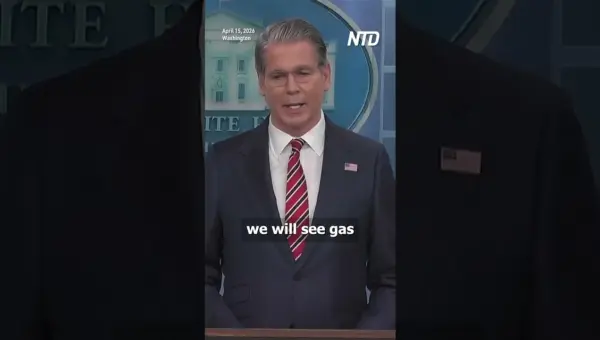
Gas Prices To Hit $3 This Summer, Treasury Chief Predicts
Treasury Secretary Janet Yellen predicts gas prices could fall to $3.00 a gallon this summer. This optimistic forecast depends on successful negotiations and the reopening of the Strait of Hormuz. Lower gas prices would provide financial relief to consumers and help ease inflation.
Maddow: Trump Aims to Humiliate Vance into Quitting
Rachel Maddow suggested on MSNBC that Donald Trump may be intentionally trying to humiliate Vice President JD Vance. Maddow believes Trump's actions could be aimed at pushing Vance to resign. This perspective follows recent setbacks experienced by Vance, highlighting a potential strategy by Trump.

Trump’s Jesus Post Cracks Christian Support Base
Donald Trump's AI image of himself as Jesus Christ has sparked debate, with some suggesting he may be the Antichrist. Historian Kristen Dum analyzes this event, noting a potential crack in his Christian support base despite past controversies. The incident highlights hypocrisy and divisions within the religious right, particularly between Christian nationalists and Catholics.