Pro-Iran March Proceeds Despite UK Minister’s Objections
A pro-Iranian Al-Quds march is set to proceed in London this weekend despite strong objections from UK Justice Minister Sarah Sackman, who stated such hate marches have 'no place in British society.' Organizers defend the event as a exercise of freedom of expression, while past controversies including displays of flags from designated groups and calls for Israel's destruction continue to fuel debate.

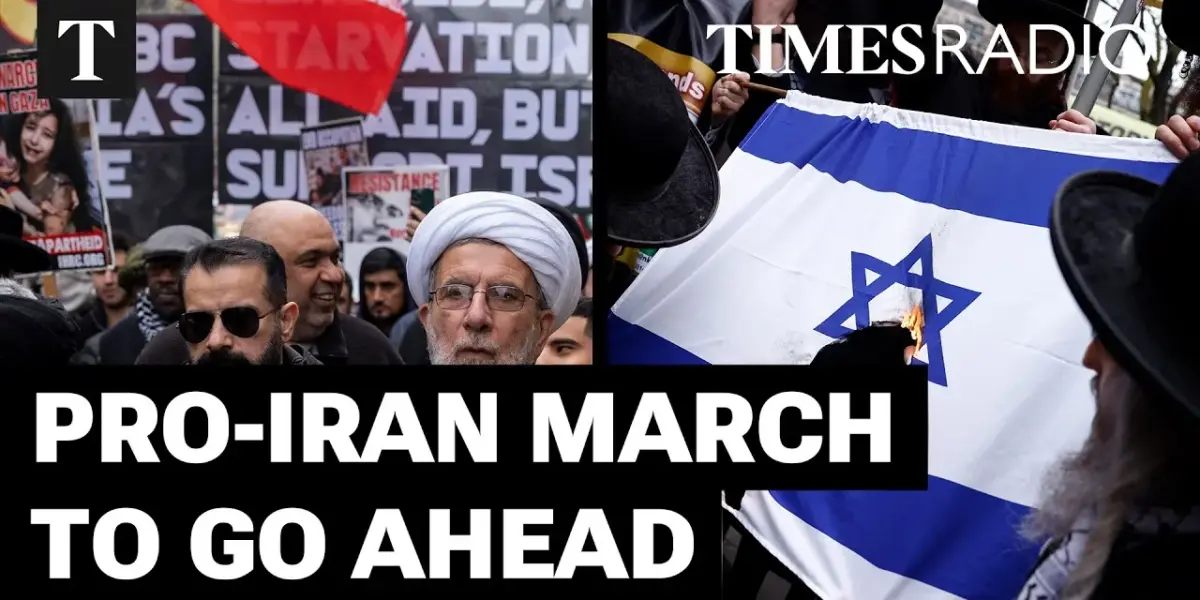
Pro-Iran March Set to Proceed Despite Justice Minister’s Objections
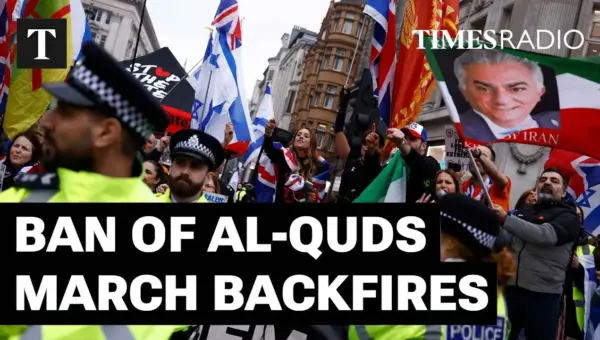
London, UK – A controversial pro-Iranian march, the Al-Quds march, is slated to proceed this weekend in London, defying objections from UK Justice Minister Sarah Sackman. Sackman had publicly stated that the march, which has previously featured displays of flags from groups like Hezbollah and calls for Israel’s destruction, has “no place in British society,” particularly in the current global climate.
The Al-Quds march, an annual event, has consistently drawn criticism for its association with the Iranian regime and its anti-Israel rhetoric. In previous years, the event has seen arrests and clashes with police, along with the display of symbols associated with designated terrorist organizations. Justice Minister Sackman emphasized her stance on Times Radio, stating, “I’m clear that hate on marches like the Al-Quds march has no place in British society and particularly in the current context where we are seeing the indiscriminate actions of malign regime of the IRGC both causing danger abroad and at home.”
Organizers Defend March as Freedom of Expression
Masud Shajari, an organizer of the Al-Quds March and chair of the Islamic Human Rights Commission (IHRC), directly responded to Sackman’s comments, asserting that the march has never supported terrorism or called for the destruction of any state. “We have actually asked for end to the ideology of Zionism and end to occupation, end to apartheid and end to genocide and we will continue to do that,” Shajari stated. He characterized these actions as a right and a duty, exercised under the principles of freedom of expression and assembly, which he described as “hardcore British values.”
Shajari further addressed the controversies surrounding past marches, including the burning of Israeli flags and the display of Hezbollah flags before its proscription. He argued that such actions were permissible under the law at the time and that the Metropolitan Police allowed them.
“If you’re saying that IHRC have been wrong by allowing this then you should also say that the Metropolitan Police have been wrong and supporting terrorism by allowing it,” he contended. He pointed out that the burning of Israeli flags has been carried out by Orthodox rabbis, who he stated are not racist or anti-Semitic, and that police have protected these demonstrations.
“It doesn’t matter who does it. It’s a pretty clear say it’s a pretty clear don’t don’t don’t misrepresent me. I didn’t say I’m okay with it or I’m not.
I’m saying that is a law of land. People can do it and those who did it were Orthodox rabbis. You can’t accuse them of being racist and anti-semite.”
Masud Shajari on the burning of Israeli flags
When pressed on the issue of burning Israeli flags, Shajari reiterated his stance that it is a matter of law. He did, however, issue a plea to potential participants, stating, “Look guys, if you’re going to come and burn the Israeli flag, don’t come because we don’t want that kind of thing on our demonstration.” He emphasized that attendees are welcome to engage in any activity that is legal and acceptable, aligning with the march’s principles.
Allegations of Support for Iranian Regime
The organizers have also faced accusations of supporting the Iranian regime, highlighted by a photograph of Shajari appearing to shout “We are all Iranian” in front of a placard featuring Ayatollah Ali Khamenei. The report in The Times suggested this implied support for a regime responsible for significant human rights abuses. Shajari strongly refuted these claims, explaining that the phrase “We are all Iranian” was part of a broader statement made outside the Israeli embassy, where he also declared, “We are all Palestinian, we are all Lebanese, we are all Syrian, we are all Iranian.” He clarified that this was not about supporting a specific group but about standing against injustice.
Regarding the placard, Shajari explained it bore the message “Stand on the right side of history.” He elaborated that this was a call for humanity to oppose genocide and its normalization, rather than an endorsement of any particular leader. He challenged the notion that supporting the “right side of history” meant aligning with Khamenei, stating, “The leader who sanctions the murder of his own people for protesting against his rule is on the right side of history.” Shajari also disputed claims about the number of protesters killed in Iran, calling them inaccurate.
Security and Legal Standing
Shajari asserted that the march has always been peaceful and has legal standing. He referenced the case of Darren Osborne, who attacked a crowd near Finsbury Park Mosque, noting that the judge in that case understood Osborne was targeting a peaceful demonstration. Shajari expressed concern that media coverage and rhetoric labeling the marchers as terrorists could incite further violence, holding the media partially responsible for such potential actions.
He concluded by questioning the fairness of objections raised against the march, particularly when similar situations in Tehran might not be permitted. The ongoing debate highlights the tension between freedom of assembly and concerns over hate speech and the potential for incitement, especially in a politically charged environment.
What to Watch Next
As the Al-Quds march approaches, attention will be on the scale of participation, the conduct of attendees, and the response from law enforcement. The Home Office and Metropolitan Police are expected to monitor the event closely, balancing the right to protest with the need to maintain public order and prevent any illegal activities or incitement to violence. The controversy surrounding the march highlights the complex challenges faced by authorities in managing public demonstrations with political and social sensitivities.
Source: Pro-Iranian March To Go Ahead Despite Justice Minister's Objection (YouTube)

Related Articles

China Silences Art: Fake Bomb Threat Cancels Toronto Shows
A fake bomb threat led to the cancellation of Shen Yun performances in Toronto, with organizers blaming the Chinese Communist Party. The CCP allegedly uses such tactics to silence Shen Yun, which showcases pre-communist China and highlights human rights abuses.

Shen Yun Faces Down Beijing’s Shadow in New Film
The documentary 'Unbroken' chronicles Shen Yun Performing Arts' rise amid alleged intimidation tactics linked to the Chinese Communist Party. It highlights the company's mission to revive traditional Chinese culture and their fight for freedom of expression.
London Al-Quds March Faces Ban, Draws Larger Crowds
London's Al-Quds Day march has been restricted to a static demonstration following a government ban, with organizers anticipating a larger turnout due to the controversy. The Islamic Human Rights Commission attributes the ban to pro-Israel lobbying and sees the event as a protest for Palestinian rights, while authorities are on high alert for hate speech and support for banned groups.