New Research Challenges Fermi Bubble Origins
Scientists have long debated the origin of the giant gamma-ray-emitting Fermi bubbles above and below the Milky Way. While a supermassive black hole was the leading suspect, new simulations suggest supernovae activity alone might be responsible, reopening the mystery.

New Research Challenges Fermi Bubble Origins
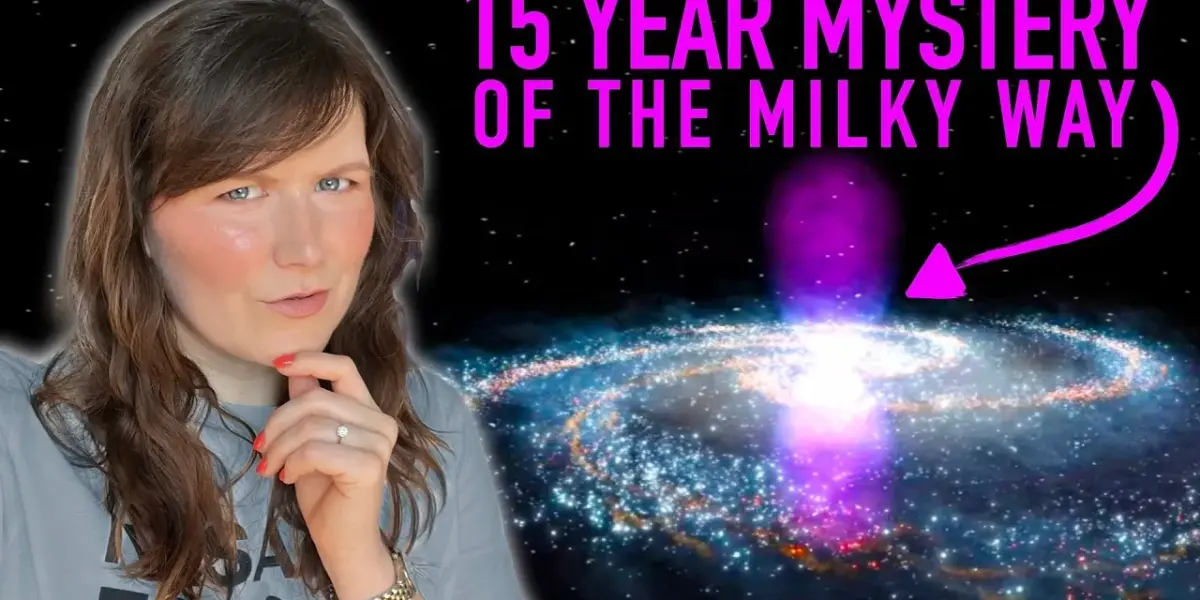
For 15 years, scientists have believed they understood the origin of the colossal gamma-ray-emitting bubbles found above and below our Milky Way galaxy. Now, new research is stirring the pot, suggesting our understanding might be incomplete.
What are the Fermi Bubbles?
These enormous structures, named after the Fermi Gamma-ray Space Telescope that discovered them in 2010, are vast clouds of superheated gas. They blast out gamma rays, the most energetic form of light in the universe, which are a billion times more powerful than the light we can see.
When the Fermi telescope first mapped the sky in gamma rays, scientists saw points of light from energetic objects like black holes and pulsars. They also saw a bright band from our own Milky Way galaxy. This galactic glow comes from high-energy particles colliding with gas and dust between the stars. It’s only when astronomers subtract these known sources that the faint, distinct glow of the Fermi bubbles becomes visible.
The gamma rays from the bubbles have a different energy signature than those from the Milky Way’s gas and dust. This suggests a different creation process. Specifically, it points to high-speed electrons, accelerated to nearly the speed of light, colliding with lower-energy light particles like infrared or radio waves. This process, called inverse Compton scattering, creates the high-energy gamma rays we detect.
Another key feature of the Fermi bubbles is their sharp, defined edges. This hints at a sudden, powerful event rather than a slow, gradual one. These bubbles are immense, stretching about 50,000 light-years from top to bottom. That’s half the width of the entire Milky Way galaxy, which itself contains around 100 billion stars.
More Than Just Gamma Rays
The Fermi bubbles aren’t just visible in gamma rays. In 2013, scientists identified them as the source of a microwave haze detected by the Planck telescope. Later, in 2020, visible light was detected coming from the bubbles, specifically from glowing hydrogen atoms. The E-Rosita telescope also detected X-ray light from these structures in 2020.
Two Main Theories for Their Creation
Scientists have proposed several ideas for what could have created such massive structures. The leading theories involve events at the heart of our galaxy:
Theory 1: A Supernova Frenzy
One idea is that many stars exploded as supernovae in the dense center of the Milky Way at roughly the same time. In the galaxy’s center, stars are packed much closer together than they are in our solar neighborhood. If a period of intense star formation occurred, the largest, hottest stars, which have the shortest lives, would have all died and gone supernova around the same time.
The combined energy and outflow from these numerous explosions could have pushed hot gas and accelerated particles outwards. While supernovae explosions are generally spherical, the outflow would follow the path of least resistance. This would be upwards and downwards, out of the flat disk of the galaxy, forming bubble-like structures.
We see similar, though smaller, bubble structures in other parts of the galaxy, like the Orion Nebula region. We also observe enormous outflow structures from other galaxies that are undergoing intense bursts of star formation, like Messier 82. This suggests that a similar past event in the Milky Way could be responsible for the Fermi bubbles.
Theory 2: A Hungry Supermassive Black Hole
Another prominent theory centers on the supermassive black hole at the Milky Way’s core. This black hole, known as Sagittarius A*, is about 4 million times more massive than our sun. While black holes themselves are invisible, the material swirling around them in an accretion disk heats up and glows intensely.
This accretion disk is a chaotic and energetic place. The immense pressure can be released through powerful winds or jets of material that shoot out from the black hole’s poles. These jets can accelerate particles to near the speed of light, similar to what’s observed with the supermassive black hole in Messier 87, which has a jet extending hundreds of thousands of light-years.
The idea is that our galaxy’s central black hole was once much more active, spewing out jets and winds that created the Fermi bubbles. Now, it has become quieter, leaving these ancient structures behind.
New Research Complicates the Picture
For years, the scientific community debated these two main theories. Some argued that supernovae wouldn’t have enough collective energy, while others pointed to a lack of evidence for past activity from our relatively quiet supermassive black hole.
In recent years, evidence favoring the supermassive black hole theory has grown. Computer simulations in 2021 and 2022 showed that galaxies similar to the Milky Way could develop X-ray emitting bubbles from the activity of their central black holes. These simulations could recreate the appearance of the Fermi bubbles in gamma rays, X-rays, and microwaves.
However, a new paper published in 2025 by Sans, Hopkins, and Panada has challenged this consensus. Their simulations focused solely on supernova activity. Remarkably, they were able to create bubble-like structures above and below galactic disks, even without including a supermassive black hole in their models. These simulated bubbles also glowed in gamma rays through inverse Compton scattering.
This latest research has thrown the scientific community back into a state of uncertainty. It suggests that supernova activity alone might be sufficient to explain the formation of these colossal bubbles.
What Comes Next?
The ongoing debate highlights the complexity of galactic evolution. While simulations provide powerful insights, they are models and need to be validated by real-world observations. Scientists will continue to refine these simulations, making predictions about what specific signatures we should look for across different wavelengths of light for each scenario.
Future observations, perhaps with more sensitive telescopes or by re-analyzing existing data, may hold the key. By comparing these detailed predictions with what we observe, astronomers hope to finally pinpoint the true origin of the Fermi bubbles. Solving this mystery will not only tell us more about our galaxy’s past but also about the powerful processes that shape galaxies across the universe.
Source: We thought we solved the Fermi Bubbles… then this happened (YouTube)

Related Articles
Our Sun Might Be a Cosmic Anomaly
New research suggests our Sun, long considered a typical star, might be more unusual than previously thought. This finding impacts our understanding of life's prevalence in the universe and the search for habitable exoplanets.
Dark Matter Weaves Cosmic Web Across Universe
Dark matter forms an invisible cosmic web, connecting galaxies with vast filaments. Computer simulations predicted this structure decades ago, and recent observations confirm its existence. The cosmic web provides crucial evidence for dark matter and helps us understand the universe's evolution.

Dark Matter’s Mystery: Why It Resists Collapse Into Black Holes
Dark matter, unlike normal matter, does not collapse into stars or black holes because it cannot radiate energy away as heat. Its inability to interact with the electromagnetic force prevents the cooling necessary for gravity to overcome particle pressure. This unique property leads to the formation of vast, diffuse structures like galactic halos and the cosmic web.