New Clues Emerge in 15-Year Mystery of Galactic Gamma-Ray Bubbles
For 15 years, scientists have puzzled over the origin of the Milky Way's massive gamma-ray emitting Fermi Bubbles. While a supermassive black hole eruption was the leading theory, new research has complicated this explanation, reopening the investigation into these energetic galactic structures.


Galactic Bubbles Reveal New Secrets in Gamma-Ray Mystery
Two colossal bubbles, stretching far above and below our Milky Way galaxy, are spewing out gamma rays – the most powerful form of light in the universe. For 15 years, scientists have been trying to solve the puzzle of their origin, and a recent discovery has thrown a fascinating new twist into the investigation.
What Are the Fermi Bubbles?
These immense structures are known as the Fermi Bubbles, first spotted by the Fermi Gamma-ray Space Telescope in 2010. They are vast clouds of superheated gas, so hot that they emit gamma-ray light. This light is an astonishing billion times more energetic than the visible light our eyes can detect.
Astrophysicists have spent the last 16 years poring over data, attempting to understand what these bubbles are and what cosmic event created them. For a time, it seemed the mystery was close to being solved.
A Long-Awaited Theory
By the early 2020s, a compelling theory had emerged. Evidence suggested that the bubbles were likely formed by a massive outburst from the supermassive black hole at the center of our galaxy, Sagittarius A*. This black hole, millions of times the mass of our Sun, is known to be very active. Scientists believed that in the past, it had unleashed a powerful jet or eruption, pushing enormous amounts of gas outwards and creating the Fermi Bubbles.
This idea fit many of the observations. The sheer scale of the bubbles and the energy involved pointed to an event of galactic proportions, and the central black hole was the prime suspect. It was a neat explanation for a grand cosmic phenomenon.
New Research Complicates the Picture
However, a new research paper published in late 2025 has introduced significant complexities. Scientists from institutions like Johns Hopkins University and the Pan-STARRS observatory have presented findings that challenge the long-held black hole eruption theory. This new research suggests that the story behind the Fermi Bubbles might be far more intricate than previously imagined.
The exact nature of the new findings is still being analyzed, but they likely involve more detailed observations of the gas within the bubbles, their temperature variations, or their interaction with the surrounding galactic environment. These subtle clues could point to alternative explanations or perhaps a combination of different events.
Looking Back: A History of Galactic Exploration
The study of our galaxy’s structure and activity has a rich history. Telescopes like Hubble and Spitzer have provided stunning images of nebulae and star-forming regions. However, Fermi’s ability to detect high-energy gamma rays opened a new window into the universe’s most violent processes. Before Fermi, understanding the energetic events shaping galaxies was much more difficult.
The discovery of the Fermi Bubbles was a landmark moment, showcasing that our galaxy is not just a collection of stars but a dynamic entity with powerful, unseen forces at play. Early theories often involved supernovae – the explosive deaths of massive stars – but the scale of the Fermi Bubbles quickly pointed towards a more powerful source.
What Comes Next?
This latest research underscores the dynamic nature of scientific inquiry. What once seemed like a solved puzzle is now an active area of investigation once more. Scientists will now focus on gathering more data, potentially using next-generation telescopes or re-analyzing existing data with new theoretical models.
Understanding the origin of the Fermi Bubbles is crucial for comprehending how galaxies evolve. The processes that create and sustain these structures can influence star formation, the distribution of matter, and the overall magnetic field of the galaxy. They are cosmic laboratories helping us understand the fundamental forces at work in the universe.
The ongoing investigation into the Fermi Bubbles is a testament to humanity’s persistent curiosity and our drive to unravel the universe’s deepest mysteries. Each new piece of information, even if it complicates our understanding, brings us closer to a complete picture of our cosmic home.
Source: The 15 year mystery of the Milky Way's Fermi Bubbles #shorts (YouTube)

Related Articles

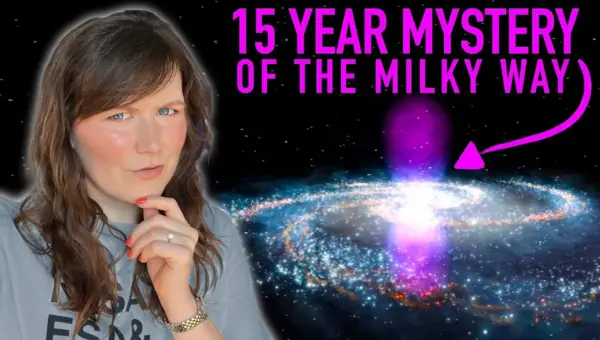
New Research Challenges Fermi Bubble Origins
Scientists have long debated the origin of the giant gamma-ray-emitting Fermi bubbles above and below the Milky Way. While a supermassive black hole was the leading suspect, new simulations suggest supernovae activity alone might be responsible, reopening the mystery.

Our Sun Might Be a Cosmic Anomaly
New research suggests our Sun, long considered a typical star, might be more unusual than previously thought. This finding impacts our understanding of life's prevalence in the universe and the search for habitable exoplanets.
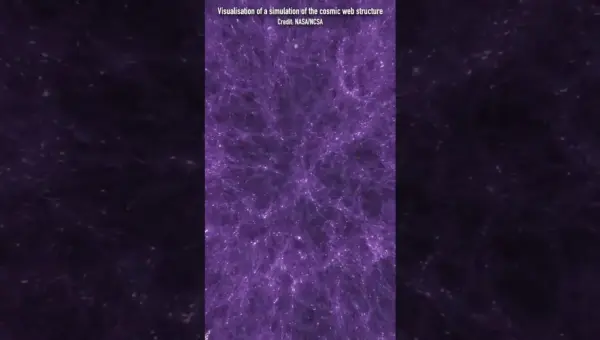
Dark Matter Weaves Cosmic Web Across Universe
Dark matter forms an invisible cosmic web, connecting galaxies with vast filaments. Computer simulations predicted this structure decades ago, and recent observations confirm its existence. The cosmic web provides crucial evidence for dark matter and helps us understand the universe's evolution.