LIGO Detects Strongest Evidence Yet for Hawking’s Area Theorem
LIGO's latest observations of a black hole merger, GW250114, provide the strongest evidence yet for Stephen Hawking's 1971 area theorem. The data confirms that the surface area of the resulting black hole was greater than the sum of the areas of the merging black holes, validating a key prediction about these cosmic enigmas.

Black Hole Physics Milestone: LIGO Data Supports 50-Year-Old Theory
The enigmatic nature of black holes has long captivated scientists, and among the most profound theoretical insights into these cosmic behemoths comes from the brilliant mind of Stephen Hawking. Now, groundbreaking observations from the Laser Interferometer Gravitational-Wave Observatory (LIGO) collaboration have provided the strongest evidence to date supporting one of Hawking’s most significant predictions: the black hole area theorem.
Unpacking the Hawking Area Theorem
Before delving into the new findings, it’s essential to understand what black holes are and the significance of Hawking’s theorem. Black holes are not literal holes in spacetime, but rather incredibly dense regions where gravity is so immense that nothing, not even light, can escape. This boundary of no return is known as the event horizon. While not a physical surface, the event horizon possesses a definable surface area.
Stephen Hawking, a towering figure in theoretical physics, proposed the area theorem in 1971. It states that the total surface area of a black hole’s event horizon can never decrease over time. In essence, for a single, isolated black hole, its event horizon’s area should remain constant or increase. This theorem is deeply connected to the black hole’s mass; a larger event horizon area implies a more massive black hole. Therefore, the theorem also implies that black holes cannot lose mass and shrink their event horizons under normal circumstances.
It’s important to note that Hawking himself later predicted the existence of ‘Hawking radiation,’ a quantum mechanical process where black holes can slowly radiate away mass as energy, theoretically causing them to shrink over vast timescales. However, the area theorem is generally understood to apply to the behavior of black holes in scenarios where such quantum effects are negligible or, crucially, in the context of mergers.
Gravitational Waves: A New Window into Cosmic Collisions
Testing such a fundamental theorem requires observing extreme cosmic events. Einstein’s theory of general relativity predicts that when massive objects like black holes interact, they warp and unwarp spacetime, sending ripples through the cosmos known as gravitational waves. For decades, these waves were purely theoretical. However, the development of sensitive detectors like LIGO and its European counterpart, Virgo, has enabled scientists to finally ‘hear’ these cosmic whispers.
LIGO operates using two incredibly precise interferometers, each with kilometer-long arms. Lasers are bounced down these arms and recombined. In the absence of gravitational waves, the light waves are designed to cancel each other out, a principle similar to noise-canceling headphones. When a gravitational wave passes, it infinitesimally stretches and squeezes spacetime, altering the lengths of the arms and disrupting this perfect cancellation. This disruption creates a detectable flash of light, signaling the passage of a gravitational wave.
The ‘shape’ of the detected gravitational wave signal, its amplitude and frequency over time, is a direct consequence of the dynamics of the merging black holes. By comparing this signal to theoretical models derived from general relativity, scientists can deduce crucial properties of the black holes involved: their masses, spins, and, critically for Hawking’s theorem, the sizes of their event horizons before and after the merger.
GW250114: A Clear Signal for a Historic Test
The recent breakthrough comes from the analysis of a gravitational wave event designated GW250114, detected on January 14, 2025. This event was remarkable for its exceptional clarity. The signal was approximately 80 times more intense than the typical background noise in the detectors, a significant improvement over earlier detections, such as the first-ever gravitational wave signal from 2015, which had a signal-to-noise ratio of only 24.
This high signal-to-noise ratio is paramount for precise scientific analysis. It allows scientists to distinguish subtle features within the gravitational wave signal that would otherwise be lost in the noise. One particularly important phase of a black hole merger is the ‘ringdown’ – the period immediately after the two black holes coalesce into a single, larger black hole. This phase is akin to the aftershocks of an earthquake, where the newly formed black hole settles into a stable state.
The ringdown phase contains detailed information about the final black hole, including its surface area. However, the gravitational waves emitted during this phase are significantly weaker than those from the merger itself. Previously, the lower signal-to-noise ratios of detected events made it difficult to extract precise measurements from the ringdown. With GW250114, the ringdown was ‘beautifully resolved,’ allowing for a much more accurate determination of the final black hole’s properties.
The Verdict: Area Theorem Holds
The LIGO collaboration analyzed the GW250114 data, fitting general relativity models to the gravitational wave signal. They calculated the total surface area of the two merging black holes and compared it to the surface area of the single black hole formed after the merger.
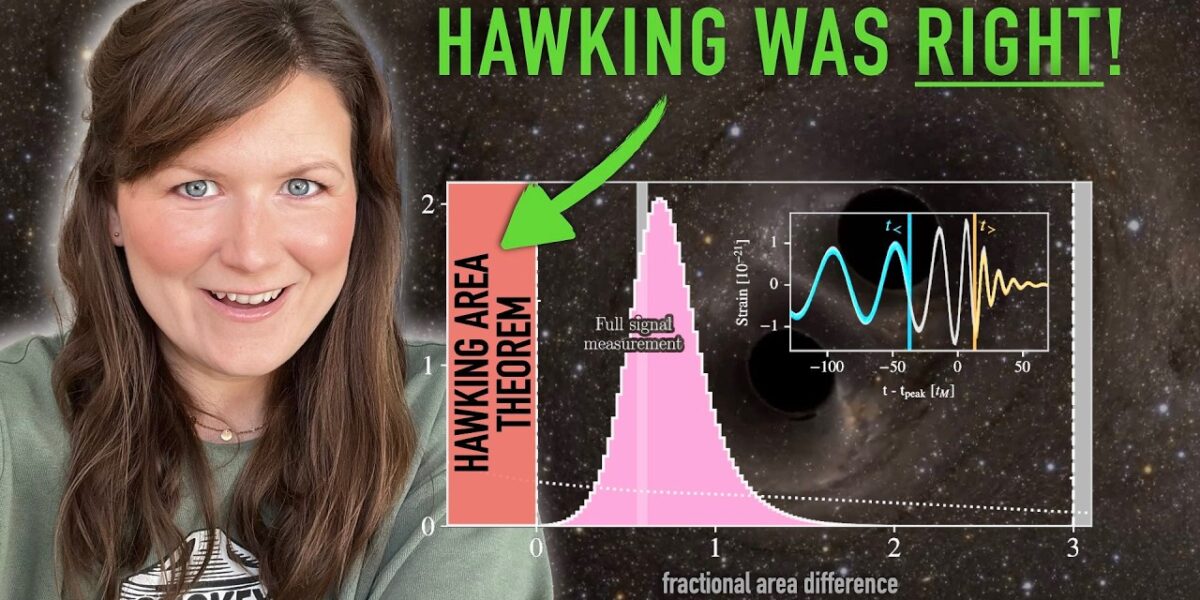
Hawking’s area theorem predicts that the final area (Af) must be greater than or equal to the sum of the initial areas (Ai). In the context of mergers, the theorem states that the surface area of the remnant black hole must be greater than or equal to the sum of the surface areas of the two progenitor black holes. The researchers plotted the fractional difference between the final and initial total areas against various model fits.
The results were compelling. None of the plausible model fits for GW250114 indicated a decrease in the total surface area. The best-fit model yielded a fractional area difference of approximately 0.8. This indicates that the final black hole’s surface area was significantly larger than the combined surface areas of the two smaller black holes. The excess is expected, as a portion of the initial mass is converted into energy and radiated away as gravitational waves during the merger, a phenomenon also predicted by general relativity.
This statistically robust finding marks a pivotal moment. For the first time, scientists have conclusive observational evidence supporting Hawking’s area theorem, a prediction made over half a century ago based on pure theoretical reasoning. Previous detections, while groundbreaking, lacked the precision to definitively confirm or refute such a subtle theoretical point.
Looking Ahead: Implications for Fundamental Physics
The confirmation of Hawking’s area theorem through gravitational wave astronomy is a testament to the synergy between theoretical prediction and technological advancement. It validates our understanding of black hole dynamics and reinforces the predictions of general relativity in extreme gravitational environments.
This success opens the door for future investigations. As detector sensitivity improves and more merger events are observed, scientists can continue to scrutinize the properties of black holes and test other fundamental predictions of physics. This ongoing research not only deepens our understanding of the universe’s most extreme objects but also pushes the boundaries of human knowledge, offering profound insights into the fundamental laws that govern reality.
Source: FINALLY: evidence for Hawking's AREA THEOREM of black holes (YouTube)

Related Articles


Milky Way’s Center: Black Hole or Dark Matter Mystery?
New research proposes that Sagittarius A*, the supermassive object at the Milky Way's center, might not be a black hole but a dense concentration of dark matter. Future observations of its photon ring could reveal the truth.


Earth’s Planetary Status Questioned, Figure-8 Orbits Debunked
Exploring Earth's planetary status, the impossibility of figure-8 orbits, the ongoing debate about dark matter's composition, and the future of human spaceflight.


Interstellar Visitor 3I/ATLAS Reveals Cosmic Secrets
Interstellar visitor 3I/ATLAS has revealed surprising details about its composition and behavior. Passing near the Sun, it exhibited intense outgassing and color changes, and was confirmed by radio telescopes to be a water-rich comet, not an artificial object. Its unique chemistry suggests it has been "cooked" by cosmic rays over billions of years.