JWST Spots Mysterious “Platypus Galaxies” in Early Universe
The James Webb Space Telescope has discovered enigmatic "platypus galaxies" in the early universe. These objects exhibit unusual spectral properties, challenging current models of galaxy formation and potentially revealing new insights into quasar activity or the birth of the very first galaxies.

Distant Galaxies Defy Expectations, Hint at Early Cosmic Evolution
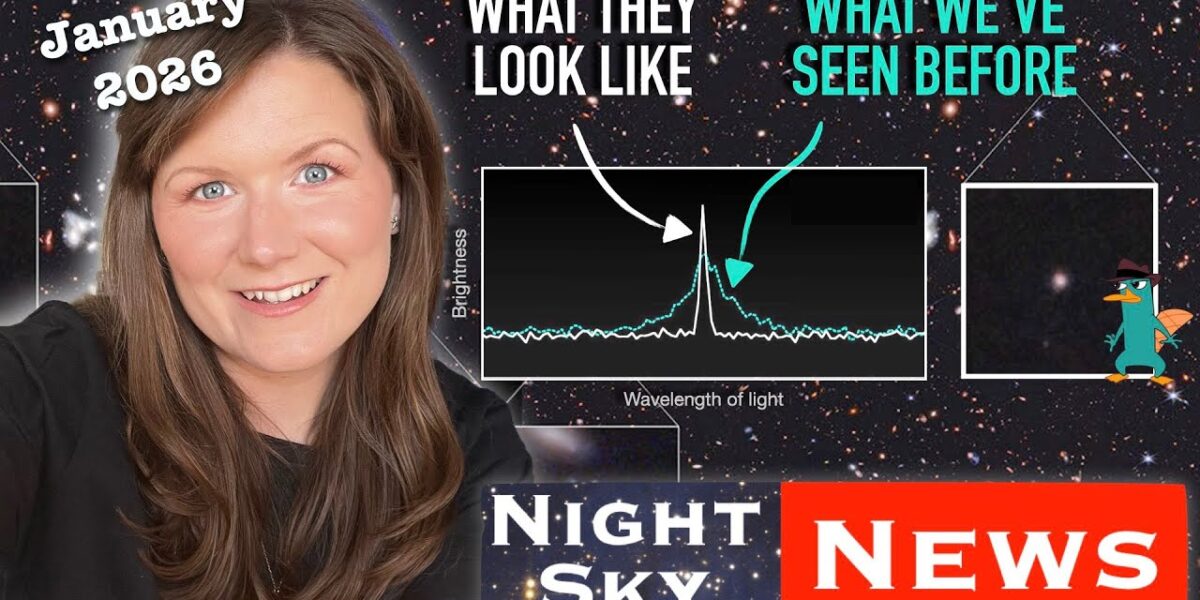
The James Webb Space Telescope (JWST) has unveiled a new cosmic enigma: a population of peculiar galaxies in the distant universe, dubbed “platypus galaxies” by researchers. These celestial objects, observed as mere pinpricks of light in JWST’s powerful images, exhibit spectral characteristics that challenge our current understanding of galaxy formation and evolution in the early cosmos. The discovery, detailed in recent astronomical findings, suggests these galaxies may be either nascent supermassive black holes growing in unprecedented ways or exceptionally young, rapidly forming star systems.
The “Platypus” Analogy: A Blend of Familiar and Strange
The moniker “platypus galaxies” stems from a fascinating analogy. Much like the platypus, a mammal with features typically associated with birds (a bill, egg-laying) and reptiles (egg-laying), these galaxies present a perplexing combination of traits. In JWST’s imaging, they appear as single, compact points of light, a morphology often associated with either nearby stars or extremely distant, bright objects called quasars. Quasars are powered by supermassive black holes at the centers of galaxies actively consuming surrounding matter, their immense brightness often outshining the host galaxy itself.
However, when astronomers analyze the light emitted by these objects – a process called spectroscopy, which breaks down light into its constituent wavelengths or colors – the platypus galaxies reveal a different story. Their spectra show bright spikes of light at specific wavelengths, indicative of elements like hydrogen glowing intensely. These spikes are characteristic of gas surrounding active black holes, similar to quasars. Yet, these spectral lines are unusually narrow, unlike the broadened lines typically seen in quasars, which are smeared due to the high-speed motion of gas around the black hole. This Doppler shift, similar to the changing pitch of an ambulance siren as it passes, is less pronounced in the platypus galaxies.
Conversely, the narrowness of these spectral lines is more reminiscent of light from star-forming regions within nearby, fully resolved galaxies. This creates the paradox: visually, they resemble quasars; spectrally, they lean towards star-forming galaxies, but at distances where they should be much larger and more developed if they were indeed star-forming galaxies.
Two Competing Theories for an Unusual Phenomenon
This spectral-imaging dichotomy has led to two primary hypotheses:
- Unusual Quasar Growth: The platypus galaxies could represent a new class of actively growing supermassive black holes, perhaps ones that formed or evolved differently in the dense, early universe. Their narrow spectral lines might indicate a less chaotic accretion process or a different composition of the surrounding material than typically observed in quasars. Understanding this could shed light on how the first supermassive black holes grew to such enormous sizes so early in cosmic history, a long-standing puzzle in astrophysics.
- Incredibly Young Star-Forming Galaxies: Alternatively, these objects could be normal star-forming galaxies, but extraordinarily young. Based on their apparent brightness and size in JWST’s images, they would have to be only about 100 million years old, a mere infant compared to the universe’s 13.7 billion-year age. Furthermore, their observed formation appears to be a calm, inward process, rather than the chaotic mergers often predicted by simulations for galaxy assembly in the early universe.
JWST: Peering Deeper into Cosmic Dawn
The James Webb Space Telescope, launched in December 2021, has revolutionized our ability to observe the universe’s earliest epochs. Its unparalleled sensitivity and infrared capabilities allow it to detect light from galaxies that formed just a few hundred million years after the Big Bang, light that has been stretched to longer, redder wavelengths by the expansion of the universe. The discovery of the platypus galaxies is a testament to JWST’s power to uncover unexpected phenomena that push the boundaries of our cosmological models.
These observations are particularly significant because they probe an era when the first stars and galaxies were igniting, fundamentally changing the universe from a dark, neutral state to the luminous cosmos we see today. Understanding the nature of these platypus galaxies is crucial for piecing together the complex processes that governed this transition.
Broader Implications and Future Research
The existence of these enigmatic objects raises fundamental questions about the diversity of galactic structures and the conditions present in the nascent universe. If they are indeed young galaxies, they suggest that galaxy formation might have proceeded in more varied ways than previously thought, possibly involving more quiescent, inside-out growth. If they represent a new type of quasar activity, it implies our models of black hole accretion in the early universe need refinement.
Further investigation is essential. Astronomers will undoubtedly focus more JWST observing time on these platypus galaxies to gather higher-resolution spectra and potentially resolve their structures more clearly. Studying their environments and searching for more examples will help determine whether they are rare anomalies or represent a common, yet previously unrecognized, phase of early cosmic evolution.
This discovery underscores the ongoing revolution in our understanding of the universe, driven by advanced observational tools like JWST. Each new observation brings us closer to comprehending the grand narrative of cosmic origins, revealing that the universe’s past is even more wondrous and complex than we had imagined.
Context from Recent Astronomical Meetings
The discussion around these platypus galaxies emerged from the flurry of discoveries announced at major astronomical conferences, such as the American Astronomical Society meeting held in January 2026. These gatherings serve as crucial platforms for presenting cutting-edge research and fostering collaboration. Alongside the JWST findings, the meeting also highlighted new analyses of asteroid light curves from the Vera C. Rubin Observatory, providing insights into asteroid rotation, shape, and composition. Additionally, the detection of a massive, starless gas cloud using China’s FAST radio telescope offered compelling evidence for the existence of dark matter and the theoretical prediction of “failed galaxies” – cosmic structures dominated by dark matter that lack sufficient gas to ignite star formation.
Looking Ahead: The Artemis Missions and Human Exploration
While the JWST continues to push the frontiers of astrophysics, NASA’s Artemis program is gearing up to return humans to the Moon. The Artemis 2 mission, slated for an early 2026 launch, will send four astronauts on a trajectory around the Moon, testing the Orion spacecraft and the Space Launch System (SLS) rocket. This mission serves as a critical stepping stone towards establishing a sustained human presence on the lunar surface and eventual missions to Mars. The scientific objectives of Artemis 2 are primarily focused on human health in deep space and lunar reconnaissance for future base construction, though the possibility of serendipitous astrophysical discoveries remains.
Source: JWST discovers “platypus galaxies” in the distant Universe | Night Sky News January 2026 (YouTube)

Related Articles


JWST Unveils Distant Galaxy’s Surprising Maturity
The James Webb Space Telescope has detected an ancient galaxy, JADES-GS-z13-0, existing just 320 million years after the Big Bang. Its surprising maturity challenges current theories about the rapid formation of early galaxies.


Milky Way’s Center: Black Hole or Dark Matter Mystery?
New research proposes that Sagittarius A*, the supermassive object at the Milky Way's center, might not be a black hole but a dense concentration of dark matter. Future observations of its photon ring could reveal the truth.


Dark Energy’s Grip May Be Weakening, Challenging Cosmic Fate
New findings from the Dark Energy Spectroscopic Instrument (DESI) suggest that dark energy, the force driving the universe's accelerated expansion, may be weakening. This challenges the long-held prediction of a Big Freeze and opens the possibility of a Big Crunch, while highlighting the incompleteness of our current cosmological models.