Galactic Radiation Bursts: First Detection on Distant Star
Scientists have detected a powerful coronal mass ejection from a distant star for the first time, offering new insights into stellar activity and planetary habitability. Meanwhile, the James Webb Space Telescope faces record proposal submissions, and new research suggests interstellar comets may be altered by cosmic radiation.

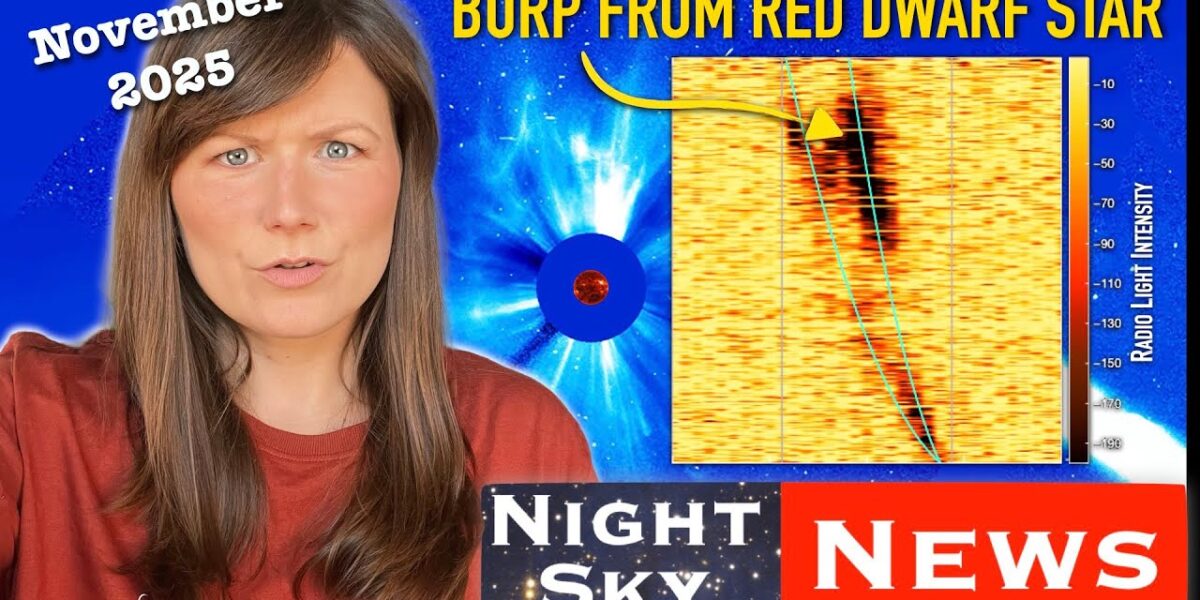
Distant Star Emits Powerful Radiation Burst, First of its Kind Detected
In a groundbreaking discovery for astrophysics, scientists have, for the first time, definitively detected a powerful burst of high-energy radiation emanating from a star other than our Sun. This phenomenon, known as a coronal mass ejection (CME), offers unprecedented insights into the violent processes occurring on distant stars and their potential impact on orbiting planets.
Understanding Coronal Mass Ejections
Our own Sun frequently experiences these energetic outbursts. A CME is essentially a massive expulsion of plasma and magnetic field from a star’s corona – its outermost atmosphere. This occurs when the star’s magnetic field lines become tangled, build up immense pressure, and then suddenly snap and reconnect. This explosive event flings vast quantities of charged particles, accelerated to incredible speeds, into space. While we readily observe CMEs from our Sun, with dedicated observatories capturing these spectacular events, detecting them on stars millions or billions of light-years away has been a significant challenge due to their faintness and the brief duration of the bursts.
A New Detection Method: Radio Telescopes and a Powerful Red Dwarf
Previous research had only hinted at the existence of CMEs on other stars, but conclusive evidence of material escaping into space remained elusive. The breakthrough came through the work of Callingham and collaborators, who utilized a highly sensitive radio telescope: the Low Frequency Array (LoAR). LoAR, composed of over 10,000 antennas spread across Europe, effectively functions as a telescope the size of the continent, making it capable of detecting faint, long-wavelength radio waves. These radio waves are generated by charged particles, specifically electrons, moving within a magnetic field – a signature characteristic of CMEs.
The team searched LoAR’s extensive sky survey data for stars exhibiting variability. They identified a brief, 2-minute radio burst originating from a red dwarf star designated STKM1-1262. This burst perfectly matched the expected signature of a CME. The data for this observation was collected in 2016, but its significance was only understood with advanced analysis and newer observational capabilities.
STKM1-1262: A Star of Extremes
STKM1-1262, observed using the X-ray space telescope XMM-Newton, is a star far different from our Sun. It is approximately half the Sun’s mass, rotates a staggering 20 times faster, and possesses a magnetic field 300 times more powerful. These extreme characteristics make it a prime candidate for frequent and intense CMEs.
The detected CME from STKM1-1262 was particularly noteworthy for the speed and density of the ejected plasma. The plasma was traveling at an astonishing 2,400 kilometers per second, a speed observed in only about one in every 2,000 CMEs from our Sun. This velocity is so high that it would be capable of stripping the atmosphere from any planets orbiting close enough to be within the star’s habitable zone.
Implications for Habitable Worlds and Exoplanet Research
This discovery has profound implications, especially considering that red dwarf stars are the most common type of star in our Milky Way galaxy, hosting roughly half of all known exoplanets. The intense radiation environment around many red dwarfs, demonstrated by this CME detection, raises questions about the potential for life on planets orbiting them.
For instance, the TRAPPIST-1 system, which hosts seven Earth-sized rocky planets, orbits a red dwarf. If a CME of this magnitude were to originate from TRAPPIST-1, it would likely have stripped the atmospheres from most of its planets. This aligns with recent findings from the James Webb Space Telescope (JWST), which has revealed little evidence of atmospheres on these TRAPPIST-1 planets, despite initial hopes.
The James Webb Space Telescope and Observation Proposals
In other astronomical news, the James Webb Space Telescope continues to be a focal point for scientific inquiry, with a record-breaking 2,900 observing proposals submitted for its fifth cycle of observations. This surge in proposals highlights the JWST’s immense capabilities and the scientific community’s eagerness to utilize its power. The selection process is highly competitive, with only about 8% of proposals expected to be granted observing time. The results of this latest round of proposals will be announced in March 2026.
Interstellar Comet 3I/Atlas and Galactic Cosmic Rays
Research on the interstellar comet 3I/Atlas, which is currently passing through our solar system, has also yielded fascinating results. Previous JWST observations revealed a significantly higher ratio of carbon dioxide (CO2) to water (H2O) than typically seen in comets originating from our solar system. This led to speculation about its formation environment.
The latest interpretation, proposed by Maggiolo and collaborators, suggests that this high CO2/H2O ratio could be explained by the comet’s prolonged exposure to galactic cosmic rays (GCRs) while in interstellar space. GCRs are high-energy particles accelerated by extreme cosmic events like supernovae. While our solar system is largely shielded from GCRs by the Sun’s magnetic field, an interstellar object would have been exposed for potentially millions or even billions of years.
Laboratory experiments and simulations indicate that GCRs can chemically alter carbon monoxide (CO) into carbon dioxide (CO2). The research suggests that the outer layers of 3I/Atlas, after billions of years of bombardment, would exhibit a high CO2/H2O ratio, while deeper, shielded layers would retain a higher CO/H2O ratio. This finding, while explaining the JWST observations, also presents a challenge: it implies that the surface layers of interstellar visitors may be significantly processed, limiting what we can learn about their original composition from telescopic observations alone. Studying the pristine interior would likely require a dedicated spacecraft mission, a challenging endeavor given the short time windows these comets spend in our vicinity.
Looking Ahead: The Vera C. Rubin Observatory
The imminent launch of the Vera C. Rubin Observatory offers hope for future interstellar object discoveries. With its ability to survey the entire sky every three nights, the Rubin Observatory is expected to detect around 70 interstellar comets annually. This increased detection rate could provide more opportunities to study these unique visitors, potentially offering advanced warning for future mission opportunities and shedding light on the prevalence of GCR processing in comets from other star systems.
As we continue to push the boundaries of astronomical observation, discoveries like the CME from a distant star and the detailed analysis of interstellar comets remind us of the dynamic and often violent nature of the cosmos, while also fueling our quest to understand our place within it.
Source: Deadly radiation burst from another star detected for the first time | Night Sky News November 2025 (YouTube)

Related Articles


Vera C. Rubin Observatory Begins Sky Survey
The Vera C. Rubin Observatory has officially begun its 10-year sky survey, promising to generate millions of astronomical alerts nightly. Meanwhile, new Webb images reveal Uranus in unprecedented detail, and the Artemis program faces timeline adjustments.


Milky Way’s Center: Black Hole or Dark Matter Mystery?
New research proposes that Sagittarius A*, the supermassive object at the Milky Way's center, might not be a black hole but a dense concentration of dark matter. Future observations of its photon ring could reveal the truth.


Cosmic Questions Answered: A Universe Today Deep Dive
Fraser Cain of Universe Today hosted a live Q&A session on March 1st, 2026, delving into exoplanets, orbital mechanics, and the search for extraterrestrial life. The event highlighted Universe Today's commitment to making space science accessible.