Cosmic Web Filament Spins: Largest Rotating Structure Found
Astronomers have discovered the largest known rotating structure in the universe, a colossal cosmic web filament spanning 50 million light-years. This discovery challenges current models of galaxy evolution and suggests the cosmic web plays a more significant role than previously thought.

Cosmic Web Filament Spins: Largest Rotating Structure Found
In a discovery that challenges our understanding of the universe’s large-scale structure, astronomers have identified the largest known rotating structure: a colossal cosmic web filament spanning an astonishing 50 million light-years. This gargantuan formation, detected through the analysis of hydrogen gas emissions, suggests that the cosmic web may exert a more profound influence on galaxy evolution than previously theorized.
Unveiling the Cosmic Web
The universe is not a uniform expanse; it’s a vast, intricate network known as the cosmic web, composed of massive filaments of gas and dark matter that connect galaxies. These filaments act as cosmic highways, channeling matter and influencing the formation and evolution of the structures within them. While the existence of these filaments has been established through galaxy surveys and cosmological simulations, a recent study has focused on the internal dynamics of one such filament.
Researchers, led by a team from Oxford University, utilized data from the South African MeerKAT radio telescope. This powerful instrument is capable of detecting the faint radio emissions from hydrogen gas, a key ingredient for future star formation. Their observations focused on a specific region of the cosmic web, revealing a long, thin structure approximately 5.5 million light-years in length, initially identified by 14 galaxies within it.
A Spinning Giant Emerges
What made this discovery particularly groundbreaking was the ability to trace the rotation of hydrogen gas within the galaxies of this filament. By analyzing the Doppler shift of the hydrogen emissions—where light is stretched or compressed by movement—the team could determine the direction of gas flow around the center of each galaxy. This allowed them to map the spin axis of these galaxies.
Simulations of the universe’s evolution generally predict that the spin axes of galaxies within filaments should be randomly oriented, unless influenced by external forces. However, the data from this filament showed a significant alignment. The average alignment of the spin axes for the 14 radio galaxies was found to be around 75 degrees, and for visually observed galaxies along the filament, it was approximately 64 degrees. This starkly contrasts with the predicted random alignment, which would average around 0.5 degrees.
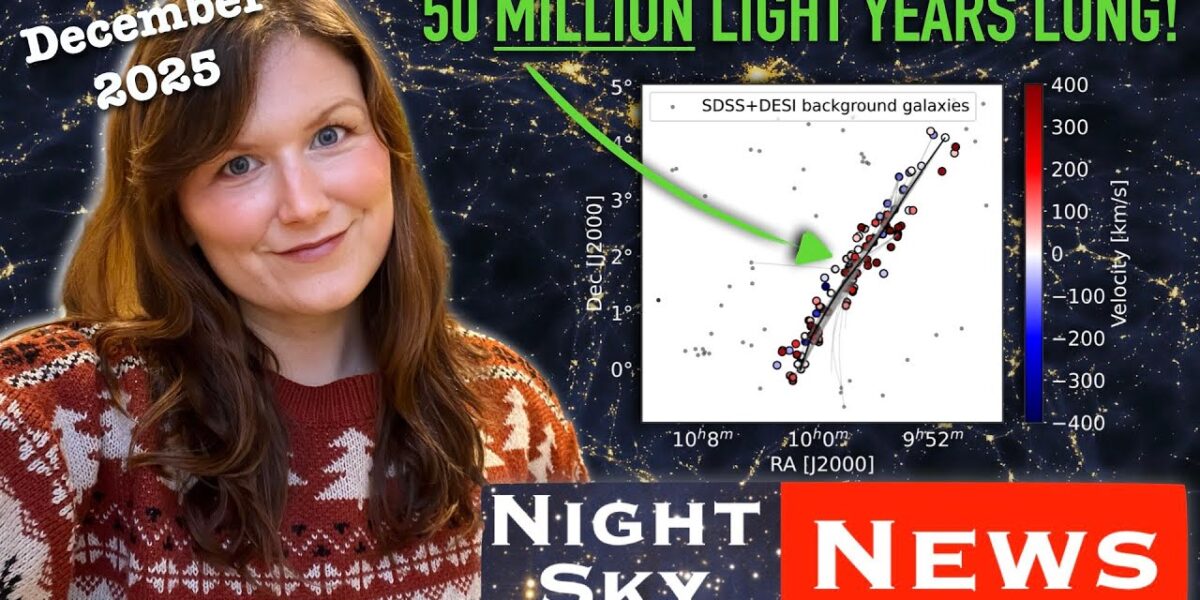
The research went a step further by analyzing the relative velocities of the galaxies within the filament. By plotting these velocities, the researchers observed evidence of a large-scale rotation of the entire filament structure. Through sophisticated modeling, they determined that this colossal filament is rotating at an impressive speed of approximately 110 kilometers per second. This rotation, combined with its immense length, makes it the largest known rotating structure in the universe, extending an incredible 50 million light-years.
Challenging Cosmological Models
This discovery presents a significant challenge to current models of galaxy formation and evolution. The prevailing theory suggests that while filaments channel gas, their influence on the spin of individual galaxies is limited, leading to random orientations. The observed preferential alignment and the colossal rotation of the filament imply that the cosmic web’s gravitational and dynamic forces may play a much more dominant role in shaping galaxies than previously understood.
The findings suggest that gas flowing along these filaments might preferentially align the spin of galaxies with the direction of the flow. Furthermore, the sheer scale and rotation of the filament itself could impart a spin to the galaxies embedded within it, influencing their development over billions of years. This could mean that the conditions for galaxy formation in the early universe were more structured and less random than anticipated.
Looking Ahead: Euclid and Rubin Observatory
The implications of this discovery are far-reaching, prompting new questions about the interplay between the cosmic web and galaxy evolution. Future research will undoubtedly focus on confirming and expanding upon these findings. Large-scale astronomical surveys, such as those conducted by the Euclid space telescope and the Vera C. Rubin Observatory, are poised to provide unprecedented data on the cosmic web.
Euclid, launched by the European Space Agency, is designed to map the distribution of galaxies and dark matter across vast cosmic distances, providing a detailed 3D map of the universe’s structure. The Rubin Observatory, with its powerful Legacy Survey of Space and Time (LSST), will survey the entire visible sky in unprecedented detail, allowing astronomers to study the evolution of galaxies and the cosmic web over cosmic time.
These future missions will be crucial in understanding whether this massive rotating filament is an anomaly or a common feature of the cosmic web. By studying more such structures, scientists hope to refine our cosmological models and gain a deeper appreciation for the intricate forces that have shaped the universe into the complex tapestry we observe today.
Historical Context and Future Impact
The concept of the cosmic web emerged from theoretical predictions and early observational hints in the late 20th century. However, it was the advent of large-scale galaxy redshift surveys, like the Sloan Digital Sky Survey, that truly revealed its filamentary and web-like structure in the early 2000s. The detection of interstellar objects like ‘Oumuamua in 2017 and 2I/Borisov in 2019 also highlighted the vastness and connectivity of our galaxy, underscoring the importance of studying objects that traverse these vast cosmic distances.
More recently, the James Webb Space Telescope (JWST) has pushed the boundaries of observation, detecting the most distant spiral galaxy and supernova ever seen. These discoveries allow us to glimpse the universe in its infancy, just 1.5 billion and 700 million years after the Big Bang, respectively. The distant spiral galaxy, with a redshift of about 4, shows that complex structures could form relatively early, while the distant supernova, with a redshift of 7.3, indicates that the fundamental processes of stellar death were similar even in the early universe, contributing to the creation of heavier elements necessary for planet formation.
The discovery of the rotating cosmic web filament adds another layer of complexity to our understanding. It suggests that the very fabric of the universe, the cosmic web, is not just a passive scaffold but an active participant in shaping the galaxies within it. This finding is vital for understanding how galaxies like our own Milky Way formed and evolved, and how the elements that make up planets and life were distributed throughout the cosmos.
As we continue to explore the universe with increasingly sophisticated instruments, we are constantly reminded of its vastness and the profound mysteries it holds. The discovery of this enormous, spinning cosmic structure is a testament to human curiosity and our relentless pursuit of knowledge, pushing the frontiers of astrophysics and inspiring future generations of scientists.
Source: The largest rotating structure ever found in the Universe | Night Sky News December 2025 (YouTube)

Related Articles


Vera C. Rubin Observatory Begins Sky Survey
The Vera C. Rubin Observatory has officially begun its 10-year sky survey, promising to generate millions of astronomical alerts nightly. Meanwhile, new Webb images reveal Uranus in unprecedented detail, and the Artemis program faces timeline adjustments.


JWST Unveils Distant Galaxy’s Surprising Maturity
The James Webb Space Telescope has detected an ancient galaxy, JADES-GS-z13-0, existing just 320 million years after the Big Bang. Its surprising maturity challenges current theories about the rapid formation of early galaxies.


Earth’s Planetary Status Questioned, Figure-8 Orbits Debunked
Exploring Earth's planetary status, the impossibility of figure-8 orbits, the ongoing debate about dark matter's composition, and the future of human spaceflight.