Beyond the Bench: Supreme Court’s Tariff Decision Ignites Trump’s Anger, Fueling Concerns Over Media Control and Democratic Integrity
A recent Supreme Court decision challenging the legality of tariffs imposed by the Trump administration has reportedly drawn sharp condemnation from the former president, sparking a broader discussion on the limits of executive power. This judicial scrutiny unfolds against a backdrop of increasing concerns over media ownership concentration and the Federal Communications Commission's role under the Trump administration, with critics arguing the landscape became heavily skewed against independent and diverse programming.

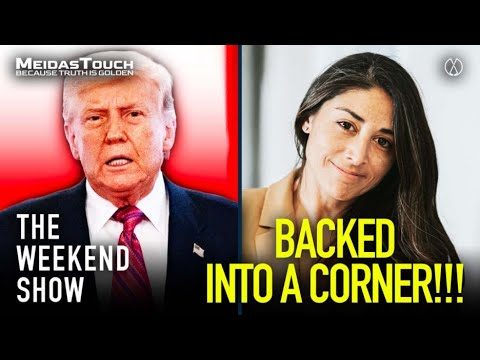
Beyond the Bench: Supreme Court’s Tariff Decision Ignites Trump’s Anger, Fueling Concerns Over Media Control and Democratic Integrity
In a recent episode of The Weekend Show, discussions between Courier News founder Tara McGowan and host Anthony Davis peeled back layers of controversy surrounding former President Donald Trump’s administration, focusing on a pivotal Supreme Court decision regarding his tariff policies and the broader implications for media independence. The conversation highlighted not only Trump’s characteristic ‘lashing out’ in response to judicial checks on his power but also raised significant alarms about the Federal Communications Commission (FCC) and media ownership landscape under his tenure, asserting a profound skew against programming not aligned with a far-right agenda.
The intersection of judicial oversight, executive authority, and the integrity of the information ecosystem presents a critical lens through which to examine the challenges facing democratic institutions. As the nation grapples with the legacies of the Trump presidency, the discussions underscore a persistent tension between presidential prerogative, constitutional boundaries, and the foundational role of a free and diverse press in an informed society.
The Tariff Tempest and Presidential Power: A Clash with the Judiciary
Central to the discussion on The Weekend Show was a Supreme Court decision concerning tariffs imposed by the Trump administration, described by the hosts as ‘illegal tariffs.’ While the specific ruling was not detailed in the provided context, the premise points to a significant legal challenge to Trump’s assertive trade policies and the extent of presidential authority in implementing them. During his presidency, Donald Trump frequently employed tariffs as a key instrument of his ‘America First’ economic strategy, aiming to protect domestic industries and leverage trade negotiations.
His administration notably imposed tariffs on steel and aluminum imports under Section 232 of the Trade Expansion Act of 1962, citing national security concerns. Additionally, a wide array of tariffs was levied on goods from China, initiating a protracted trade war with the world’s second-largest economy. These actions, while lauded by some as necessary to rebalance trade relationships and safeguard American jobs, faced considerable opposition from various sectors, including businesses that relied on imported goods, economists warning of retaliatory measures, and legal scholars questioning the scope and application of presidential power.
Legal Challenges and the Supreme Court’s Role
The legality of Trump’s tariffs was frequently challenged in lower courts, with arguments often centering on whether the administration had overstepped its statutory authority or misused national security justifications. Critics contended that the broad application of Section 232, initially designed for genuine national defense, was being stretched to cover economic protectionism, thus bypassing congressional authority over trade policy. A Supreme Court decision, particularly one that would deem certain tariffs ‘illegal,’ represents a profound check on executive power, signaling that even in areas traditionally afforded presidential discretion, judicial review can and will apply.
Such a ruling would not only invalidate specific tariff measures but could also set crucial precedents regarding the separation of powers and the constitutional limits of a president’s ability to unilaterally impose trade restrictions. It underscores the judiciary’s role as a vital arbiter, ensuring that executive actions, even those framed as matters of national security or economic necessity, remain within the bounds of the law and the Constitution. For an administration that often pushed the boundaries of executive action, a Supreme Court rebuke on such a visible policy front would be a significant blow.
Trump’s Characteristic Response: ‘Lashing Out’
The transcript indicates that Trump ‘lashes out’ in response to this SCOTUS decision. This reaction is entirely consistent with his historical approach to institutions and rulings that challenge his authority or policies. Throughout his presidency, Trump frequently expressed disdain for judicial decisions that went against his administration, often criticizing judges by name, questioning their legitimacy, and accusing them of political bias. This rhetoric extended to other governmental bodies, media organizations, and even members of his own party who disagreed with him.
His ‘lashing out’ can be understood as a tactic to delegitimize unfavorable rulings, rally his base, and maintain a narrative of being unfairly targeted by what he often termed the ‘deep state’ or partisan actors. For a president who prided himself on his deal-making prowess and executive strength, a Supreme Court decision limiting his ability to wield economic leverage through tariffs would be perceived as a direct affront to his policy agenda and personal authority. Such a reaction, while predictable, also carries broader implications for public trust in institutions, potentially eroding confidence in the impartiality of the judiciary and fostering a climate of political polarization.
Broader Implications for Presidential Power and Trade Policy
A Supreme Court ruling curtailing presidential tariff authority would have far-reaching consequences beyond the immediate economic impact. It would likely prompt future administrations to be more circumspect in their use of broad statutory powers like Section 232, potentially requiring greater collaboration with Congress on trade matters. This could strengthen the legislative branch’s role in trade policy, aligning more closely with constitutional principles of checks and balances.
Moreover, such a decision could influence international trade relations. Clarity on the legal limits of a U.S. president’s ability to impose tariffs might offer greater predictability for global markets and trading partners, potentially reducing the volatility associated with unilateral trade actions. For a nation whose economic stability is deeply intertwined with global commerce, the balance between executive flexibility and legal constraints in trade policy remains a delicate and crucial consideration.
Media Under Siege: Ownership, Regulation, and Bias Under Trump
Beyond the courtroom drama, The Weekend Show discussion pivoted to another critical area of concern: the state of media ownership and regulation under the Trump administration. Tara McGowan, founder of Courier News, a progressive news organization focused on local journalism, brought a unique perspective to this discussion, highlighting how the media landscape became ‘incredibly skewed against programming that doesn’t support this far-right regime.’
This claim speaks to a broader unease among media watchdogs and advocates for diverse, independent journalism regarding the concentration of media ownership and the regulatory environment shaped by the Federal Communications Commission (FCC) during Trump’s presidency.
The Shifting Media Landscape: Consolidation and Partisan Divides
The American media landscape has been undergoing significant transformation for decades, marked by increasing consolidation. Large corporations have acquired numerous media outlets, leading to fewer independent voices and a potential homogenization of news content. This trend has been exacerbated by the economic challenges facing traditional journalism, particularly local newspapers, which have seen massive declines in revenue and widespread closures. The vacuum left by local news has often been filled by national partisan outlets or by content generated by larger media conglomerates, often with specific political leanings.
During the Trump era, this issue became particularly acute. The president frequently labeled mainstream news organizations as ‘fake news’ and ‘enemies of the people,’ while simultaneously promoting and engaging with media outlets that were largely supportive of his administration. This created a deeply polarized media environment where trust in traditional journalism plummeted for a significant portion of the population, and partisan news consumption became more entrenched. The concern raised on The Weekend Show suggests that this polarization was not just a natural market phenomenon but was actively influenced by regulatory policy.
The FCC’s Role and Trump-Era Policies
The Federal Communications Commission (FCC) is an independent agency of the United States government that regulates interstate and international communications by radio, television, wire, satellite, and cable. Its mandate includes ensuring a diverse and competitive media landscape, promoting the public interest, and preventing undue concentration of media ownership. Under the Trump administration, the FCC, led by Chairman Ajit Pai, pursued a deregulatory agenda that critics argued favored large media corporations and reduced safeguards for media diversity.
One of the most controversial decisions was the repeal of net neutrality rules in 2017. While not directly related to broadcast ownership, net neutrality’s repeal raised concerns about internet service providers (ISPs) potentially throttling or blocking content, which could disproportionately affect smaller, independent, or non-mainstream news sources. More directly relevant to media ownership were changes to broadcast ownership rules. The FCC moved to relax restrictions on cross-ownership of newspapers and broadcast stations in the same market and to lift limits on the number of local TV stations a single company could own in a market. These changes paved the way for greater consolidation.
A prime example of the concerns raised was the proposed merger between Sinclair Broadcast Group and Tribune Media. Sinclair, known for its conservative-leaning local news segments that all its stations were required to air, sought to acquire Tribune’s stations, which would have given it an unprecedented reach into American homes. Critics, including public interest groups and some members of Congress, argued that this merger would severely limit local news diversity and push a singular political narrative across hundreds of local markets. Although the merger ultimately failed due to regulatory hurdles and a strong public backlash, the FCC’s initial posture was seen as highly favorable to such consolidation, reinforcing the perception that the regulatory body was tilting the scales.
Skewed Programming and the ‘Far-Right Regime’ Claim
McGowan’s assertion that the media landscape became ‘incredibly skewed against programming that doesn’t support this far-right regime’ reflects the anxieties of those who believe that deregulation and consolidation enabled a more partisan and less diverse media environment. The argument is that by allowing fewer, larger entities to control more media outlets, and by reducing the regulatory pressure to serve a broad public interest, the door was opened for a more ideologically uniform form of media to proliferate, particularly one that aligns with conservative or far-right viewpoints.
This skew is not necessarily about overt censorship but rather about the cumulative effect of ownership structures, editorial priorities, and the amplification of certain narratives over others. When a handful of powerful media companies, some with explicit political agendas, control a vast array of local and national outlets, the range of perspectives available to the public can narrow considerably. This has profound implications for democratic discourse, as an informed citizenry relies on access to a wide spectrum of credible information to make decisions and hold leaders accountable.
Intersecting Crises: Democracy, Information, and Accountability
The discussions on The Weekend Show, encompassing both the Supreme Court’s challenge to presidential tariffs and the concerns over media control, paint a picture of a democracy facing multifaceted pressures. These two issues—judicial independence as a check on executive power and a diverse media as a pillar of an informed citizenry—are fundamentally intertwined in the health of a democratic system.
A president who ‘lashes out’ at judicial rulings, questioning their legitimacy, risks undermining the rule of law and the separation of powers. This rhetoric can erode public trust in the institutions designed to safeguard constitutional governance. Similarly, an information ecosystem that is perceived as ‘skewed’ or overly consolidated can undermine the public’s ability to discern truth from falsehood, to engage in critical thinking, and to hold elected officials accountable. When citizens are exposed primarily to ideologically aligned information, it can deepen societal divisions and make consensus-building increasingly difficult.
Tara McGowan’s work with Courier News highlights an effort to counter these trends by investing in local, fact-based journalism, often with a progressive perspective, to ensure that diverse voices and perspectives are not drowned out by consolidated media giants. This grassroots approach reflects a broader recognition that maintaining a healthy democracy requires not only robust legal and constitutional checks but also a vibrant, independent, and accessible press.
The challenges discussed on The Weekend Show are not confined to a single administration or a particular political moment. They represent ongoing tensions inherent in any democracy: how to balance executive efficiency with constitutional limits, how to foster a free market for ideas while ensuring media diversity, and how to protect the public’s right to know in an age of information overload and partisan division. The conversation serves as a potent reminder that eternal vigilance is required to safeguard the principles of accountability, transparency, and an informed public square.
Conclusion
The Weekend Show’s exploration of a Supreme Court ruling on Trump’s tariffs and the state of media under his administration underscores critical vulnerabilities within the American democratic framework. The former president’s reported fury over judicial checks on his ‘illegal tariffs’ highlights the enduring struggle between executive ambition and constitutional boundaries. Simultaneously, the concerns articulated by Tara McGowan regarding media ownership and the FCC’s role during the Trump years spotlight how the information environment can be manipulated, potentially limiting diverse perspectives and fostering partisan division.
These discussions are vital for understanding the complex interplay between judicial independence, executive power, and the health of the press. They serve as a powerful call to action for citizens, policymakers, and journalists alike to champion robust checks and balances, advocate for media diversity, and uphold the integrity of information as foundational pillars of a resilient democracy.
Source: LIVE: Trump LASHES OUT as Supreme Court RUINS his Presidency | The Weekend Show (YouTube)

Related Articles
Trump Open to Iran Talks After Attacks, Shifts on Regime Change
President Trump has agreed to negotiate with Iran's new leadership following recent U.S. and Israeli attacks, signaling a potential shift from his regime change objective. The move has drawn scrutiny from former officials who question the strategic coherence of U.S. policy.
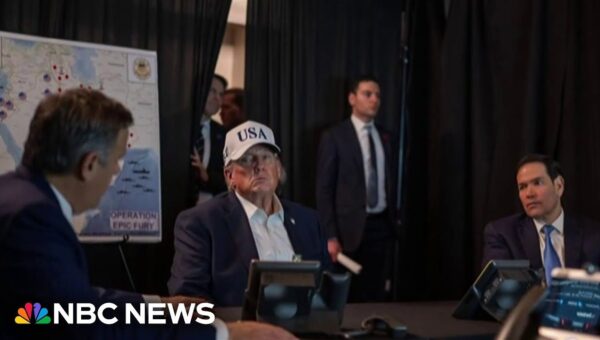
Trump: Iran Strikes Ahead of Schedule, Expects ‘Great Deal for World’
Three U.S. service members have been killed amid escalating conflict with Iran, President Trump confirmed. He stated that strikes are ahead of schedule, with senior Iranian leaders killed, and expressed optimism for a "great deal for the world" despite ongoing talks with Iranian officials.
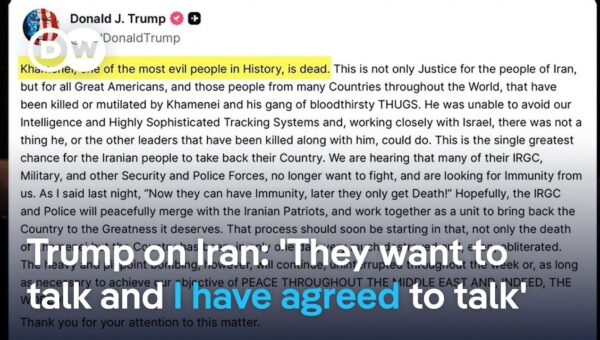
Trump Agrees to Talks with Iran After Major Strikes
President Donald Trump has agreed to talks with Iran's leadership following coordinated strikes that reportedly killed key figures, including the Supreme Leader. While Trump claims significant military successes, U.S. strategy remains unclear, and public opinion shows limited support for the actions amid rising American casualties.