Giant Gamma-Ray Bubbles Discovered Above and Below Milky Way
Two enormous gamma-ray bubbles, stretching 50,000 light-years, have been discovered above and below the Milky Way. Their distinct high-energy emissions and sharp edges suggest a powerful, sudden event in our galaxy's past, possibly linked to its central supermassive black hole.


Cosmic Giants Revealed: Gamma-Ray Bubbles Erupt from Milky Way
Our Milky Way galaxy is not just a flat disk of stars and gas. It also hosts two enormous, invisible bubbles that shoot out the universe’s most energetic light. These are the Fermi Bubbles, and their discovery has changed how we see our galactic home.
Unveiling the Invisible
Imagine trying to see a faint glow in a brightly lit room. That’s similar to how scientists first detected the Fermi Bubbles. They are hidden by the overwhelming light and gas within our own galaxy. It wasn’t until astronomers carefully masked out the familiar glow of our galaxy’s stars and dust that the distinct signal from these bubbles appeared.
The light coming from the Fermi Bubbles is special. It’s gamma-ray light, the most powerful form of light in the universe. This light has a different energy signature compared to the light from our galaxy’s disk. The bubbles emit gamma rays at much higher energies than we typically see from the Milky Way’s plane.
How Gamma Rays Are Born
Creating such high-energy gamma rays requires extreme conditions. Scientists believe it involves incredibly fast electrons, moving at speeds close to the speed of light. When these super-fast electrons collide with low-energy photons – like infrared or radio waves – something amazing happens. The electron loses some of its speed, but the photon gains a massive amount of energy, transforming into a gamma ray. This process is called inverse Compton scattering.
This is why the emission from the Fermi Bubbles is so different from the emission we see from the gas and dust in our galaxy. It tells a story of powerful events happening far above and below the galactic disk.
Sharp Edges, Sudden Bursts
Another clue to the bubbles’ origin comes from their edges. Unlike the gentle fading of gas clouds, the Fermi Bubbles have very clear, sharp boundaries. This suggests they weren’t formed slowly over a long time. Instead, their sharp edges point to a sudden, powerful release of energy in the past.
A Sky-Filling Phenomenon
The sheer size of these bubbles is astonishing. If you look at an image of the entire night sky, the Fermi Bubbles would cover about 10% of it. They stretch an incredible 50,000 light-years from top to bottom. To put that in perspective, that’s half the width of our entire Milky Way galaxy, which itself is about 100,000 light-years across and contains around 100 billion stars.
What Could Cause Such Giant Bubbles?
Given their immense size, high-energy gamma-ray emissions, and sharp edges, scientists have proposed several ideas for what created the Fermi Bubbles.
The Supermassive Black Hole Theory
One leading theory points to the supermassive black hole at the center of our Milky Way, called Sagittarius A*. This black hole is millions of times more massive than our sun. When this black hole actively feeds on gas and stars, it can unleash powerful jets of particles and energy. These jets could have erupted upwards and downwards, inflating the enormous bubbles we see today.
Imagine a giant cosmic fountain. If the black hole at the center of our galaxy is like the nozzle, spewing out material at incredible speeds, it could create these vast structures over time. This outflow would have propelled the electrons needed for inverse Compton scattering, producing the observed gamma rays.
Past Starburst Activity
Another possibility is a period of intense star formation in the Milky Way’s past. At the center of galaxies, sometimes a huge number of stars can form in a relatively short period. This is called a starburst. When massive stars in such a burst die, they explode as supernovae. These explosions can create shockwaves that push gas outwards, potentially forming bubbles.
Think of it like a massive fireworks display at the galaxy’s core. The combined force of many stellar explosions could push gas and energy outwards, creating the Fermi Bubbles. This scenario also provides the necessary ingredients – energetic particles and a source of photons – for gamma-ray production.
Looking Ahead
The discovery of the Fermi Bubbles, made possible by NASA’s Fermi Gamma-ray Space Telescope launched in 2008, continues to be a subject of intense study. By analyzing the precise energy and distribution of the gamma rays, astronomers hope to pinpoint the exact mechanism that created these colossal structures.
Understanding the Fermi Bubbles helps us learn more about the dynamics of our own galaxy and how supermassive black holes and star formation influence their surroundings. It’s a reminder that even in our familiar cosmic neighborhood, there are still vast mysteries waiting to be uncovered, pushing the boundaries of our knowledge about the universe.
Source: How did we discover the Milky Way's Fermi Bubbles? #shorts (YouTube)

Related Articles


New Clues Emerge in 15-Year Mystery of Galactic Gamma-Ray Bubbles
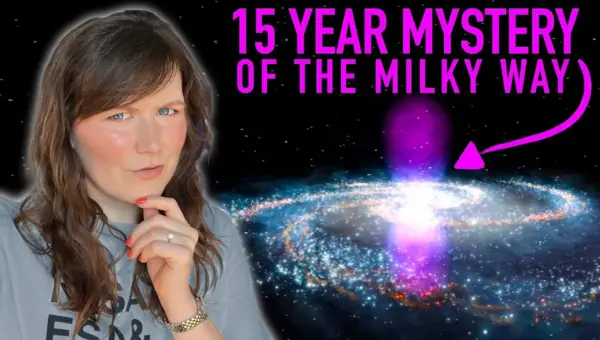
For 15 years, scientists have puzzled over the origin of the Milky Way's massive gamma-ray emitting Fermi Bubbles. While a supermassive black hole eruption was the leading theory, new research has complicated this explanation, reopening the investigation into these energetic galactic structures.

New Research Challenges Fermi Bubble Origins
Scientists have long debated the origin of the giant gamma-ray-emitting Fermi bubbles above and below the Milky Way. While a supermassive black hole was the leading suspect, new simulations suggest supernovae activity alone might be responsible, reopening the mystery.
Our Sun Might Be a Cosmic Anomaly
New research suggests our Sun, long considered a typical star, might be more unusual than previously thought. This finding impacts our understanding of life's prevalence in the universe and the search for habitable exoplanets.