Antimatter Meteor Threat: Could Space Rocks Annihilate Earth?
Could rare meteors made of antimatter pose an existential threat to Earth? While theoretically possible, the harsh conditions of space make it highly unlikely for such objects to survive long enough to reach our planet. Antimatter's annihilation with regular matter releases immense energy, but its rarity and the vastness of space offer us protection.

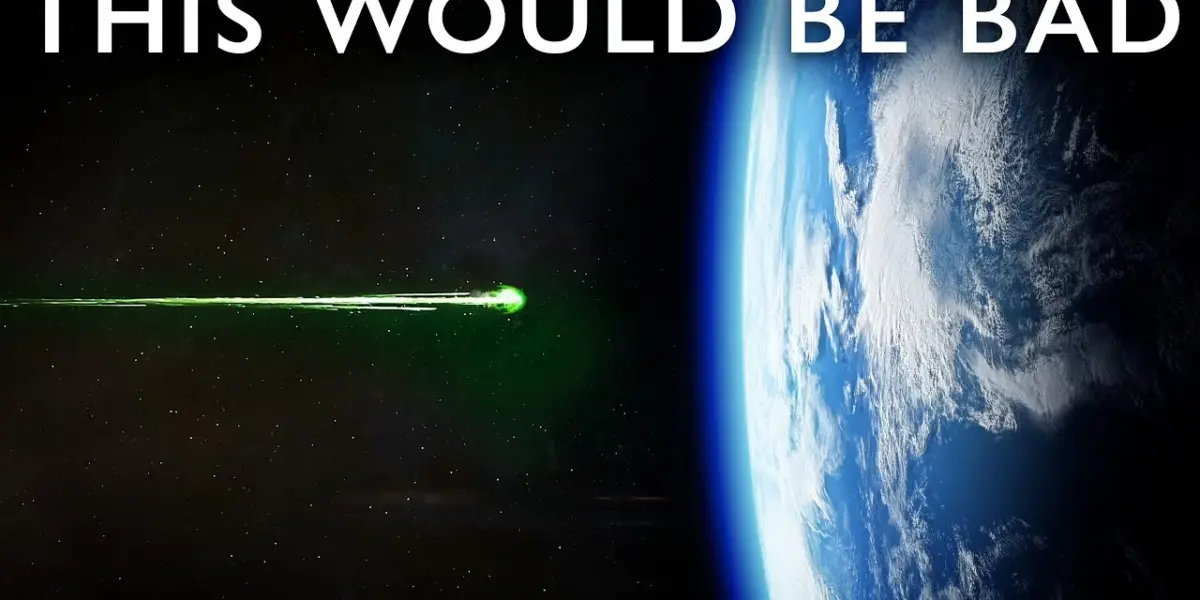
Antimatter Meteor Threat: Could Space Rocks Annihilate Earth?
Meteors can dramatically change our planet, wiping out life with a single impact. However, not all space rocks are so destructive. We are bombarded daily by over 100 tons of tiny, sand-sized particles that go unnoticed. About once a year, a car-sized meteor enters our atmosphere, but it burns up completely before reaching the ground, leaving a spectacular fiery streak.
It takes millions of years for Earth to face a threat from a kilometer-wide meteor, large enough to cause serious damage. Fortunately, we haven’t encountered such a massive impact since the time of the dinosaurs. But size isn’t the only factor determining a meteor’s destructive potential. Some theories suggest that the most catastrophic impacts might come from objects made of something far more unusual than rock.
Exotic Space Rocks: The Antimatter Threat
In the vacuum of space, these rare meteors would look identical to ordinary space rocks. However, their encounter with Earth would be vastly different. While regular meteors create a fiery show, an antimatter meteor would unleash energy exceeding that of the largest nuclear bombs. A kilometer-sized antimatter meteor, comparable to the one that ended the dinosaur era, could potentially destroy our planet entirely.
This raises a crucial question: could antimatter meteors actually exist? What clues might help us distinguish them from normal meteors? And how large would they need to be to pose a significant threat? This exploration delves into the scientific theory behind antimatter meteors and assesses the likelihood of such objects lurking in our solar system.
Understanding Antimatter
Antimatter is a peculiar substance, and its very existence is a scientific marvel. It closely resembles regular matter but possesses a key difference: an inverted electrical charge. When antimatter and matter meet, they annihilate each other completely, converting almost all their mass into pure energy.
In the early universe, both matter and antimatter were created in seemingly equal amounts. Scientists theorize that all this matter and antimatter should have collided, resulting in a universe with nothing left. The fact that we exist is thanks to a slight imbalance. A tiny surplus of matter, perhaps just one extra particle of matter for every billion pairs, allowed the universe as we know it to form.
This imbalance remains one of science’s great unsolved mysteries. The reason for this slight excess of matter is still being investigated. Whatever caused it, this difference is why our universe is overwhelmingly composed of matter. We primarily observe antimatter in tiny quantities produced in experiments at facilities like CERN and in medical applications, such as PET scans.
Could Antimatter Pockets Exist?
Just because we don’t commonly see antimatter doesn’t mean it couldn’t exist in isolated pockets. As the early universe cooled and particles began to form, local fluctuations could have led to regions dominated by antimatter. Imagine flipping a coin many times; you’re bound to get streaks of heads or tails.
If these clumps of antimatter were large enough, they might not have annihilated themselves. Instead, they could have formed entire regions of the universe, with pockets of matter eventually disappearing. This could have resulted in stars and planetary systems made entirely of antimatter.
Searching for Anti-Stars
While highly theoretical, the possibility of antimatter solar systems is intriguing. If such systems exist, they would be visually similar to our own. An anti-star would follow the same laws of gravity and appear much like a regular star. The main clue to its antimatter nature would be the gamma radiation emitted when regular matter, like interstellar winds, interacts with its edges.
Interestingly, astronomers have observed some star systems that exhibit this behavior. In 2021, NASA’s Fermi Large Area Telescope identified 14 candidate anti-star systems in the Milky Way. These candidates match the expected profiles for anti-stars, and other gamma-ray emitters like pulsars or black holes have been ruled out. If these are indeed anti-stars, then antimatter systems, complete with planets and asteroids, might exist. The estimated ratio suggests about one anti-star for every 400,000 stars.
The Journey to Earth: An Antimatter Meteor
If antimatter solar systems and their associated objects are possible, then antimatter meteors could also exist. The question then becomes: what are the chances of them reaching Earth?
The idea of antimatter meteors impacting our planet isn’t new. Physicists have speculated about their existence since the discovery of antimatter as a concept. It’s possible our solar system could have passed through an antimatter system in the past. The Sun’s gravity might have then nudged some stray antimatter meteors into orbits that could eventually lead them towards us.
Antimatter meteors likely wouldn’t form within our own solar system, as any stray antimatter particles would have quickly annihilated with the abundant matter. However, in the vast, relatively empty vacuum of space, they could potentially survive.
Atmospheric Encounter: A Devastating Collision
An antimatter meteor faces a significant challenge upon entering Earth’s atmosphere. Similar to regular meteors, the intense friction caused by atmospheric entry can cause them to burn up. However, for antimatter, the situation is far more extreme.
Every particle of atmosphere the antimatter meteor encounters would annihilate with a portion of the meteor. This process converts mass directly into energy, following Einstein’s famous equation, E=mc². The energy released would be immense, as both the atmospheric particle and the meteor particle annihilate.
Calculating the Catastrophe
To estimate the destructive power, we consider the amount of atmosphere between space and the Earth’s surface. Over 90% of the atmosphere’s mass is concentrated within the lower 16 kilometers due to gravity. By calculating the mass of air in a direct path from space to the ground, we can determine the minimum size of an antimatter meteor needed to survive.
One calculation suggests that a meteor roughly 3 meters cubed, weighing about 91,800 kilograms, would annihilate most of its mass in the atmosphere. However, approximately 600 kilograms of this antimatter meteor could still reach the surface. This remaining mass is comparable to a large grand piano.
The energy released from 600 kilograms of antimatter annihilating upon impact is staggering. It would generate about 5.4 x 10^19 Joules of energy, and double that when the Earth’s surface also annihilates, totaling 108 quintillion Joules. For comparison, a 1-megaton nuclear bomb releases about 4.18 x 10^15 Joules. Even the Tsar Bomba, the largest nuclear weapon ever detonated at 50 megatons, released only 2.09 x 10^17 Joules – over five thousand times less energy than our hypothetical antimatter grand piano.
The impact of such an antimatter meteor could devastate an entire state like Texas, vaporizing the center and devastating the surrounding region. This calculation doesn’t even include the kinetic energy of the impact. Furthermore, the energy released from the annihilation in the atmosphere itself would expand the destruction zone significantly, potentially affecting an entire country.
The Likelihood of Survival
Despite the catastrophic potential, the chances of an antimatter meteor reaching Earth are extremely low. Space, while considered a vacuum, is not entirely empty; it contains trace amounts of dust.
An antimatter object traveling through interstellar space would likely encounter enough dust to annihilate itself within about 300 years. Given that our solar system last passed another star, Scholz’s star, 70,000 years ago, any antimatter meteor would need incredible luck to survive the journey without disintegrating into gamma radiation.
Similarly, an interstellar antimatter comet would face the same fate. Smaller ones would burn up, while larger masses would emit detectable gamma rays long before reaching us. No such objects have ever been observed. Therefore, while a devastating event, an antimatter meteor surviving long enough to hit our planet is highly improbable, assuming antimatter stars and systems even exist.
The Tunguska Event: A Lingering Mystery?
Could there be historical evidence? In 1908, a massive explosion occurred over Siberia, known as the Tunguska Event. A fireball lit up the sky, and the resulting blast flattened trees over a wide area, causing fires and shockwaves felt hundreds of kilometers away. Witnesses reported a flash brighter than the sun.
Scientific expeditions to the remote site found immense destruction but very little evidence of the object that caused it, beyond microscopic particles. While the Tunguska Event is widely believed to have been caused by a conventional meteor or comet fragment exploding in the atmosphere, the lack of a significant crater and impactor has fueled speculation for decades. However, scientists generally agree it was not an antimatter meteor, but the event serves as a reminder of the dramatic power of cosmic impacts.
While the threat of an antimatter meteor strike is fascinating, the current scientific understanding suggests that Earth is likely safe from such an event. The universe’s composition and the harshness of interstellar space make the survival of antimatter objects incredibly unlikely. We can continue to gaze at the stars with wonder, knowing that our cosmic neighborhood, while full of surprises, is probably not hiding an imminent antimatter apocalypse.
Source: What If an Antimatter Meteor Hit the Earth? (YouTube)

Related Articles

NASA Pivots: Mars Nuclear Probe, Moon Base Ahead
NASA is pivoting its exploration strategy, prioritizing a nuclear-powered Mars probe and accelerating plans for a moon base. The International Space Station's future is uncertain, with a shift towards commercial platforms. Meanwhile, new telescope data reveals overmassive black holes in dwarf galaxies and captures stunning images of Saturn and the Crab Nebula.


US Military Pursues Secret Tech, Lunar Base Plans Emerge
Reports indicate the US military and defense contractors are exploring advanced technologies, possibly reverse-engineering unknown craft. Concurrently, NASA plans a lunar base, while millions of UAP-related files are allegedly deleted, raising transparency concerns. These developments could reshape global power dynamics.


Dark Matter Defies Gravity, Forming Fuzzy Clouds Instead of Stars
Dark matter, which outweighs all visible matter, surprisingly does not collapse under gravity to form stars or black holes. Instead, it forms vast, diffuse clouds around galaxies, baffling scientists with its unique behavior. Understanding this cosmic enigma is key to comprehending the universe's structure and evolution.