Windrose E700: A Serious Electric Truck Contender
The Windrose E700 electric truck emerges as a strong contender in the heavy-duty segment, boasting an impressive 670 km range, LFP battery technology for longevity, and a driver-focused interior. With a target price of around $250,000, it aims to disrupt the market.

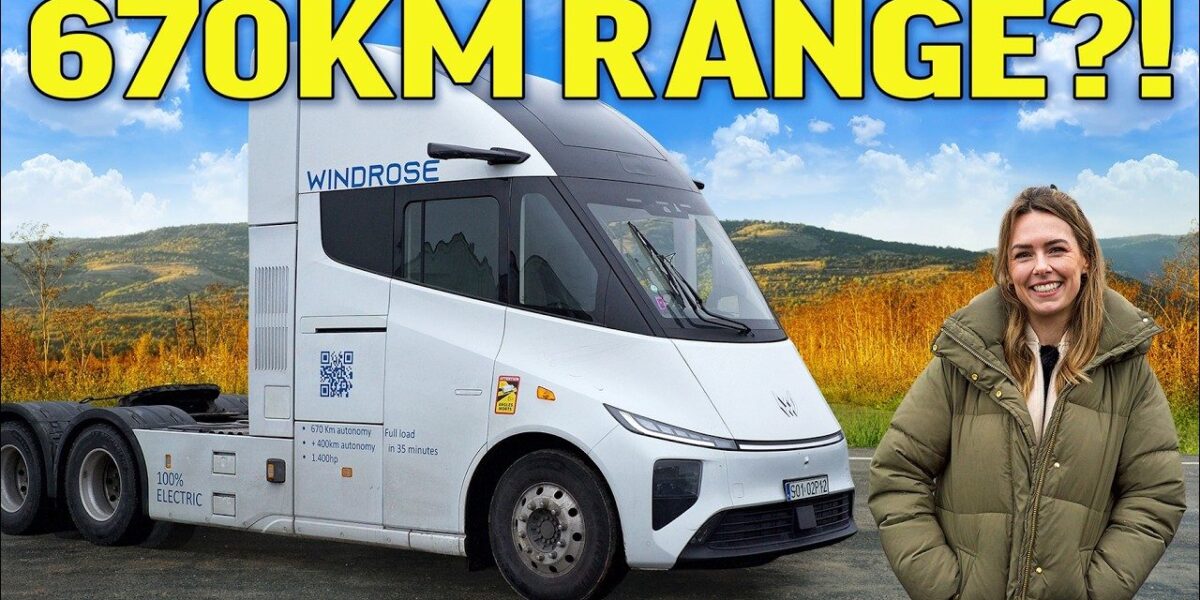
Windrose E700: A Serious Electric Truck Contender
Antwerp, Belgium – The automotive world is buzzing with the arrival of the Windrose E700, a heavy-duty electric truck that is making waves for its ambitious design, impressive specifications, and a strategic approach to market penetration. While its aerodynamic silhouette might draw comparisons to the Tesla Semi, the E700 distinguishes itself with a focus on long-haul practicality, advanced technology, and a compelling value proposition that aims to redefine the future of freight and logistics.
Long-Haul Ready with Impressive Range and Capacity
Designed from the ground up for demanding long-haul operations, the Windrose E700 is engineered to tackle big distances with substantial loads. Windrose claims a remarkable range of up to 670 km (approximately 460 miles) when fully loaded, with a cargo capacity of around 25 tons. This electric HGV is built to seamlessly integrate into existing logistics operations, rather than forcing a complete overhaul of current business models. The company emphasizes a no-compromise approach, aiming to provide a meaningful alternative to diesel-powered trucks.
Beneath the Surface: LFP Batteries and Powerful Drivetrain
Powering the E700 is a massive battery pack exceeding 700 kWh. Notably, Windrose has opted for Lithium Iron Phosphate (LFP) battery technology, a choice that might surprise some given NMC’s higher energy density. However, LFP offers superior cycle life, a critical factor for the total cost of ownership in commercial vehicles. These batteries are warrantied for an impressive 1 million km and are projected to last up to 2.5 million km, a staggering figure that underscores the durability and long-term economic viability of the E700.
The E700 boasts an electric motor at each of its four wheels, delivering a peak power output of 1,000 kW (approximately 1,340 horsepower) and a continuous power rating of 680 kW. This output surpasses that of many diesel equivalents. The truck features a 6×4 dual-axle configuration, enhancing traction control and providing excellent grip, especially in challenging conditions like icy weather. Windrose claims a startability of 25%, meaning the E700 can pull away fully loaded from a standstill on a 25% gradient, showcasing its robust capability in worst-case scenarios.
Aerodynamics and Efficiency
A key to the E700’s efficiency is its highly aerodynamic design. The striking front end, which contributes to its visual similarity with other electric trucks, has been meticulously optimized to reduce drag. While a typical HGV has a drag coefficient of around 0.6, the Windrose E700 achieves an impressive 0.2755. This focus on aerodynamics is crucial for maximizing range and minimizing energy consumption, especially for large, heavy vehicles.
A Driver-Centric and Technologically Advanced Interior
Addressing the global shortage of HGV drivers, Windrose has invested heavily in creating a comfortable and technologically advanced interior. The cabin features a central driving position, which not only aids in the overall aerodynamic design but also makes the large vehicle feel more manageable and akin to a standard electric car. This design choice, coupled with the availability of physical buttons alongside large touchscreen displays for climate control, navigation, and communication, creates an elegant and user-friendly environment.
The E700 also offers a sleeper cab, a crucial feature for long-haul drivers, without compromising the aerodynamic profile. The spacious interior boasts ample headroom, and driver comfort is prioritized with features like massage, heated, and cooled seats. This emphasis on driver well-being is a significant differentiator, potentially attracting new talent to the profession.
Future-Proofing and Connectivity
The E700 is a software-defined vehicle, designed for continuous improvement through over-the-air (OTA) updates. This allows the truck to become more efficient and adaptable over time. Furthermore, its open data integration with fleet management platforms like Geotab and Samsara minimizes friction for fleet operators, allowing them to integrate their preferred systems without being locked into proprietary software. This focus on ease of integration is vital for accelerating adoption.
The truck is equipped with a completely drive-by-wire system for steering, braking, and throttle, eliminating mechanical connections. This electronic control architecture positions the E700 as a robust platform for future autonomous driving technologies. Windrose envisions its trucks serving as the physical AI platform for companies developing autonomous solutions.
Charging Infrastructure and Speed
Charging the E700 is designed to be efficient and align with mandatory driver breaks. It features standard CCS ports, often on both sides for convenience. Thanks to its 800-volt architecture, it can accept charging speeds of up to 750 kW, enabling a 10% to 80% charge in approximately 35 minutes. This charging speed is strategically aligned with the 45-minute mandatory breaks required for drivers in many regions.
Looking ahead, the E700 also supports the Megawatt Charging Standard (MCS), the next-generation charging technology for HGVs, capable of delivering multi-megawatt charging speeds. Windrose is actively working to address charging infrastructure gaps and is offering early customers in the Los Angeles area three months of free charging, a move reminiscent of Tesla’s early strategies.
Global Reach and Manufacturing Strategy
Windrose has a truly global outlook, with the E700 operating in 22 countries across five continents and servicing 16 of the world’s top 40 highway corridors. The company is collaborating with major logistics operators worldwide. The E700 is described as having Chinese origins, with core components manufactured in China and final assembly occurring locally in the US and Europe using knockdown kits. This strategy helps to mitigate tariffs and maintain a competitive price point.
Pricing and Value Proposition
Windrose aims to price the E700 around the $250,000 mark, significantly lower than many European rivals. Despite potential US tariffs, which the company acknowledges are substantial, government subsidies in states like California and New York help to offset these costs. Windrose’s confidence in the E700’s superior design and lower overall cost of ownership suggests a strong competitive advantage. The company is committed to the US market, viewing it as a crucial growth area.
The Road Ahead: Focus on Delivery
For 2026, Windrose’s primary objective is delivery. The company has set an aggressive target of delivering 2,000 trucks, produced from its China supply chain with assembly in Europe and potentially the US. These deliveries will focus on their five key markets: North America, South America, Australia/New Zealand, China, and Europe.
Verdict
The Windrose E700 presents itself as a highly capable and strategically positioned electric heavy-duty truck. Its blend of long-range capability, LFP battery longevity, powerful performance, advanced technology, driver-centric interior, and a competitive price point makes it a formidable contender in the rapidly evolving electric HGV market. By focusing on seamless integration into existing logistics operations and offering a compelling total cost of ownership, Windrose is making a strong case for the widespread adoption of electric trucks, challenging established players and paving the way for a cleaner, more efficient future in freight transportation.
Source: Windrose E700: Better Than A Tesla Semi?! (YouTube)

Related Articles

2026 Toyota Camry: A Hands-Free Hopeful, But Not Quite There
The 2026 Toyota Camry, a hybrid powerhouse, undergoes the demanding Woolly Mammoth Challenge for hands-free driving. While packed with safety features, it falls short of true autonomy, scoring 45 points and highlighting Toyota's conservative yet value-rich approach.

Chevy Silverado EV Trail Boss Tackles King of the Hammers
The Chevrolet Silverado EV Trail Boss tackled the rugged terrain of King of the Hammers, proving its off-road mettle against electric rivals. Despite its size and weight, the Trail Boss demonstrated surprising capability in sandy washes and rocky climbs, showcasing the evolving potential of electric trucks in extreme environments.

Quirky Rides: Top 10 Unique Cars Under $25,000
Discover the most unique and characterful vehicles you can buy for under $25,000. From three-wheeled marvels to retro icons, these quirky cars offer individuality and fun without breaking the bank.