Webb Telescope Unveils Hidden Water Worlds in Distant Galaxy
The James Webb Space Telescope has detected significant amounts of water vapor in a galaxy located 12.5 billion light-years away. This discovery provides crucial insights into the conditions of the early universe and the prevalence of water, a key ingredient for life.

Webb Telescope Unveils Hidden Water Worlds in Distant Galaxy
The James Webb Space Telescope (JWST) has once again pushed the boundaries of astronomical discovery, revealing compelling evidence of vast reservoirs of water vapor in a galaxy billions of light-years away. This groundbreaking observation, made possible by JWST’s unparalleled infrared vision, offers a tantalizing glimpse into the conditions of the early universe and the potential for life beyond our solar system.
A Glimpse into the Cosmic Dawn
The target of this remarkable observation is a distant galaxy, identified by astronomers as SPT0311-58. Located approximately 12.5 billion light-years from Earth, this galaxy existed when the universe was only about 1.5 billion years old, a mere fraction of its current 13.8 billion-year age. This period, often referred to as the “cosmic dawn,” was a time when the first stars and galaxies were beginning to form, transforming the dark, primordial universe into the luminous cosmos we observe today.
SPT0311-58 is not just any distant galaxy; it is a starburst galaxy, meaning it is undergoing an exceptionally rapid rate of star formation. This intense activity makes it a prime candidate for studying the chemical composition and physical conditions of galaxies in the early universe. However, observing such distant objects, especially their subtle atmospheric signatures, requires instruments with extraordinary sensitivity and wavelength coverage.
Webb’s Infrared Prowess
This is where the James Webb Space Telescope shines. Launched on December 25, 2021, JWST is the most powerful space telescope ever built. Its large primary mirror, spanning 6.5 meters (21 feet) in diameter, is designed to collect infrared light, which is crucial for observing the universe’s most distant and earliest objects. As light travels across vast cosmic distances, it is stretched to longer, redder wavelengths due to the expansion of the universe – a phenomenon known as redshift. JWST’s infrared capabilities allow it to capture this redshifted light, effectively peering back in time.
Using JWST’s Near-Infrared Spectrograph (NIRSpec), astronomers were able to analyze the light emitted from SPT0311-58. Spectroscopy involves splitting light into its constituent wavelengths, much like a prism splits white light into a rainbow. Each chemical element absorbs or emits light at specific, unique wavelengths, leaving a characteristic spectral fingerprint. By examining these fingerprints, scientists can determine the composition, temperature, and other properties of celestial objects.
Detecting Water Vapor at Unprecedented Distances
The analysis of SPT0311-58’s spectrum revealed the unmistakable signature of water vapor. This detection is significant not only because it confirms the presence of water, a fundamental ingredient for life as we know it, but also because of the sheer quantity and the extreme distance at which it was found. The amount of water vapor detected is substantial, suggesting that this early galaxy harbors significant reservoirs of molecular gas, the raw material for star and planet formation.
The redshift of SPT0311-58 indicates that the light we are observing today began its journey towards us when the universe was only about 10% of its current age. To detect water vapor at such an early epoch is a testament to JWST’s capabilities. Previous telescopes, while capable of detecting water in closer galaxies, lacked the sensitivity and spectral resolution to make such a definitive identification at these cosmological distances.
Historical Context and Early Universe Chemistry
The discovery of water in the early universe has profound implications for our understanding of cosmic evolution. While water molecules are common throughout the universe, their presence in such quantities in a galaxy so early in cosmic history suggests that the chemical processes necessary for their formation were already well underway. This implies that the building blocks for planets, and potentially life, were present much earlier than previously thought.
Previous observations with instruments like the Hubble Space Telescope and the Atacama Large Millimeter/submillimeter Array (ALMA) have provided insights into the early universe. Hubble has shown us the evolution of galaxies over cosmic time, while ALMA has allowed us to study the cold gas and dust from which stars and planets form. However, JWST’s ability to observe in the infrared and its advanced spectrographs enable a more detailed chemical analysis of these nascent galaxies.
What Comes Next?
This discovery is just the beginning. Astronomers plan to use JWST to survey other distant galaxies, searching for similar signatures of water and other key molecules. By studying a larger sample of early galaxies, they aim to build a comprehensive picture of how galaxies formed and evolved, and how the chemical ingredients for life were distributed throughout the cosmos.
The search for exoplanets, planets orbiting stars other than our Sun, is another area where JWST is expected to make significant contributions. By analyzing the atmospheres of exoplanets, scientists hope to find biosignatures – chemical indicators of life. While SPT0311-58 is too distant to resolve individual planets, the presence of abundant water vapor in its gas reservoirs suggests that the conditions for planet formation, including the availability of water, were ripe even in the universe’s infancy.
Why This Matters
The detection of water vapor in a galaxy billions of light-years away is more than just a scientific curiosity; it is a profound reminder of our place in the universe. It suggests that the fundamental ingredients for life are not unique to our corner of the cosmos but are likely widespread. This discovery fuels our innate human drive to explore, to understand our origins, and to answer the age-old question: Are we alone?
As JWST continues its mission, we can anticipate further revelations that will undoubtedly reshape our understanding of the universe and our place within it. The cosmos, it seems, is teeming with possibilities, and the James Webb Space Telescope is our most powerful tool yet for uncovering them.
Source: Open Space March 9, 2026: Live QA with Fraser (YouTube)

Related Articles
Cosmic Cradle: Unraveling the Universe’s First Moments
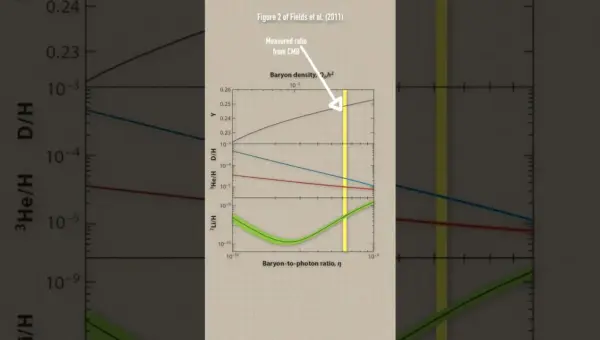
Scientists have precisely mapped the first three minutes of the universe's existence, revealing how nuclear reactions forged the lightest elements. This Big Bang Nucleosynthesis provides crucial evidence for the Big Bang theory and the origin of the universe's fundamental building blocks.


Black Holes: 10 Years of Cosmic Mysteries Unraveled
For ten years, questions about black holes have dominated public curiosity. A new 10-hour compilation reveals fascinating insights into their formation, behavior, and cosmic role, from stellar remnants to galactic centers.


Cosmic Lithium Mystery Puzzles Big Bang Theory
The Big Bang theory, our leading model for the universe's origin, faces a persistent challenge: a significant deficit of lithium. Observations consistently show less lithium than predicted, prompting scientists to explore new physics or stellar destruction mechanisms.