Webb Telescope Captures First Glimpse of Planet Birth
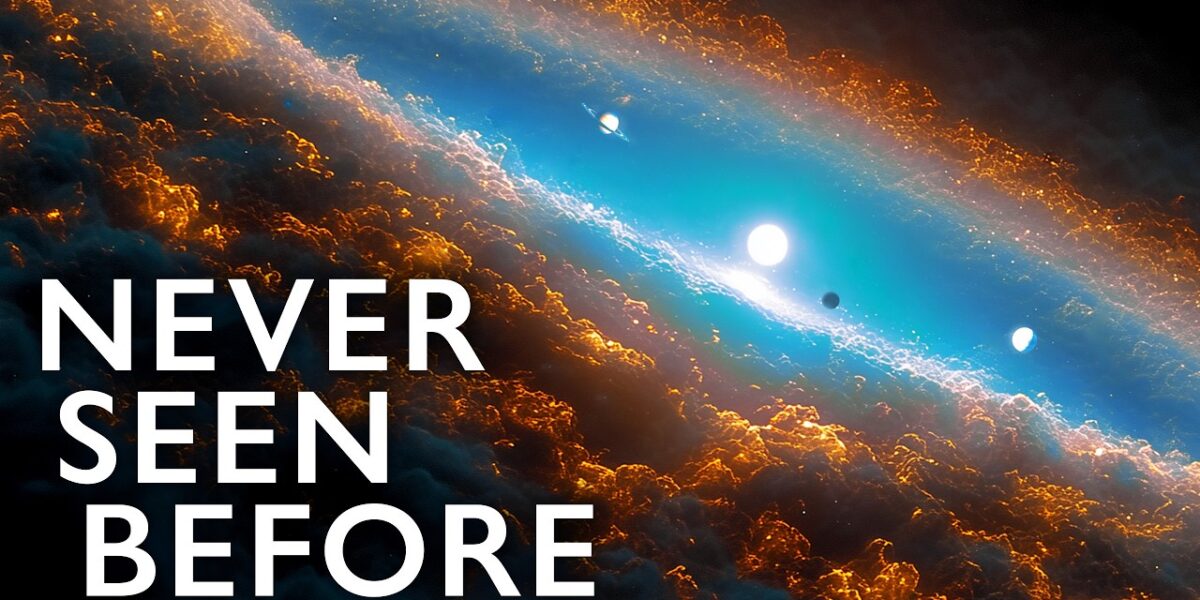
The James Webb Space Telescope has captured the first direct image of planet formation in action around the young star HOPS-315. This breakthrough observation reveals the crucial moment when gas condenses into solid material, offering unprecedented insights into the earliest stages of planetary system development and providing a potential mirror to our own solar system's birth.

Webb Telescope Captures First Glimpse of Planet Birth
For centuries, humanity has gazed at the stars, unraveling countless cosmic mysteries. Yet, one of the most profound questions, paradoxically, has remained closest to home: how do planetary systems like our own come into being? While our understanding has been built upon the analysis of meteorites, observations of our solar system’s planets, and sophisticated computer models, the very earliest stages of planetary formation have remained shrouded in mystery. Until now. The James Webb Space Telescope (JWST) has provided an unprecedented, direct view of a nascent solar system, capturing the crucial moments when gas and dust begin to coalesce into the building blocks of planets.
The Elusive Dawn of a Solar System
Our current model of planetary formation, known as the nebular hypothesis, paints a picture of a process beginning within vast molecular clouds of gas and dust. These clouds, trillions of miles across, exist in a delicate balance between outward thermal pressure and inward gravitational pull. A cosmic catalyst, such as a supernova shockwave, can disrupt this equilibrium, triggering a gravitational collapse. As the cloud collapses, it spins faster, much like a figure skater pulling in their arms, and a heat gradient forms. The majority of the mass concentrates at the center, igniting into a protostar, while the remaining material flattens into a swirling protoplanetary disk—the cosmic womb for future planets.
The very nature of this process, however, makes it incredibly difficult to observe. The dense envelopes of gas and dust obscure the view, rendering these early stages invisible to many telescopes. While advancements in technology have allowed us to catch glimpses, such as the Herschel Orion Protostar Survey (HOPS) in 2013, which identified extremely young, cold protostars in the Orion Molecular Cloud complex, these observations primarily focused on the stars themselves, not the intricate dance of planet formation within their disks.
A Window into Planetary Genesis: HOPS-315
The breakthrough came with JWST’s observation of HOPS-315, a young star located approximately 1,300 light-years away in the Orion Nebula. This star, less than 150,000 years old and with about 0.6 times the mass of our Sun, is still actively growing, enveloped in a thick veil of gas and dust. Crucially, JWST’s infrared capabilities allowed astronomers to peer through this veil and detect a gap, revealing a remarkable sight: the presence of warm silicon monoxide gas and tiny silicate crystals near the young star.
This observation marks the first time scientists have directly witnessed the condensation of gas into solid material—a fundamental step in planet formation. As a protoplanetary disk cools, different compounds crystallize in a specific order based on their condensation temperatures, a process known as the condensation sequence. The detection of both silicon monoxide gas and solid silicate crystals around HOPS-315 indicates that this system is at the very nascent stages of this sequence. As lead author Melissa McClure stated, “For the first time, we’ve identified the earliest moment when planet formation is initiated around a star other than our Sun.”
Synergy of Telescopes: Webb and ALMA
To further investigate this groundbreaking discovery, researchers employed the Atacama Large Millimeter/sub-millimeter Array (ALMA) telescope. While JWST excels at observing warm regions in infrared light, ALMA specializes in detecting colder dust and gas that emit at millimeter and sub-millimeter wavelengths. By combining the data from both observatories, astronomers could map the chemical composition and structure of the molecular cloud surrounding HOPS-315, connecting JWST’s evidence of early planet formation with ALMA’s pinpointing of its location within the disk.
Intriguingly, the region around HOPS-315 where these early condensates were found is remarkably similar to the region where asteroid-forming materials are found around our Sun. This suggests that the initial steps of planet formation might be universal. Furthermore, the outflow jet from HOPS-315 showed a surprisingly low abundance of silicon, the key element for silicate formation. This deficiency, rather than being a setback, might be an indicator that planetesimals—the larger building blocks of planets—are already forming and accreting material in this region, mirroring processes that likely occurred in our own solar system.
Rewriting the Timeline of Planet Formation
The discovery at HOPS-315 challenges long-held assumptions about when planet formation begins. Previously, it was thought that gas condensation into solids primarily occurred in Class II systems, where the stellar envelope has largely dissipated and a relatively stable debris disk remains. However, observations of several young protostars over the past decade have hinted at earlier formation. HOPS-315 provides the crucial confirmation, pushing the timeline back to less than 150,000 years after star formation begins.
Scientists are particularly interested in understanding how millimeter-sized particles, like chondrules, grow into kilometer-sized planetesimals. This growth is a significant hurdle, as small particles don’t readily stick together, and intermediate-sized objects are susceptible to gas drag, potentially spiraling into the star. One hypothesis suggests that gravitational instability within dense pockets of dust could directly form planetesimals. By studying the changing gas-to-solid ratio in HOPS-315, researchers hope to determine the speed of solid growth, factors limiting coalescence, and their impact on planet development.
A Mirror to Our Own Origins
Perhaps the most profound implication of the HOPS-315 discovery is its potential to serve as a direct analogue for our own solar system’s formation. By comparing the dust chemistry of HOPS-315 with meteorites found on Earth, scientists can test whether the same condensation sequences and elemental distributions that shaped our planets are common elsewhere. This offers an unprecedented opportunity to validate and refine our models of planetary evolution.
The implications extend to predicting the potential structure of the HOPS-315 system. The condensation sequence dictates the types of planets that form and their locations. The concept of the “snow line”—the distance from the star where volatile compounds like water can freeze—is critical. Beyond the snow line, ice and dust accumulate, forming the cores of gas giants, which can then accrete vast amounts of gas due to slower-moving particles. Closer to the star, within the snow line, only materials with high melting points survive, leading to the formation of smaller, rocky planets like Earth. While the exact planetary configuration of HOPS-315 remains to be seen, scientists anticipate a similar inner rocky/outer gas giant structure, though planetary migration and the presence of hot Jupiters cannot be ruled out.
Future Prospects and Cosmic Questions
The location of the early condensation around HOPS-315, near where our own asteroid belt resides, raises questions about whether this young system will also develop an asteroid belt. Such belts are thought to form when a massive planet’s gravity, like Jupiter’s in our solar system, disrupts the accretion process, trapping planetesimals in stable orbits. The formation of an asteroid belt around HOPS-315 would depend on whether a sufficiently massive planet emerges.
HOPS-315 offers a unique portal into our own past, allowing us to study our solar system as it might have appeared 4.6 billion years ago. The discovery also sparks new questions: How common are solar systems like ours? Does planet formation universally begin at similar distances? How rapidly does the transition from dust to planetesimals occur? To address these, the search will expand to more very young stars, seeking to identify more systems like HOPS-315. If multiple such systems exhibit similar characteristics, it will provide a wealth of data to deepen our understanding of our cosmic origins.
As we continue to explore the universe, we are reminded of our own humble beginnings—a dispersion of gas and dust. The study of HOPS-315 not only illuminates the grand processes of cosmic creation but also offers a profound perspective on our place within the vast, unfolding story of the universe.
Source: We've Finally Seen How Planets Form (YouTube)

Related Articles


Vera C. Rubin Observatory Begins Sky Survey
The Vera C. Rubin Observatory has officially begun its 10-year sky survey, promising to generate millions of astronomical alerts nightly. Meanwhile, new Webb images reveal Uranus in unprecedented detail, and the Artemis program faces timeline adjustments.

JWST Unveils Distant Galaxy’s Surprising Maturity
The James Webb Space Telescope has detected an ancient galaxy, JADES-GS-z13-0, existing just 320 million years after the Big Bang. Its surprising maturity challenges current theories about the rapid formation of early galaxies.

Earth’s Planetary Status Questioned, Figure-8 Orbits Debunked
Exploring Earth's planetary status, the impossibility of figure-8 orbits, the ongoing debate about dark matter's composition, and the future of human spaceflight.