Vanguard’s Gloomy Outlook Faces Skepticism
Vanguard's latest 'Economic and Market Outlook' predicts below-average returns and potential market downside, drawing parallels to the dot-com bubble. However, historical performance and the accelerating impact of technology suggest caution against overly pessimistic forecasts. Experts emphasize the importance of long-term planning and consistent investing over market timing.

Vanguard’s Gloomy Outlook Faces Skepticism
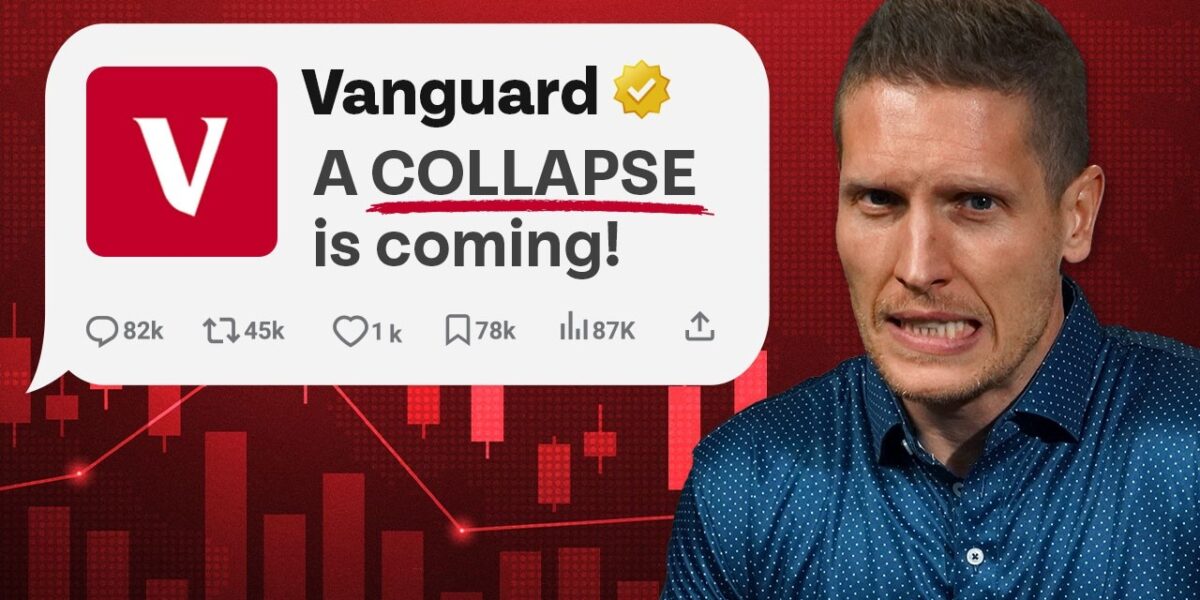
Vanguard, a titan in the investment management industry, has once again issued a report that paints a cautious, if not outright pessimistic, picture of future market returns. The firm’s annual ‘Economic and Market Outlook’ report, often a closely watched document, has this year highlighted concerns around ‘AI exuberance’ potentially masking an impending ‘stock market downside.’ However, this familiar refrain of caution, which has been a hallmark of Vanguard’s predictions for years, is increasingly being met with skepticism, particularly in light of historical market performance that has defied such forecasts.
The ‘Below Average Returns’ Prediction
Vanguard’s latest outlook suggests a future of ‘below average returns’ for investors, a prediction that has become almost predictable in its timing and tone. The report quantifies this by projecting a weighted average annual performance for the next 10 years to be between 4% and 5%. While this figure is a slight increase from previous years’ projections (e.g., 3.7% to 5.7% in 2024 and 2.8% to 4.8% in 2025), it still signals a subdued outlook compared to historical norms.
“It’s scary out there. There’s there’s bad below average returns coming your way.”
This consistent messaging, while seemingly prudent, has often been contrasted by actual market performance. For instance, Vanguard’s 2024 outlook warned that ‘US equity valuations need to fall to return to fair value.’ Despite this warning, the US equity market delivered a robust 23.3% return in 2024. Similarly, the 2025 outlook pointed to ‘digging deeper into US equity overvaluation,’ yet the market still achieved a significant 16.5% return. This pattern suggests that Vanguard’s predictive models may be consistently underestimating the market’s capacity for growth, particularly in periods driven by technological innovation.
The ‘Wealth Tipping Point’ Data Point
A particularly alarming data point presented in the report concerns a potential ‘wealth tipping point.’ Vanguard compared the historical median five-year rolling period increase in wealth across equities and real estate, which stands at approximately 46% (23% for equities, 22% for real estate). They contrasted this with the period preceding the dot-com bubble, where a five-year increase reached 82% (57% for equities, 26% for real estate). The report then presented current data showing a 44% increase in equities and a 28% increase in real estate over the last five years, concluding that current market conditions are closer to ‘dot-com bubble territory’ than historical medians.
However, critics argue that such comparisons can be misleading, akin to finding spurious correlations in sports statistics. The argument is that cherry-picking specific data points and historical periods to create a narrative of impending doom can ignore broader economic trends and the inherent dynamism of markets, especially in the age of rapid technological advancement like Artificial Intelligence (AI).
AI Exuberance and Market Hedging
The report’s headline, ‘AI exuberance, economic upside, stock market downside,’ suggests a dichotomy where enthusiasm for AI is driving market sentiment, but underlying economic fundamentals may not support current valuations. Yet, the slight upward revision in Vanguard’s 10-year return projections from previous years is seen by some as an implicit acknowledgment of the potential for technology to drive higher returns. This suggests that even within their cautious framework, Vanguard may be hedging its bets against the accelerating returns driven by innovation.
Market Impact and Investor Takeaways
The recurring theme of Vanguard’s cautionary outlook raises several points for investors:
- Don’t Fall for Sensational Headlines: The financial media often amplifies the most alarming aspects of such reports. Investors are advised to look beyond the sensationalism and consider the broader context.
- No One Knows for Sure: Predicting market movements with precision, especially over short to medium timeframes (6-24 months), is notoriously difficult. Many so-called market predictors have a history of being wrong.
- The Power of Long-Term Investing: Historically, bull markets have been longer and more substantial than bear markets. For instance, bull markets typically last around 4.3 years with cumulative returns of 150%, while bear markets average about 11 months with a 32% loss. This historical data suggests that staying invested through volatility is often more rewarding than trying to time the market.
- Focus on a Plan: The most crucial element for investors is to have a well-defined financial plan that aligns with their goals, risk tolerance, and time horizon. This plan should be robust enough to weather market downturns.
- Volatility is Normal: Market downturns are an inevitable part of investing. The key is to ensure your portfolio is structured to handle these fluctuations, with allocations adjusted based on your stage of life (e.g., a 25-year-old’s portfolio should differ significantly from a 55-year-old’s).
- The Yo-Yo Analogy: Investing can be likened to walking uphill with a yo-yo. While there’s day-to-day movement (up and down), the overall trend is upward if you are consistently moving towards your long-term financial goals.
- Wealth Creation is Not Zero-Sum: The concept of ‘accelerating returns’ driven by innovation suggests that the overall economic pie can grow, benefiting investors over the long term. This contrasts with a zero-sum game where one person’s gain is another’s loss.
The ‘Always Be Buying’ Strategy
In the face of uncertainty and potentially pessimistic forecasts, a simple yet effective strategy is to ‘always be buying.’ This means maintaining a consistent investment approach, such as regular contributions through dollar-cost averaging, regardless of market conditions. For new investors, the first decade is often an educational period, and sticking to a plan, even if the market experiences a significant downturn in a specific year like 2026, is paramount.
Addressing Specific Investor Questions
The discussion also touched upon specific investor concerns, including saving for college and managing Employee Stock Ownership Plan (ESOP) shares.
College Savings: 529 Plans vs. Brokerage Accounts
When considering saving for college, the efficiency of a 529 plan was highlighted. While a taxable brokerage account offers flexibility, a 529 plan provides significant tax advantages, including potential state tax deductions, tax-free growth, and tax-free withdrawals for qualified education expenses. Furthermore, recent changes have expanded the utility of 529s to include K-12 tuition (up to $20,000 annually), trade schools, and even funding Roth IRAs for beneficiaries, offering more ‘escape hatches’ than in the past. The advice suggests that a 529 is often the most efficient vehicle for dedicated college savings, though a hybrid approach combining 529s and brokerage accounts is also viable.
ESOP Shares and Savings Rates
For individuals with high household incomes (e.g., over $200,000) receiving ESOP shares from a private company, the advice was to be cautious about relying solely on these shares for retirement savings. While ESOPs represent ownership and contribute to net worth, they are not always liquid and their future value is tied to the company’s success. Given the risks associated with company viability and the potential for significant future consumption needs at higher income levels, maintaining a strong personal savings rate (e.g., 25% of gross income) is crucial. ESOP shares should be viewed as a potential bonus rather than a guaranteed component of a retirement plan, especially for those whose income significantly outpaces social security benefits.
In conclusion, while Vanguard’s outlook provides a point of discussion, investors are reminded that historical data, a sound financial plan, and a disciplined, long-term approach are more reliable guides than speculative predictions, however authoritative the source.
Source: Vanguard Predicts Market Collapse in 2026 (Are They Right?) (YouTube)

Related Articles


AI’s Economic Shift: Ownership is the New Wage
Artificial intelligence is projected to significantly reduce the economic value of human labor within a decade. Experts suggest that capital ownership, rather than wages, will become the primary means of wealth accumulation. Investors are urged to consider this shift in their long-term strategies.


Germany’s Fake Laws: AI Disinformation Campaign Exposed
Viral AI-generated videos falsely claim Germany has enacted absurd laws, including fines for flushing toilet paper. Experts reveal a disinformation campaign aiming to portray Germany as chaotic, with potential commercial or political motives behind the fabricated content.


Google’s Reddit Deal Fuels Marketer Shift
Google's exclusive data access deal with Reddit, reportedly worth hundreds of millions, is transforming search results by prioritizing authentic user discussions. This strategic move positions Reddit content at the forefront of Google searches and AI answers, creating new opportunities and challenges for marketers.