US War Justification Questioned Amid Iran Tensions
U.S. officials are facing intense questioning over the justification for military action in Iran, with a recent congressional hearing highlighting discrepancies in intelligence assessments of an imminent nuclear threat. Experts suggest a lack of public appetite for ground troops and note differing views on the existential nature of the threat between the U.S. and Israel.


US Leaders Divided on Iran War Rationale
The United States government is facing intense scrutiny over its justification for engaging in military action in the Middle East, specifically concerning Iran. Questions are being raised about the timing of the conflict and its potential end, with President Trump suggesting he could halt hostilities but facing potential escalation risks. This has led to a broader debate about why the administration initiated a new foreign war.
Congressional Hearing Highlights Intelligence Discrepancies
A recent hearing on Capitol Hill revealed significant disagreement regarding the intelligence assessment of an imminent nuclear threat from Iran. When asked directly if the intelligence community assessed an imminent nuclear threat, a cabinet member stated that only the president can determine what constitutes an imminent threat. This response drew sharp criticism from lawmakers who argued that intelligence agencies are meant to provide objective, timely, and independent assessments, free from political influence.
During the hearing, a congressman pressed the official on whether the intelligence community’s assessment was that Iran’s nuclear program was obliterated and that no efforts were being made to rebuild its enrichment capability. Despite this, the official maintained that determining an imminent threat is the president’s role, based on the information he receives, rather than the intelligence community’s direct assessment. This exchange suggested a potential disconnect between intelligence findings and the administration’s stated reasons for military action.
Expert Analysis Raises Doubts on Imminent Threat
Andrew Ready, an associate research professor at UC Berkeley’s Goldman School of Public Policy and founder of the Berkeley Risk and Security Lab, commented on the situation. He noted that a former chief counterintelligence director had written a resignation letter arguing there was no imminent threat from Iran. Ready suggested that the uncertainty surrounding Iran’s motives, desired end goals, and the appropriateness of US actions makes it difficult to fully understand the situation.
Ready emphasized the importance of the intelligence community providing assessments that are separate from political considerations. He believes that political appointees within the administration may be hesitant to contradict the president’s views, which could explain the evasiveness observed during the congressional hearing. The expert also clarified that while Iran may possess 60% enriched uranium, this does not automatically mean it has the capability to build a warhead or deliver it. There is considerable uncertainty about Iran’s efforts to rebuild its nuclear infrastructure following previous attacks.
Ground Troops Likely for Securing Nuclear Materials
When discussing the possibility of securing or eliminating Iran’s uranium stockpiles, Ready stated that it is highly unlikely to achieve these goals without deploying U.S. troops on the ground. He acknowledged that questions remain about who would carry out such a mission, mentioning potential roles for Kurdish forces or a coalition of willing nations. A negotiated settlement involving international inspectors returning to monitor sites is also seen as a possible, though challenging, outcome.
The prospect of ground troops faces significant opposition within the United States, with a lack of public appetite for such a deployment. This public sentiment is a critical factor for any administration considering such a drastic military step.
Israel Views Iran as Existential Threat, US Disagrees
In contrast to the U.S. perspective, some Israeli leaders view Iran as an existential threat. A prominent opponent of Israeli Prime Minister Benjamin Netanyahu described the war as having “moral clarity” and being a “just war” to prevent Israel from facing a nuclear outcome. This sentiment suggests a broader consensus in Israel regarding the urgency of the threat posed by Iran’s nuclear ambitions.
However, Ready argued that Iran does not pose an existential threat to the United States in the same way it does to Israel. He explained that while countries like North Korea have developed missile technology capable of reaching the U.S. West Coast over time, a newly nuclear Iran would likely take considerable time to develop the capability to hold the entire United States at risk. Nevertheless, he acknowledged that Israel’s concerns about Iran’s ability to deliver a payload to targets in the near term are valid. There are also worries about less conventional delivery methods, such as naval vessels or sleeper cells, which could pose a threat to the U.S. in the short term.
Conflicting Motivations for War
The lack of a clear, singular justification for the war is a major point of contention. Experts suggest that the U.S. president’s decision to go to war could stem from various motivations. These include concerns about Iran’s nuclear program, attempts at regime change, a response to domestic protests, or simply supporting a key regional ally. Each of these potential drivers would significantly influence the assessment of whether the chosen means are appropriate.
Ready pointed out that numerous presidents have previously war-gamed this crisis and decided that the potential costs of action outweighed the benefits. The current administration’s decision to proceed suggests a different risk assessment, the consequences of which are now unfolding.
Comparison to North Korea and Proliferation Concerns
The situation is often compared to North Korea, which already possesses nuclear weapons. While deterrence is accepted with North Korea, the U.S. appears willing to consider war with Iran. Ready explained that North Korea’s conventional capabilities alone can threaten key allies like South Korea, leading to significant civilian casualties. Furthermore, North Korea’s established nuclear arsenal provides a different deterrent effect.
He suggested that Iran may have aimed to become a “threshold nuclear state,” capable of proliferating if threatened, but this strategy appears to have failed. The expert also highlighted the role of international dynamics, such as Russian targeting information for Iran and Chinese support for North Korea, which significantly influence regional security. The lessons learned from past events, including Libya and Ukraine, might unfortunately suggest to some nations that nuclear proliferation could offer a form of security, a concern that resonates in parts of Europe.
Looking Ahead
As the conflict continues, the focus remains on the U.S. government’s evolving rationale for its military involvement and the potential for de-escalation. The differing perspectives between the U.S. and its allies, particularly Israel, on the nature and immediacy of the threat from Iran will likely shape future diplomatic and military strategies. The international community will be watching closely to see if a clear path toward resolution emerges, or if the conflict risks further expansion, potentially influenced by the complex dynamics of nuclear proliferation and regional alliances.
Source: US government conflicted over justification for war in the Middle East | DW News (YouTube)

Related Articles


G7 Allies Clash Over Iran War Strategy, Urge Focus on Russia
G7 foreign ministers met in Paris, revealing deep divisions over the U.S. war with Iran. European allies urged the U.S. to pressure Russia, linking its actions to the conflict and fearing support for Ukraine will wane.


Israelis Forge Resilience Amidst Constant Bomb Shelter Drills
Life in Israel is a blend of resilience and constant vigilance, with many families adapting to frequent bomb shelter drills and even sleeping in makeshift shelters. Despite ongoing missile attacks, Israelis strive to maintain normalcy, though businesses face disruption and emotional fatigue is a growing concern.

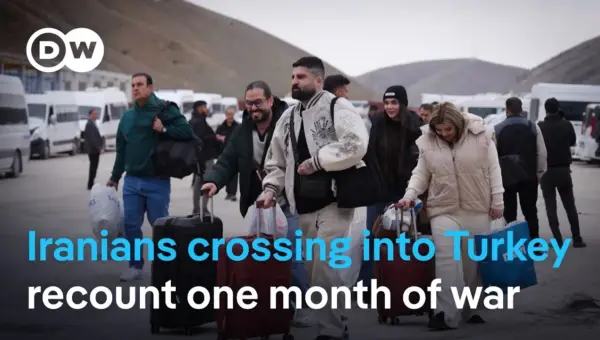
Iran War Exodus: Refugees Flee to Turkey Amidst Bombings
A train from Tehran brings refugees to Turkey, fleeing daily bombings and economic collapse. Many express deep fear for loved ones left behind, while some hold onto national pride and hope for victory. The conflict's impact is also felt economically in Turkey, with rising gas prices.