US Strikes Iran’s Carg Island, Escalating Oil War Tensions
The U.S. has struck military targets on Iran's critical Carg Island, a move that escalates tensions in the Persian Gulf and raises concerns about global oil supply. The action coincides with a significant deployment of U.S. Marines to the region, as experts weigh the economic and geopolitical ramifications.


US Strikes Iran’s Carg Island, Escalating Oil War Tensions
In a significant escalation of the ongoing conflict, the United States has launched strikes against military installations on Iran’s strategically vital Carg Island. The move, announced by President Trump, targets a key node in Iran’s oil infrastructure and signals a potential shift in military strategy, with implications for global energy markets.
Carg Island: Iran’s Oil Achilles’ Heel
Carg Island, a small but critical island located in the Persian Gulf, serves as the linchpin for a staggering 80-90% of Iran’s oil processing and export operations. Its strategic importance was highlighted by President Trump, who stated that while military installations were targeted, the oil infrastructure itself was left intact, at least for now. This delicate balance suggests a deliberate strategy to exert pressure without immediately crippling global oil supply, a move that experts believe could change if the Strait of Hormuz remains closed to international shipping.
Escalation and Deployment of Forces
The strikes on Carg Island coincide with a massive deployment of U.S. military assets to the Middle East. Reports indicate that thousands of U.S. Marines and sailors are being dispatched to the region, a move seen as a significant show of force and a potential precursor to further action. This deployment raises questions about the U.S. strategy, with some analysts suggesting it could be a signal to Iran of the U.S.’s capacity for escalation and a bid to compel capitulation.
Global Economic Ramifications and Oil Prices
The ongoing conflict and the closure of the Strait of Hormuz are already having a tangible impact on global oil prices. With supply chains disrupted, oil prices have surged, reaching levels not seen in decades. While the United States, as an oil exporter, is somewhat insulated from direct import disruptions, global consumers are facing higher prices at the pump. Experts warn that prolonged closures or further escalation could lead to significant knock-on effects, including higher transportation and food costs worldwide. The situation is particularly acute for countries like China and India, which are heavily reliant on oil imports.
“If the Strait of Hormuz isn’t reopened, then the oil infrastructure on Carg Island may be struck next.”
Expert Analysis and Future Outlook
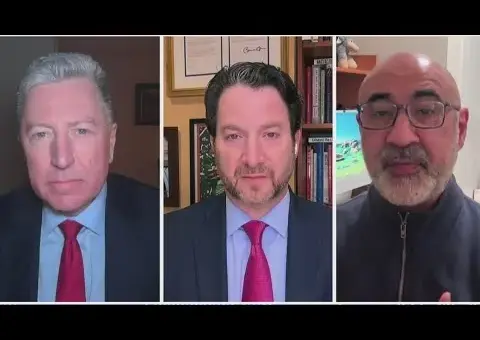
“Stay Tuned” is set to feature insights from a range of experts, including former energy advisors and defense analysts, to dissect the complexities of the situation. Robert McN, former energy advisor to President George W. Bush, emphasized Carg Island’s critical role, stating, “It means everything. Carg Island is a 5-mile long island that has a terminal, an oil terminal on it, and Iran exports 90% of its oil from that island. So, it’s by far the crown jewel.” He also noted that while both sides have shown restraint by not attacking critical energy infrastructure, the U.S. strike on military facilities signals a willingness to escalate if Iran does not back down.
The potential for mines in the Strait of Hormuz and the challenges of mine-clearing operations were also discussed. John Isme, a New York Times Pentagon reporter and former EOD officer, explained the technicalities of underwater surveys and the time-consuming nature of establishing safe shipping lanes. The U.S. military is investing in advanced autonomous underwater vehicles to aid in this process, but the threat remains significant.
Uncertainty and the Path Forward
The situation remains fluid, with significant uncertainty surrounding Iran’s response and the potential for further escalation. The U.S. strategy appears to be centered on demonstrating escalation dominance, aiming to persuade Iran to de-escalate. However, the Iranian regime, potentially feeling it is in a fight for survival, may not perceive backing down as advantageous, especially with internal pressures from its own population. The coming days are expected to be critical in determining whether de-escalation and back-channel negotiations will lead to a ceasefire or if further military action will drive oil prices even higher.
Source: Stay Tuned NOW Streaming Behind The Scenes! – March 13 (YouTube)

Related Articles

U.S. Iran Tensions Rise Amid Shifting Alliances
Rising tensions between the U.S. and Iran are creating a volatile geopolitical situation. With conflicting signals on de-escalation and potential shifts in alliances like NATO and U.S.-Israel relations, the path forward remains uncertain. The global economy and regional stability hang in the balance.


Iran Targets US With Cyberattacks, Escalating Digital Warfare
Iran is increasingly using cyberattacks to challenge the U.S., as seen in a recent hack of the FBI director's account. Experts say this is a strategic shift due to Iran's limitations in conventional warfare. The U.S. needs to strengthen its digital defenses, focusing on encryption and cloud computing, rather than solely relying on traditional security measures.


Iran Hacks FBI Chief, Exposing U.S. Cyber Vulnerabilities
A recent hack of FBI Director Kash Patel's personal email by an Iran-linked group highlights Iran's growing cyber threat to the U.S. Experts explain how simple security oversights are exploited, emphasizing the need for basic defenses like two-factor authentication to protect against propaganda and potential infrastructure attacks.