US Stocks Hit New Highs Amid Economic Divergence
The U.S. stock market has reached unprecedented highs, yet a significant divergence exists between market performance and the financial reality for average Americans, marked by record credit card debt. Increased government and Federal Reserve intervention, alongside a heavy concentration in mega-cap tech stocks, are reshaping market dynamics and diversification strategies.


US Stocks Reach Record Highs Despite Growing Economic Disconnect
The U.S. stock market continues to defy economic headwinds, with major indices, including the S&P 500, recently surpassing 7,000 points for the first time in history. This milestone, however, arrives as concerning economic indicators paint a starkly different picture for the average American, suggesting a widening gap between market performance and household financial well-being.
The Divergent Economy: A Tale of Two Realities
While the stock market celebrates new highs, a significant portion of the population faces mounting financial pressures. A key indicator of this strain is the record-high credit card debt held by Americans, which has surged to $1.28 trillion. This figure represents a staggering 66% increase since 2021, a period when credit card debt was actually declining. This surge in consumer debt, coupled with rising living costs, means many households are allocating their entire income to essential expenses like rent and groceries, leaving little room for savings or investment.
This economic dichotomy is often described as a ‘K-shaped recovery.’ In such a scenario, while some segments of the population experience significant wealth accumulation, others see their financial standing deteriorate. The current environment appears to be exacerbating this trend, with financially savvy investors seeing their wealth grow, while the average American struggles with diminished purchasing power.
Government Intervention and Market Stabilization
The landscape of market dynamics has also been reshaped by increased government and central bank involvement. Following the initial economic shock of the pandemic, the Federal Reserve implemented aggressive monetary easing policies, famously described by Chairman Jerome Powell as having “flooded the system with money.” This quantitative easing (QE) involved injecting liquidity into the economy and financial markets, which initially spurred market growth and wage increases.
However, this influx of currency led to inflationary pressures. In response, the Federal Reserve shifted to quantitative tightening (QT) starting in 2022, aiming to withdraw money from the economy to combat rising inflation. While QT aimed to slow future inflation, it did not reverse the prior price increases. Consequently, many individuals experienced wage growth that lagged behind the accelerating cost of goods and services, leading to a real-terms decrease in their purchasing power over several years.
A significant shift occurred on December 1, 2025, when the Federal Reserve resumed quantitative easing. This move signaled a renewed effort to stabilize markets by injecting liquidity once again. This policy change directly impacts market liquidity and investor sentiment.
Beyond monetary policy, the U.S. government has also taken a more direct role in the stock market, particularly since 2025. Driven by a desire to compete with China and reduce reliance on foreign supply chains, the administration has begun investing taxpayer dollars directly into specific U.S. companies. Notable investments include hundreds of millions into MP Materials, billions into Intel to bolster domestic chip manufacturing, and significant capital into companies like Lithium Americas and Trilogy Metals. This direct government investment creates a new dynamic, as the state becomes an active participant, potentially influencing stock performance and creating an uneven playing field for individual investors who cannot match the government’s financial capacity.
The Shifting Nature of Diversification
The concept of diversification within investment portfolios is also undergoing a transformation, particularly for those invested in broad market indices like the S&P 500. Historically, the S&P 500 offered diversification by representing 500 of the largest publicly traded companies. However, a significant concentration has emerged, with the seven largest companies, often dubbed the ‘Magnificent Seven,’ now comprising approximately 34% of the index’s total market capitalization. These seven companies, predominantly in the technology and artificial intelligence sectors, were responsible for over 40% of the S&P 500’s total return in 2025.
While this concentration has fueled market gains, it introduces a new layer of risk. If these dominant companies experience a downturn, the impact on the entire S&P 500 could be amplified. Investors who perceive the S&P 500 as a diversified investment may be unaware of this heightened reliance on a small group of mega-cap stocks, potentially misjudging their portfolio’s risk exposure.
Market Impact and Investor Considerations
The confluence of these factors—a widening economic disparity, active central bank intervention through QE, direct government investment in equities, and increasing market concentration—presents a complex environment for investors. The resilience of the stock market in the face of geopolitical tensions, such as the recent conflict escalation impacting oil prices and global travel, highlights its disconnect from immediate global events, likely due to the stabilizing effect of monetary and fiscal policies.
For investors, understanding these underlying shifts is crucial. The traditional notion of diversification may require re-evaluation, potentially prompting a search for alternative methods to spread risk beyond simply holding a broad market index heavily weighted towards a few tech giants. The government’s strategic investments also signal potential growth areas, though direct competition with state-backed capital is challenging.
While the long-term trend of asset prices has historically been upward, the current market structure suggests that navigating volatility and identifying genuine opportunities requires a sophisticated understanding of these evolving economic and policy landscapes. The ability to adapt investment strategies to these new realities could be key to protecting and growing wealth in the coming years.
The reality is all of these things create opportunity for the financially savvy. All of these things create the ability for people to grow their wealth a whole lot faster. Because if we see growth in the markets because the government, the Federal Reserve Bank is pumping money in. You have to identify how that creates opportunity. If you see this lack of diversification, there are other ways to diversify your money which can create other opportunities for you. That’s why it is important for you to be a financially savvy investor.
Source: Something Isn’t Right With the Stock Market (YouTube)

Related Articles


Nippon Steel Deal Promises Investment, Hiring Boost for US Steel
U.S. Steel's Irving plant is slated for significant investment and job growth following its acquisition by Nippon Steel. The deal, approved by former President Trump, promises to boost manufacturing amid sector-wide job losses. Federal Reserve officials are closely monitoring the plant's operations and labor challenges, which could impact inflation and interest rate decisions.


Kraken Gains Fed Access, Trump Backs Crypto Regulation
Kraken has secured a Federal Reserve master account, enabling direct access to the Fed's payment system. Former President Donald Trump urged banks to support crypto legislation, while analysis links Bitcoin's future bull market to the economic PMI cycle.
Global Stocks Surge Past U.S., Investors Eye Diversification
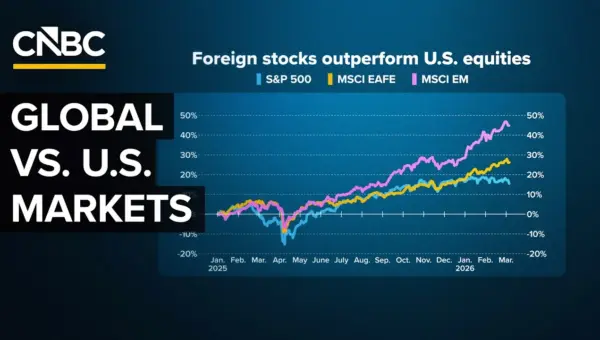
International equities surged past U.S. markets in 2025, with developed markets up 32% and emerging markets gaining 34%. Investors are diversifying portfolios due to U.S. concentration risk, geopolitical concerns, and a weakening dollar.