US Rockets Back to the Moon: Why the Renewed Lunar Focus?
The United States is intensifying its focus on the Moon with plans for astronaut landings by 2028 and a $20 billion lunar base. This renewed interest is driven by both scientific discovery, particularly at the lunar poles where water ice may exist, and a growing international competition, often dubbed the 'new space race'.


US Eyes Lunar Return, Aims for Moon Base
The United States is once again setting its sights on the Moon, with ambitious plans for astronaut landings and even a permanent base. NASA aims to land humans on the lunar surface by 2028. Just last week, NASA chief Bill Nelson announced a bold goal: to build a $20 billion lunar base within the next seven years. This renewed push marks a significant shift in space exploration priorities. But why now? What is driving this intense focus on our closest celestial neighbor?
Unlocking Lunar Secrets: Science Drives the Mission
Scientists believe there is still a wealth of knowledge to uncover on the Moon. Previous Apollo missions, which landed astronauts in the 1960s and 70s, focused on a single region near the Moon’s equator. This area was chosen because it was the easiest place for spacecraft to land safely. While those missions yielded valuable data, including rock samples and insights from the lunar rover, they only scratched the surface of what the Moon has to offer.
The Moon’s poles, in particular, hold significant scientific interest. These regions contain areas of permanent shadow where water ice is believed to exist. This ice is not just a scientific curiosity; it could be a vital resource for future space missions. Imagine using lunar ice as a source of drinking water for astronauts or breaking it down into hydrogen and oxygen to create rocket fuel. Such resources could make long-duration space travel, including missions to Mars and beyond, far more feasible and less expensive.
A New Space Race: Global Competition Heats Up
Beyond scientific discovery, a growing international interest in the Moon has fueled a sense of competition. Many are calling this the dawn of a new space race. China has openly stated its intention to land its own astronauts on the Moon by 2030. This has raised concerns within the U.S. about securing access to potential lunar resources.
NASA and U.S. policymakers see a strategic imperative to establish a presence on the Moon. The fear is that if one nation gains exclusive control over valuable lunar resources, it could limit access for others. This could lead to geopolitical tensions and hinder collaborative efforts in space exploration. Therefore, the U.S. aims to be at the forefront, ensuring that the Moon’s resources are accessible for peaceful exploration and scientific advancement by multiple nations.
Policy and Public Interest Align for Lunar Exploration
The convergence of scientific opportunity and international competition is driving a renewed focus on the Moon. Policymakers in Washington are increasingly recognizing the strategic and economic importance of lunar exploration. This alignment between scientific goals and national interests is crucial for securing the funding and political will needed for such ambitious undertakings.
The public also seems to be captivated by the idea of returning to the Moon. With recent successful missions and forward-looking plans, the Moon is once again capturing the imagination. This public enthusiasm can translate into strong support for NASA’s programs and lunar initiatives. The coming years will be critical as NASA works to establish its presence on the Moon, paving the way for future human endeavors in deep space.
What’s Next for the Moon?
The next few years will be pivotal for lunar exploration. With astronaut landings planned for 2028 and the ambitious goal of a lunar base, the pace of activity is set to accelerate. All eyes will be on NASA’s Artemis program and its international partners as they work to overcome the technical and logistical challenges. The success of these missions will not only advance scientific knowledge but also shape the future of human presence beyond Earth.
Source: Why is the U.S. so focused on the moon right now? (YouTube)

Related Articles


Artemis II Launch: Humans Return to Deep Space
NASA's Artemis II mission is set to launch Wednesday, sending four astronauts on a historic lunar flyby. This marks humanity's return to deep space after 50 years and tests crucial systems for future Moon and Mars missions. The launch window opens at 6:24 p.m. ET.

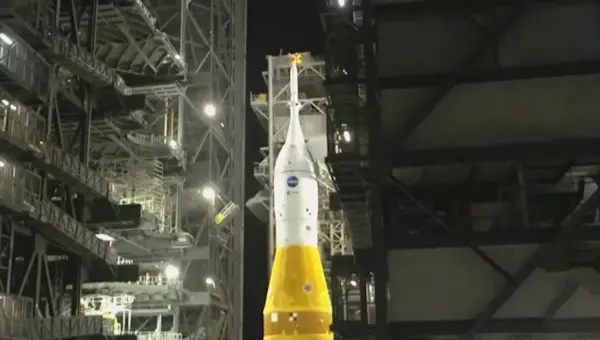
Artemis II: NASA’s Bold Leap Back to the Moon
NASA's Artemis II mission is set to send astronauts on a historic flyby around the moon, marking humanity's return to lunar space after over 50 years. The mission aims to test critical systems and inspire a new generation of explorers.


US Rockets to Moon, Igniting New Space Race
The Artemis II mission marks humanity's return to the Moon after 53 years, with NASA astronauts and a Canadian counterpart set to orbit our celestial neighbor. This ambitious journey is driven by scientific goals, resource potential, and a renewed push for American leadership in space, potentially igniting a new era of international competition.