US Reclaims Moon Race Lead, Artemis II Completes Key Step
NASA's Artemis II mission successfully separated its Orion crew capsule from the service module before a critical atmospheric re-entry. This key step advances the US goal of returning astronauts to the Moon and establishing a long-term presence beyond Earth.


US Reclaims Moon Race Lead, Artemis II Completes Key Step
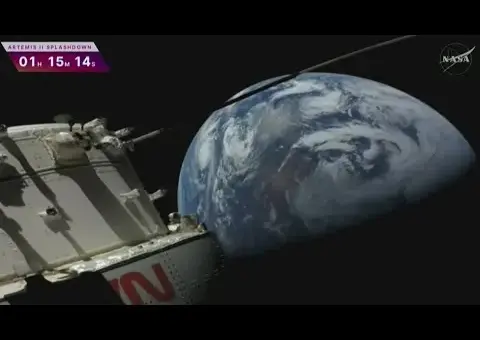
NASA’s Artemis II mission has successfully completed a critical maneuver, separating the Orion crew module from its service module. This event marks a significant step in the United States’ renewed push to return astronauts to the Moon. The separation happened just minutes before the capsule began its fiery re-entry into Earth’s atmosphere. This mission is part of a larger effort to establish a long-term human presence on the lunar surface and beyond.
Orion’s Journey and Separation
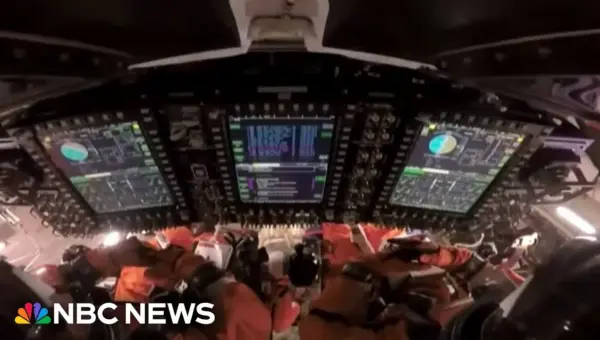
The European Service Module, which provides power, propulsion, and life support, detached from the Orion crew capsule. This separation is a vital procedure, ensuring the capsule is properly oriented for its descent. The capsule’s heat shield is designed to face forward, absorbing the immense heat generated by friction with the atmosphere. Small explosive bolts, known as pyrotechnics, were used to achieve this separation. While some emergency messages appeared on the control panel, they were expected alerts due to the loss of data connection with the departing service module. Mission control confirmed these were not a cause for concern.
Preparing for Re-entry
Astronaut Victor Glover played a key role in positioning the capsule, nicknamed ‘Integrity’, for its return. He ensured the spacecraft’s teardrop shape was correctly aligned. This precise positioning is crucial for a safe and controlled re-entry. Unlike the Space Shuttle program, which used specific deorbit burns to slow down, Artemis relies on the spacecraft’s inertia and the atmosphere itself. The capsule will use its trajectory and the planet’s pull to guide its return. Some minor course correction burns were performed earlier in the mission.
The Return to Earth
The re-entry process is expected to be intense. As the capsule hits the upper layers of the atmosphere, friction will generate extreme heat. The heat shield is the primary defense against this. The mission control team closely monitored the spacecraft’s progress throughout. The burn, or re-entry phase, was scheduled to begin shortly after the service module separation. Communication blackouts are expected during the most intense parts of re-entry. These periods, known as loss of signal, occur as the plasma sheath forms around the capsule. Contact is expected to be re-established later in the descent.
Global Space Race Context
The Artemis program is NASA’s ambitious plan to send humans back to the Moon, including the first woman and first person of color. This effort is a direct response to renewed international interest in lunar exploration. China, for example, has its own ambitious lunar program, including plans for a research station. Russia has also expressed interest in lunar missions. The United States aims to use the Moon as a stepping stone for future missions to Mars. Establishing a sustained presence on the Moon could provide valuable experience and resources for deeper space exploration.
Economic and Strategic Interests
Space exploration is no longer solely about scientific discovery. It involves significant economic and strategic interests. Countries are looking to secure access to potential lunar resources, such as water ice, which could be used for fuel and life support. Control over key orbital positions and future space infrastructure also carries strategic weight. The success of missions like Artemis II demonstrates technological prowess, which can translate into international influence and economic opportunities in the growing space sector. Private companies are also heavily involved, creating a competitive and collaborative environment.
Future Scenarios
The Artemis program faces several challenges. Funding levels can fluctuate, and technical hurdles are always present in space exploration. However, the successful completion of key mission phases like the service module separation builds confidence. Future missions aim to land astronauts on the lunar south pole, an area believed to hold significant water ice deposits. Long-term goals include building a lunar base and preparing for human missions to Mars. The continued cooperation and competition between nations will shape the future of space exploration.
Global Impact
The Artemis II mission’s successful re-entry signifies a major step forward for human spaceflight. It reaffirms the United States’ capability in deep space exploration. This achievement could inspire a new generation of scientists and engineers. It also sets the stage for more complex missions, including lunar landings. The ongoing competition and collaboration in space exploration highlight a global effort to understand our universe and expand humanity’s reach beyond Earth. These endeavors foster technological innovation that often benefits life on our own planet.
Source: Orion crew and service modules separate as Artemis II re-entry progresses | Elizabeth Vargas Reports (YouTube)

Related Articles

Artemis II Astronauts Face Fiery Re-entry After Moon Trip
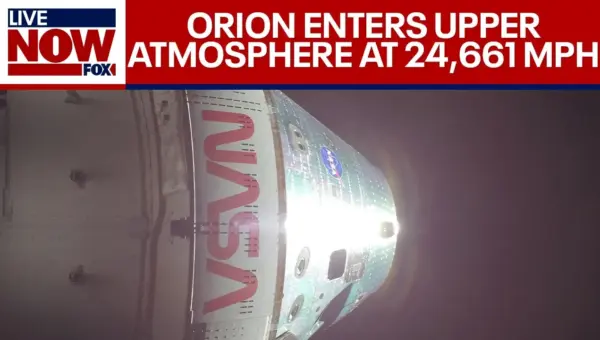
The Artemis II mission is set for a high-stakes splashdown as the Orion capsule, carrying four astronauts, re-enters Earth's atmosphere at nearly 25,000 mph. The crew faces extreme heat and G-forces, while NASA monitors the performance of the capsule's heat shield after unusual findings on the prior uncrewed mission. This historic return follows a successful journey around the moon, marked by significant scientific observations.

Artemis Astronauts Brace for Fiery Re-entry Splashdown
The Artemis II astronauts are preparing for a critical splashdown off the California coast after a perilous re-entry into Earth's atmosphere. Concerns linger over the Orion capsule's heat shield performance, which showed significant damage on a previous uncrewed mission. The mission's success is vital for NASA's future lunar and Martian exploration goals.
Moon Missions Reignite Space Race Ambitions
The Artemis II mission has shifted focus back to the Moon, revealing new geological insights and boosting confidence in lunar hardware. This renewed emphasis signals a potential new era of sustained lunar presence, moving beyond earlier Mars-focused ambitions and echoing the historical space race.