US Navy to Escort Oil Tankers Through Strait of Hormuz
The U.S. Navy will escort oil tankers through the Strait of Hormuz, a move confirmed by Treasury Secretary Steven Mnuchin amid concerns the Pentagon underestimated Iran's response capabilities. This strategic waterway, crucial for global oil transport, faces potential disruption as tensions escalate.


US Navy to Escort Oil Tankers Through Strait of Hormuz Amid Tensions
In a significant development amid escalating regional tensions, the United States Navy has announced its intention to escort oil tankers through the strategically vital Strait of Hormuz. This move comes as reports suggest the Pentagon and National Security Council may have underestimated Iran’s capacity to retaliate against U.S. military actions, potentially including the disruption of critical global oil supply routes. Treasury Secretary Steven Mnuchin confirmed the Navy’s commitment, stating that escorting vessels through the strait has “always been in our planning.”
Underestimation of Iranian Response Alleged
Recent reporting, including from CNN and The New York Times, indicates that senior Trump administration officials acknowledged during classified briefings that they did not adequately prepare for the possibility of Iran closing the Strait of Hormuz in response to U.S. military strikes. Three sources familiar with these closed-door sessions revealed this critical oversight, suggesting a potential miscalculation in the lead-up to recent escalations.
Naval Escorts and Strategic Challenges
Treasury Secretary Mnuchin, in a recent interview with Sky News, asserted that the U.S. Navy is prepared to escort oil tankers through the strait. He noted that tankers, including Iranian and Chinese-flagged vessels, are currently transiting the waterway, indicating it has not been mined. However, military experts caution that escorting tankers through the strait, especially under potential Iranian attack, presents an “extraordinarily difficult exercise.” MSNCB reporter Josh Einiger, reporting from Dubai, highlighted that the presence of U.S. naval ships alongside cargo vessels could turn them into targets. “The idea that you would put U.S. naval vessels at risk for drones, speedboats, swarming attacks is just a nonstarter,” one analyst told Einiger, suggesting that a military solution is unlikely and a political arrangement may be necessary.
Iran’s Leverage and Strategic Targeting
The Strait of Hormuz is a critical chokepoint, through which approximately 20% of the world’s oil passes daily. Iran has historically used its position to exert leverage. Reports indicate that Iran’s new supreme leader’s rhetoric suggests a continued strategy of using the strait as a point of pressure to increase the costs of conflict for the United States. This strategy appears to involve targeting key infrastructure and shipping lanes to cripple the global economy and American interests in the region. Einiger noted that in the preceding 48 hours, six ships were targeted in the Persian Gulf, emphasizing that even if attacks are not directly within the strait, the broader region is vulnerable.
Attacks in Dubai and Regional Impact
The conflict’s reach extends to major economic hubs. An attack, described by the government as resulting from debris from an intercepted drone, caused significant damage to a building in Dubai’s International Financial Center, the financial heart of the city. While no injuries were reported in this specific incident, the broader impact of such attacks is felt. Einiger reported that in the UAE, six people have been killed and over 100 injured due to falling debris from intercepted drones targeting residential areas. Despite these incidents, Einiger observed that the overall atmosphere in Dubai does not feel like a war zone, largely due to the city’s sprawling nature and the strategic targeting of infrastructure like airports and oil facilities, rather than densely populated civilian areas.
Economic Ramifications and Diplomatic Outlook
The potential disruption of oil flow through the Strait of Hormuz carries significant economic weight. Experts suggest that the idea of individual tankers being escorted is not a sustainable solution, and the lack of insurance for fully loaded tankers could prolong the economic impact. Richard Hauss, commenting on the situation, stated, “This is not going to rebound quickly. It’s going to take time for this to play itself out.” He emphasized that a lasting resolution will likely require a broader political arrangement, not just concerning the strait, but encompassing the post-conflict Middle East, involving Iran, the United States, and Israel. “It’s going to take three to stop it,” Hauss remarked, pointing to the need for diplomacy between these key players.
The “New Middle East” and Future Prospects
The region’s transformation into a hub for data centers and energy, often referred to as the “New Middle East,” adds another layer of complexity and high stakes to the current geopolitical climate. The economic infrastructure is modernizing, yet it remains vulnerable to regional instability. The consensus among analysts is that a purely military solution is unlikely to resolve the current crisis. Instead, a comprehensive diplomatic approach, addressing the multifaceted issues at play, appears to be the most viable path forward. The coming weeks and months will be crucial in observing whether diplomatic efforts can de-escalate tensions and ensure the stable passage of vital global energy resources through the Strait of Hormuz.
Source: 'Always in our planning': U.S. Navy will escort oil tankers through Strait of Hormuz (YouTube)

Related Articles

G7 Allies Clash Over Iran War Strategy, Urge Focus on Russia
G7 foreign ministers met in Paris, revealing deep divisions over the U.S. war with Iran. European allies urged the U.S. to pressure Russia, linking its actions to the conflict and fearing support for Ukraine will wane.
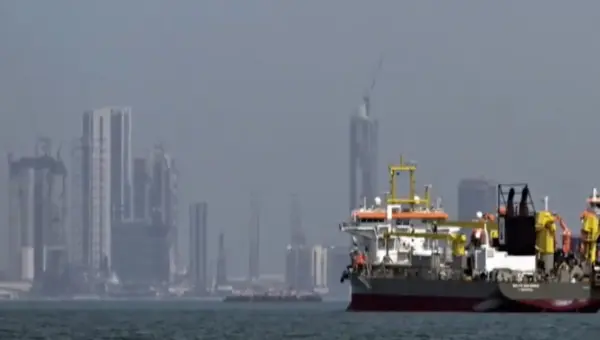
Iran Blocks China Ships, Exposing Beijing’s Weak Grip
Iran's recent decision to block Chinese ships at the Strait of Hormuz is exposing the limits of Beijing's influence in the Middle East. This action is causing delays and cancellations for Chinese manufacturers, turning a perceived geopolitical win into an economic strain.
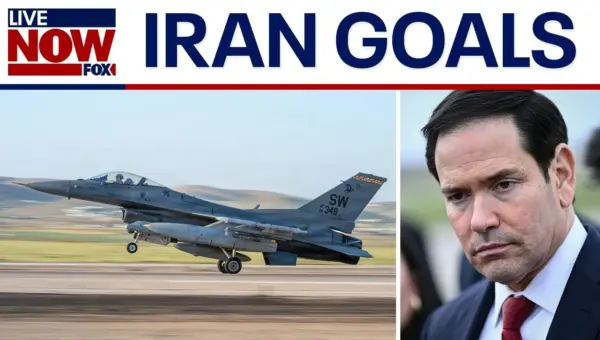
Rubio: US Can Achieve Iran War Goals Without Troops
Senator Marco Rubio outlined a strategy to counter Iran without deploying U.S. ground troops, focusing on weakening the regime and enhancing maritime security. He also criticized Cuba's economic system and expressed concerns about West Bank violence.