US Military Strikes Iran to Curb Missile, Nuclear Threats
The U.S. military has launched strikes targeting Iran's missile production, naval power, and nuclear program, aiming to prevent regional aggression. While military objectives are clear, the administration navigates a delicate political path, avoiding explicit regime change goals but creating conditions for internal shifts.

US Military Strikes Iran to Curb Missile, Nuclear Threats
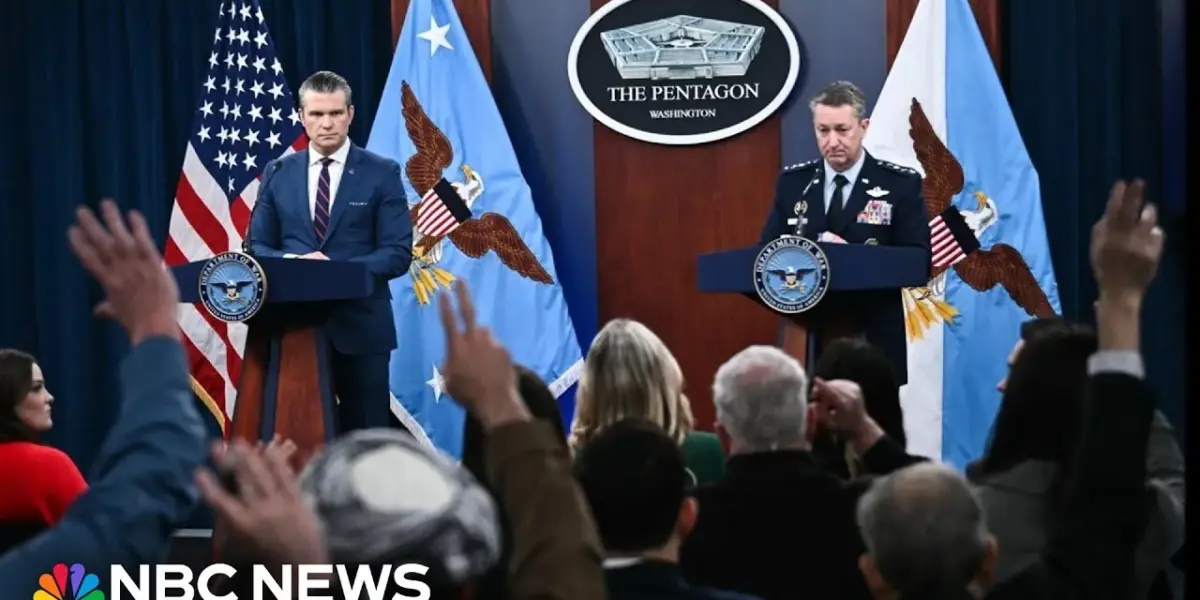
WASHINGTON D.C. – The United States military has launched a series of strikes aimed at crippling Iran’s missile production capabilities, its naval power, and its nuclear program, senior defense officials announced Friday. The operation, ordered by President Trump, seeks to prevent Iran from projecting strength or violence beyond its borders. The timeline of the decision-making process, which occurred while the President was traveling, has been detailed, alongside a clearer articulation of the military objectives guiding the U.S. actions.
Clear Military Objectives, Ambiguous Political Goals
Secretary of Defense Hegseth, speaking from the White House, outlined the primary goals of the operation. “The goals of this operation are to eliminate Iran’s missiles, their missile production capability, their navy and anything that remains of their nuclear problem,” Hegseth stated. He further elaborated that the overarching aim is to “essentially prevent Iran from projecting strength or violence anywhere beyond its borders.” These efforts are expected to be sustained over time.
General Caine provided insights into the military assets deployed and the preparatory measures taken in the weeks preceding the strikes, emphasizing the meticulous planning to ensure the operation’s success. The military confirmed that four U.S. service members were killed when a tactical operations center was hit by an Iranian missile, an incident that underscores the volatile nature of the ongoing conflict.
A War Not of Regime Change, But of Circumstance
While the military objectives have been clearly defined, the political ramifications and the administration’s ultimate aims remain less transparent. Secretary Hegseth was careful to frame the current engagement as “not a war of regime change.” However, he also noted the evolving political landscape within Iran, suggesting that the regime is “in the process of changing.” He asserted that the U.S. “did not start this war,” a statement that may be met with international skepticism, given the historical context stretching back to the Iranian Revolution in the 1970s.
“This is not a war of regime change, but noti ng that the regime has, in fact, changed. It’s in the process of changing.” – Secretary Hegseth
The administration appears keen to avoid the perception of an “endless war” in the Middle East, with Hegseth suggesting that “this generation knows better” than to get bogged down in prolonged conflicts. This sentiment aims to reassure the public and international allies about the strategic scope and intended duration of U.S. involvement.
Ambiguity on U.S. Troop Presence
When questioned about the presence of U.S. “boots on the ground,” Secretary Hegseth provided a non-committal response. “No, there are no boots on the ground now,” he stated, adding, “but we wouldn’t necessarily tell you if there are.” This response highlights the Pentagon’s policy of withholding specific operational details, a move that could have long-term implications if the conflict, as President Trump has indicated, extends for several weeks.
A Call to the Iranian People
Notably, Secretary Hegseth twice urged the Iranian people to take action, stating, “We hope the Iranian people take advantage of this opportunity. This is your moment.” This statement suggests a potential divergence between the purely military objectives and the broader political aspirations of the U.S. administration. While the military strikes are not explicitly designed for regime change, the U.S. appears to be creating conditions that could facilitate such an outcome, without direct American military intervention on the ground.
The Trump administration seems determined to avoid being associated with the goal of regime change as a primary driver for continued U.S. involvement. However, the underlying strategy appears to be one of empowering the Iranian populace to instigate change from within, with the U.S. providing the impetus and opportunity rather than direct participation in internal political upheaval.
Looking Ahead
As the situation in Iran continues to develop, the international community will be closely watching the effectiveness of the U.S. military strikes in achieving their stated objectives. The long-term political consequences, the potential for escalation, and the response of the Iranian people to the administration’s calls for internal change will be critical factors to monitor in the coming weeks and months.
Source: What are the military's objectives in Iran? (YouTube)

Related Articles

US Launches ‘Operation Epic Fury’ Against Iran
President Trump authorized "Operation Epic Fury" on February 27th, initiating a massive, synchronized daylight strike against Iran on March 1st. The operation involved over 100 aircraft, naval missile strikes, and cyber warfare, aiming for speed, surprise, and overwhelming force.

US Won’t Rule Out Ground Troops in Iran, Cites Strategic Ambiguity
Secretary Hegseth stated the U.S. currently has no troops in Iran but refused to rule out future ground deployments, citing strategic ambiguity. He emphasized that revealing military plans to adversaries is "foolishness" and that the U.S. will "go as far as we need to go" to advance its interests.


Iran Missile Strike Kills Many Near Jerusalem
A direct Iranian ballistic missile strike on a residential neighborhood in Beamesh, near Jerusalem, has resulted in heavy casualties and widespread destruction. The attack, which bypassed Israeli air defenses, represents a significant escalation and has left the region on high alert.