US Launches New Moon Race: Artemis II Ignites Space Ambitions
NASA's Artemis II mission is set to launch, marking the first human journey to the Moon in over 50 years. This 10-day lunar flyby will test critical spacecraft systems, serving as a vital step towards establishing a sustainable presence on the Moon and future Mars missions.

US Launches New Moon Race: Artemis II Ignites Space Ambitions
NASA’s Artemis II mission is poised to make history, marking the first human journey to the Moon in over 50 years. The upcoming 10-day, 130,000-mile mission will send four astronauts on a lunar flyby, testing crucial spacecraft systems before future crewed landings. This ambitious undertaking represents a significant step in America’s renewed focus on lunar exploration and its long-term goals in space.
Artemis II: A Mission of Critical Tests
The Artemis II crew is preparing for launch from Cape Canaveral, with the mission’s success heavily dependent on favorable weather. As of recent reports, all systems are functioning correctly, and the spacecraft is deemed ready. The astronauts, who have been in quarantine leading up to the launch, are described as excited and well-prepared. Their preparation involves years of intensive training, including extensive work in simulators and mock-ups. They have spent nearly three years learning every detail of the Orion spacecraft and its systems.
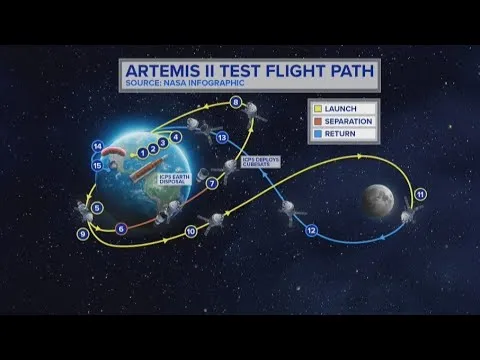
This mission is not a lunar landing but a lunar flyby. Its primary goal is to rigorously test the new systems aboard the Artemis II Orion spacecraft. For the first 24 hours, the crew will focus on validating the environmental control, life support, and propulsion systems. Following this, a critical burn will set the spacecraft on a free-return trajectory around the Moon. The mission includes a close approach of about 4,000 miles on the far side of the Moon before returning to Earth for a splashdown off the coast of San Diego.
Why the Long Wait? Understanding the Challenges
The question of why it has taken over 50 years to return humans to the Moon is a common one. While the Apollo program achieved lunar landings decades ago, the landscape of space exploration has changed significantly. For many years, the focus shifted to low Earth orbit and the International Space Station. Building and maintaining a sustained presence on the Moon requires vastly more advanced technology than earlier missions.
The Artemis program aims to overcome these challenges. The Orion spacecraft is designed for longer missions, capable of supporting a crew for up to 21 days. It features advanced systems like regenerative power from solar arrays and a regenerative life support system. These innovations are crucial for supporting NASA’s long-term objective: establishing a permanent human presence on the Moon and eventually venturing to Mars.
Global Impact: Reshaping Space Exploration
The Artemis II mission is more than just a technological test; it signifies a renewed global interest in lunar exploration. While the United States is leading this current phase, other nations and private companies are also pursuing lunar ambitions. This renewed focus could spur international cooperation, but also competition, as countries vie for leadership in space. The development of new technologies for lunar missions can have spillover effects, benefiting various industries on Earth.
For future generations, missions like Artemis II serve as a powerful inspiration. They encourage young people to pursue careers in science, technology, engineering, and mathematics. Seeing astronauts embark on such daring journeys can spark curiosity and a sense of wonder about the universe, fostering a new wave of explorers and innovators.
Historical Context: From Apollo to Artemis
The Artemis program builds upon the legacy of the Apollo missions, which first landed humans on the Moon between 1969 and 1972. Apollo 11, the most famous of these missions, was a monumental achievement that captured the world’s imagination. However, the Apollo program was also a product of its time, driven by the Cold War space race between the United States and the Soviet Union.
Artemis represents a different era. Instead of a direct competition, it aims for a sustainable, long-term presence on the Moon. This approach involves developing reusable technologies and fostering partnerships with international space agencies and commercial entities. The goal is not just to visit the Moon again but to learn to live and work there, using it as a stepping stone for further exploration of the solar system.
Future Scenarios: A Stepping Stone to Mars
The success of Artemis II is a critical precursor to future Artemis missions, including Artemis III, which aims to land the first woman and the next man on the lunar south pole. These missions are designed to test technologies and operational strategies needed for eventual human missions to Mars. The Moon serves as a valuable proving ground, allowing astronauts and engineers to gain experience in deep space operations, resource utilization, and long-duration spaceflight.
The long-term vision includes establishing a lunar base, which could support scientific research, resource extraction, and even space tourism. This sustained human presence on the Moon would mark a significant expansion of humanity’s reach beyond Earth, paving the way for bolder exploration of the cosmos.
Source: ‘All systems are go’: Artemis II will soon start its journey to the moon | Morning in America (YouTube)

Related Articles


US Threatens Iran’s Infrastructure, Faces Diplomatic Backlash
U.S. President Trump has escalated rhetoric against Iran, threatening to destroy civilian infrastructure if a deal isn't reached, while Iran denies direct talks and calls proposals "unrealistic." Meanwhile, the Artemis II mission prepares for a historic lunar orbit, marking a new era of space exploration.


NASA’s Artemis 2 Mission: Astronauts Launch for Moon
NASA's Artemis 2 mission is set to launch, sending four astronauts on a historic journey around the moon. This marks humanity's first crewed voyage beyond Earth's orbit in over 50 years and is a crucial step towards establishing a long-term lunar presence and future Mars missions. The crew will test the Orion spacecraft's systems and conduct scientific observations during their 10-day mission.

Artemis II Crew Prepares for Historic Moon Mission Launch
NASA's Artemis II mission is set for launch this Wednesday, sending four astronauts on a ten-day journey around the Moon. This historic flight will test the Orion spacecraft and Space Launch System rocket, marking humanity's first return to lunar proximity in over 50 years. The crew will perform critical system checks and manual flight tests, paving the way for future deep space exploration.