US Launches Full-Scale Conflict with Iran; Retaliatory Strikes Hit Gulf States
The United States has entered day four of a full-scale conflict with Iran, marked by escalating retaliatory strikes from Tehran targeting U.S. interests across the Gulf states. While U.S. officials cite an imminent threat, the endgame remains unclear, with Iran's capacity for sustained attacks and the internal stability of the nation under increasing scrutiny.


US Escalates Conflict with Iran, Day Four Sees Retaliatory Strikes
The United States has launched a full-scale conflict against Iran, entering its fourth day with no clear endgame in sight. The escalation followed an imminent threat assessment, according to administration officials, who stated that Iran would have retaliated against U.S. interests had Iran itself been attacked. The situation has rapidly intensified, with Iran stepping up retaliatory strikes on American targets across the Middle East, including in key Gulf states.
Iran’s Retaliatory Strikes Expand Across the Gulf
Overnight, Iran launched retaliatory strikes targeting American interests in several Gulf nations, including Bahrain, Kuwait, the United Arab Emirates, Qatar, and Saudi Arabia. Reports indicate drones were fired at the U.S. Embassy in Riyadh, signaling a significant metastasizing of the conflict. International Correspondent Matt Bradley, reporting from Israel, described a state-of-the-art dispatch center for Magen David Adom, Israel’s ambulance and emergency service, which has been heavily supported by American donations. This advanced infrastructure, including underground blast doors and sophisticated alert systems, has contributed to remarkably low casualty numbers in Israel despite the ongoing hostilities.
“We’re seeing a real metastasizing of this conflict, which is exactly what people were warning about if Iran got attacked.”
Matt Bradley, NBC News International Correspondent
The extent of Iran’s remaining munitions and its capacity to sustain further attacks on American targets remains a significant open question. Despite Israel achieving near-complete air superiority over Iran, missile alerts continue to sound in the region, indicating that Iranian forces are still actively engaged.
Inside Iran: Chaos, Displacement, and Economic Fears
On the ground in Iran, the situation is described as chaotic and harrowing for civilians. Reporter Matt Bodner detailed accounts from Tehran, where the initial U.S. bombing campaign left the city covered in smoke. Many targets, including police stations, are located near residential buildings, leading to reports of civilians being shaken by closely falling munitions. The city’s roads were jammed as residents attempted to flee to safer regions. At least one hospital in the northwest of the city reportedly filled with injured civilians and militia members.
While the public mood is reportedly quieter, there is significant concern about the country’s future leadership and its potential to survive as a coherent entity. The economy is also a major concern, with rising prices and the potential for citizens to deplete their savings if the conflict prolongs, echoing sentiments from previous protests.
Succession Questions Loom Over Iran’s Leadership
The death of the Ayatollah has triggered a leadership vacuum, with the Assembly of Experts, an 88-member panel of religious clerics, tasked with choosing a new Supreme Leader. The constitution mandates this process occur as quickly as possible. However, potential deterrents to a swift appointment include the risk of the U.S. targeting a newly appointed leader. Figures like Ali Reza Ashrafi, appointed to lead a temporary transitional council, are being closely watched.
“The constitution says that this must happen as quickly as possible. What that means in practice will be anyone’s guess.”
Matt Bodner, NBC News Reporter
US Citizens Urged to Evacuate Amidst Growing Danger
The U.S. State Department has issued no general evacuation orders for American citizens in affected regions, leaving many stranded. One American citizen attempting to fly out of Doha found his plane turned around, leaving him uncertain of his next steps. While Israel has robust civil defense infrastructure, including mandatory bomb shelters in most buildings, other nations in the Gulf are receiving a significant amount of incoming fire from Iran. The safest locations are increasingly determined by the availability of protection rather than geographical position.
Military Perspective: A Defined Mission, But Unpredictable End
Retired Colonel Peter Mansoor, former executive officer for General David Petraeus during the Iraq War, offered perspective on the conflict’s potential duration. He noted that while the U.S. military has a stated goal of a 4-to-6-week operation to destroy missile threats and naval capabilities, the actual end of the conflict is contingent on Iran’s response. If Iran continues to fight beyond this period, the U.S. and its allies will need to continue defending their facilities and urban areas.
Looking Ahead: The Unfolding Crisis
As the conflict enters its fifth day, the immediate focus remains on the ongoing retaliatory strikes and the humanitarian impact within Iran. The international community watches closely as the U.S. navigates the complex geopolitical landscape, while Iran grapples with internal stability and the critical question of its future leadership. The coming days will be crucial in determining the trajectory of this rapidly escalating crisis.
Source: LIVE: NBC News NOW – March 3 (YouTube)

Related Articles


Trump Not a Russian Asset, Analyst Argues
Despite actions that appear to align with Russian interests, Donald Trump is likely not a Russian asset, according to a new analysis. The argument suggests the current administration's approach to the Ukraine war is driven by a lack of preparedness and a focus on future business opportunities with Russia, rather than direct allegiance.
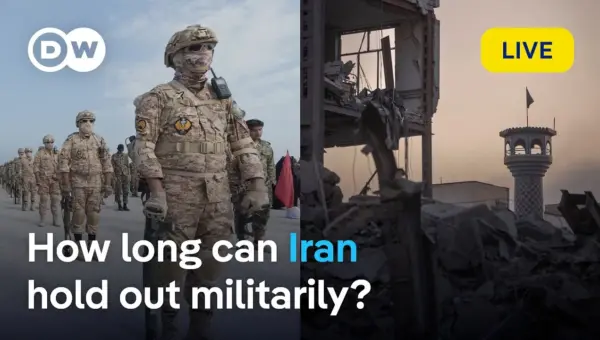
Iran’s Military Endurance Tested Amidst US-Israeli Conflict
DW News examines Iran's military endurance amidst the US-Israeli conflict, analyzing its strategic capabilities, economic pressures from sanctions, and the role of regional proxies. The discussion highlights the complex factors determining Iran's resilience in a protracted confrontation.

Iran Strikes Gulf States, London Insurance Market Faces Crisis
Iran's escalating strikes on Gulf states, including a major hit on a Saudi oil refinery, have sent oil prices soaring and triggered a severe crisis in London's insurance market. The geopolitical turmoil is raising questions about the shifting justifications for U.S. military actions and the complex internal dynamics within Iran.