US, Israel Strike Iran; Supreme Leader Khamenei Dead
The United States and Israel launched a joint military strike on Iran, resulting in the death of Supreme Leader Ayatollah Ali Khamenei. President Trump declared "the hour of your freedom is at hand" for the Iranian people amidst escalating regional conflict.


US, Israel Launch Joint War on Iran, Supreme Leader Killed
In a dramatic escalation of Middle East tensions, the United States and Israel launched a coordinated military strike on Iran early Saturday morning, resulting in the death of Iran’s Supreme Leader, Ayatollah Ali Khamenei. The operation, described as a “tectonic shift” by observers, marks a significant escalation in the long-standing conflict between the Islamic Republic and Western powers.
“Hour of Your Freedom is at Hand,” Declares Trump
Following the initial strikes, U.S. President Donald Trump took to social media to announce the death of Ayatollah Khamenei, who had led Iran for over 35 years. Trump declared that “the hour of your freedom is at hand” for the people of Iran, urging citizens to remain sheltered due to the ongoing danger. He suggested this could be a generational opportunity for Iranians to take control of their government.
The announcement of Khamenei’s death was initially met with denials from the Iranian government but was later confirmed on state television by an emotional presenter. While some Iranians reportedly grieved the loss, others were seen celebrating in the streets, dancing and expressing joy.
“A Plan That’s Been in Motion for Decades”
Gabrielle Wineer, The Times’ Israel correspondent, reporting from Tel Aviv, described the immediate aftermath. “We were woken up around 8:00 a.m. local time with air raid sirens, which was quite surprising,” she stated. “Everyone went down to the shelters to find them locked. It turns out the first siren was a warning that Israel is at war. That was how they announced it to the public so that people could prep.”
Wineer characterized the U.S. and Israeli operation as “completely joint” from the outset, differentiating it from previous engagements. “This is a plan that’s been in motion really for decades,” she explained. “Israel is deeply embedded in the Iranian network. They have placed themselves and their intelligence agencies all over Iran and I think they used a lot of their intel to organize their opening gambit which was extremely strong and caught Iran completely off guard.”
Targeting the Supreme Leader
The assassination of Ayatollah Khamenei was seen as the “ace card” for Israel. “He’s the top decision maker; he’s the spiritual leader of Iran; he’s in charge of absolutely everything. He is Iran,” Wineer emphasized. The strike, which reportedly involved “30 bombs” dropped on his compound, was particularly surprising as it occurred in “full daylight,” a departure from expectations of a nighttime operation.
The attack also reportedly targeted a meeting of senior Iranian military and political leaders, with reports suggesting that “top leaders were all meeting together” at the time of the strike.
Regional Conflict Spreads
The Iranian response was swift and widespread, raising questions among analysts about whether this was part of a planned strategy or a sign of fractured command. “It’s not just military bases. They are sort of hitting citizens in different countries,” Wineer noted.
Iran has reportedly targeted four Gulf Arab countries hosting American military bases: Bahrain, Kuwait, Qatar, Dubai, and the UAE, using “kamikaze drones.” Additionally, Iran fired missiles in the direction of Cyprus, where the UK has military bases, indicating a broadening of the conflict beyond Israel.
Nuclear Talks as a “Sideshow”?
The strikes occurred amidst ongoing negotiations over Iran’s nuclear program. Journalists found it difficult to lend credence to reports that these talks were progressing positively. “I think the plan was always to topple the regime while it was weak,” Wineer suggested.
Peter Westmacott, a former British diplomat and ambassador to the U.S. and Turkey, echoed this sentiment, questioning the wisdom of the strikes without a clear plan for the aftermath. “It’s one thing with brilliant intelligence and extraordinary military capability to take out Ayatollah Kame and a lot of his other senior people. But then what?” he asked.
Westmacott pointed out that Iran has contingency plans for succession, as Khamenei was 86 years old. He noted the existence of potential successors, including Khamenei’s son, Mujtaba, and Ali Larijani, as well as the powerful Revolutionary Guard. However, he cautioned, “there is no touchy-feely wonderful liberal freedom-loving democratic opposition movement which is ready to step into the breach.”
Historical Context and Suspicion
The history of U.S. and British involvement in Iran, including the 1953 coup and support for Saddam Hussein during the Iran-Iraq war, breeds deep suspicion among Iranians. “The Iranians held us and the Americans responsible for the 1953 coup which got rid of Muadec, the democratically elected prime minister,” Westmacott stated. He also referenced the 1979 hostage crisis and the 1983 Beirut barracks bombing, attributing it to Iranian proxies.
Legality and Global Markets
The legality of the preemptive strike was questioned, with Westmacott noting the lack of an imminent threat that would justify such action under international law. He also highlighted the U.S. administration’s decision not to seek a UN resolution or even a vote in Congress, a departure from previous military actions.
The conflict’s impact on global markets is a significant concern, particularly with the potential closure of the Strait of Hormuz, through which a substantial portion of the world’s oil and gas passes. “The price of oil goes up. And other markets I would have thought would be somewhat spooked by this,” Westmacott observed, suggesting that market reactions could influence President Trump’s decisions.
Uncertain Future
As the situation unfolds, the Middle East stands at a critical juncture. The assassination of Ayatollah Khamenei and the ensuing military action have created profound uncertainty about the region’s future, with potential for wider conflict and unpredictable political realignments. The coming weeks will be crucial in determining whether this “tectonic shift” leads to lasting instability or a new regional order.
Source: Ayatollah Khamenei Assassinated: Middle East Conflict Latest Updates (YouTube)

Related Articles
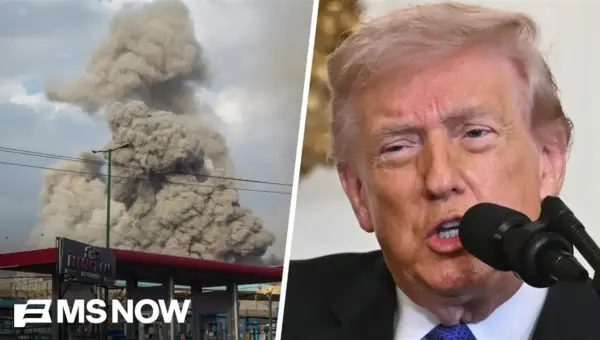
Trump Hints at Escalation: ‘The Big One Is Coming Soon’
President Trump's recent remarks about an impending major escalation with Iran, stating "The big one is coming soon," have been met with confusion due to inconsistent messaging from his administration. Conflicting narratives on regime change and the immediacy of threats, coupled with reports of diplomatic overtures and regional instability, leave a cloud of uncertainty over the escalating conflict.

Middle East Erupts: US-Iran War Escalates, Jets Downed
The U.S.-Iran war has escalated dramatically, with three American jets downed by friendly fire in Kuwait and Israel launching a new offensive against Hezbollah in Lebanon. These events follow U.S.-Israeli strikes that killed Iran's Supreme Leader, Ayatollah Khamenei, prompting Iranian retaliation that has killed U.S. troops and targeted regional infrastructure.

Russia’s Muted Response to Middle East Escalation Puzzles Markets
As the Middle East faces a dramatic escalation with U.S. and Israeli-led strikes on Iran, Russia's conspicuous absence from the conflict has become a central question. Analysts explore whether Russia's non-intervention stems from military constraints, strategic economic benefits from rising oil prices, or a deliberate effort to avoid broader global conflict.