US, Iran Agree to Ceasefire Amidst Conflicting Claims
Markets and oil prices surged following President Trump's announcement of an 11th-hour ceasefire agreement with Iran. However, conflicting statements from both nations have cast doubt on the deal's specifics and durability. Key issues like the Strait of Hormuz and Iran's nuclear program remain points of contention as diplomatic talks loom.

US, Iran Announce Ceasefire Amidst Confusion
Markets surged and oil prices plunged on April 8th following President Trump’s announcement of an 11th-hour ceasefire agreement with Iran. The deal, intended to halt hostilities, has been met with mixed reactions and considerable uncertainty, with conflicting statements emerging from both sides regarding its details and the commitment to a 14-day truce.
Conflicting Accounts Emerge on Deal Details
President Trump initially announced the ceasefire on social media, stating that bombing would cease if Iran immediately reopened the Strait of Hormuz. He also mentioned receiving a “workable” 10-point proposal from Iran, though specifics were not provided. Iran’s Security Council, however, declared the ceasefire a victory against American aggression, with celebrations reported in the streets of Iran.
Vice President Vance acknowledged the ceasefire is on “shaky ground” but warned of serious consequences if Iran breaks the agreement. Meanwhile, President Trump described the ceasefire as a “total and complete victory for the U.S.,” a sentiment echoed by Defense Secretary Hegseth. Hegseth detailed “Operation Epic Fury” as an “overwhelming victory on the battlefield” that “decimated Iran’s military.”
However, Iran’s parliamentary speaker claimed multiple points of the deal have been violated. White House Press Secretary Karine Leavitt stated that Iran’s public announcements about the agreement cannot be trusted. She explained that an initial, “fundamentally unserious” 10-point plan from Iran was discarded, and a more “reasonable and entirely different and condensed plan” was later presented, which the President found workable. Leavitt emphasized that President Trump’s red lines, including ending Iranian enrichment, have not changed.
Confusion Over Iran’s Proposals
Vice President Vance further elaborated on the confusion surrounding Iran’s proposals, mentioning at least three different 10-point plans. He described one as “probably written by ChatGPT” and immediately rejected, a second as more reasonable and based on back-and-forth with Pakistan and Iran, and a third that was more maximalist. Vance indicated the President was referencing the second, more reasonable proposal.
Strait of Hormuz Remains a Flashpoint
Adding to the tension, Iran announced it was suspending traffic through the Strait of Hormuz, accusing Israel of violating the agreement following Israeli attacks on Hezbollah in Lebanon. White House Press Secretary Leavitt called this unacceptable, stating that while Iran’s public announcement claimed the strait was closed, private reports indicated an uptick in traffic. The President’s expectation remains that the Strait of Hormuz be reopened immediately, quickly, and safely.
The ceasefire has also not stopped broader military actions. Qatar’s Defense Ministry reported being targeted by seven missiles and drones launched from Iran and Kuwait, with petroleum facilities attacked. These developments occur as Pakistan prepares to host diplomatic talks in Islamabad, with Vice President Vance, Special Envoy Steve Witkoff, and Jared Kushner leading the U.S. delegation.
Diplomatic Efforts and Regional Concerns
White House Correspondent Monica Alba reported that the main agreement seems to be a pause to allow for diplomatic talks, but the fine points remain unrevealed. Key areas of disagreement include the potential presence of U.S. service members, easing sanctions, and the handling of the Strait of Hormuz. Alba noted that Iran’s public proposals, such as full compensation for damages and the removal of all sanctions, are likely non-starters for the U.S.
Vice President Vance’s leadership of the U.S. delegation in Islamabad is seen as significant, especially given his past opposition to U.S. strikes in Iran. His involvement carries political weight, potentially impacting his future presidential aspirations.
From Saudi Arabia, Chief International Correspondent Keir Simmons described the situation as “confusion” but noted that a former IRGC commander suggested Iran is prepared to negotiate and sees its points as a starting point. However, attacks in Lebanon are considered a “red line” for Iran, potentially jeopardizing the talks. Simmons also highlighted that U.S. allies in the region, like Saudi Arabia and Bahrain, are frustrated by continued attacks. He pointed out the potential role of China in pressuring Iran, suggesting a shift in the regional balance of power.
Israel’s Role and Military Assessment
In Tel Aviv, International Correspondent Matt Bradley reported a sense of returning normalcy and optimism following the ceasefire announcement. However, the Israeli government remains worried about the progress, particularly concerning Lebanon. Israel has stated its determination to destroy Hezbollah, Iran’s proxy, and is trying to decouple Lebanon from Iran to negotiate peace while continuing its offensive against Hezbollah. This effort is seen as a significant challenge to the negotiated truce.
On the military front, Courtney Kube reported that Secretary Hegseth declared victory, and the Pentagon provided details on battle damage inflicted on Iran’s conventional military during “Operation Epic Fury.” However, Kube noted that the primary objective of destroying Iran’s ballistic missile and drone capabilities has not been fully achieved, despite significant damage to Iran’s production ability. The status of Iran’s enriched uranium stockpile remains a critical concern, with the U.S. reserving the option for further strikes if necessary.
Market Reaction and Future Outlook
Business and Economy Reporter Allie Canal highlighted a significant relief rally on Wall Street, with the Dow surging over 1300 points and oil prices plunging. Investors are reacting to the first piece of positive news regarding the conflict, particularly the focus on the Strait of Hormuz. However, Canal noted a disconnect between market expectations and the current reality, as shipping companies are still adopting a cautious approach due to ongoing uncertainty about maritime safety.
The coming weeks will be crucial as diplomatic talks proceed. The ability of both sides to reconcile their vastly different interpretations of the ceasefire and the underlying proposals will determine whether this fragile truce holds and if a lasting resolution can be found. The potential for renewed military action remains if negotiations falter or if the ceasefire is violated.
Excerpt:
Markets and oil prices surged following President Trump’s announcement of an 11th-hour ceasefire agreement with Iran. However, conflicting statements from both nations have cast doubt on the deal’s specifics and durability. Key issues like the Strait of Hormuz and Iran’s nuclear program remain points of contention as diplomatic talks loom.
Source: Meet the Press NOW – April 8 (YouTube)

Related Articles
Trump Orders Strait of Hormuz Blockade, Risks Global Oil Shock
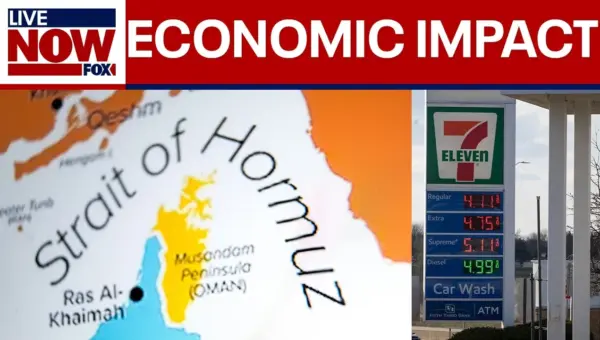
President Trump has ordered the U.S. Navy to blockade the Strait of Hormuz, a critical global oil transit point, sparking fears of soaring energy prices and inflation. This strategic move aims to exert pressure on Iran and China, while also addressing domestic economic concerns ahead of midterm elections.

Iran’s Strait of Hormuz Blockade Shifts Global Oil Power
Iran's control over the Strait of Hormuz, a vital global oil route, is shifting economic power dynamics. As former President Trump declared a U.S. naval blockade, experts highlight Iran's effective use of this physical choke point, challenging U.S. financial leverage and potentially forcing negotiations under duress.

US Tightens Grip, Eyes Regime Change in Iran
John Bolton argues that the recent ceasefire with Iran was a mistake and advocates for a renewed military strategy. His proposal includes reopening the Strait of Hormuz and maintaining a blockade on Iranian oil to pressure the regime, with the ultimate goal of regime change.