US Ground Invasion of Iran Risks ‘Mission Creep,’ Warns Retired General
Retired General David Deptula warns that a U.S. ground invasion of Iran carries no guarantees and risks 'mission creep,' potentially leading to prolonged conflict. As the U.S. considers ground troop options, objectives appear to be shifting from regime change to managing economic fallout and securing maritime routes.


US Weighs Iran Ground Options Amid Shifting War Aims
The United States is actively considering ground troop options in Iran, with officials preparing multiple scenarios for the president. This comes as reports suggest Secretary Rubio informed G7 allies of a swift, two-to-four-week timeline for the conflict’s conclusion. However, retired U.S. Air Force Lieutenant General David Deptula warns that any ground operation carries significant risks, particularly the potential for ‘mission creep’ that could draw the U.S. into a prolonged conflict.
Conflicting Signals: Diplomacy and Escalation
National security reporter Vera Bergen-Gruin of The Wall Street Journal highlighted the mixed messages coming from U.S. leadership. While Secretary Rubio told allies the war could be won quickly without needing ground troops, the Pentagon is reportedly considering sending an additional 10,000 troops, with some already arriving in the Middle East. This dual approach of signaling openness to negotiation while preparing for military escalation is characteristic of the Trump administration’s strategy.
“Rubio was telling them, we actually don’t need these ground troops to meet our military objectives,” Bergen-Gruin explained. “So he’s giving them a very particular timeline. And at the same time, you know, it really is highlighting this approach that Trump has taken, which is to both negotiate and escalate at the same time.”
Shifting Objectives: From Regime Change to Economic Stability
Initial objectives, such as regime change in Iran, appear to have taken a backseat to managing the economic consequences of the conflict. “You’ve stopped hearing U.S. officials speak as much about regime change now,” Bergen-Gruin noted. “They’re really, really distracted and focused much more on the economic fallout.” Current discussions reportedly center on containing economic damage and ensuring the free flow of maritime traffic, particularly through the Strait of Hormuz.
The Role of Ground Troops: Calculated Risk or Slippery Slope?
General Deptula, now dean of the Mitchell Institute for Aerospace Studies, explained that the U.S. military’s doctrine emphasizes using the right force at the right time. He acknowledged that contingency planning often includes ground forces, especially if diplomatic efforts fail or maritime pressure intensifies. However, he stressed that deploying ground troops is not a preferred option due to the inherent risk of casualties.
“However, there may be an option if there are objectives that cannot be accomplished any other way,” General Deptula stated. “A perfect example is physically securing Iran’s enriched uranium.” He emphasized that the decision to use ground troops depends entirely on the specific goals of the campaign and the desired outcomes.
The Specter of ‘Mission Creep’
The concern that a limited ground operation could escalate into a full-scale invasion or occupation remains a significant worry. General Deptula directly addressed this, stating, “There is no guarantee. There are no guarantees in war because of the level of uncertainty.” He pointed to the example of Afghanistan, where initial objectives were met, but the U.S. became involved in nation-building for two decades.
“So things happen. There are no guarantees,” he reiterated, underscoring the unpredictable nature of military engagements. The potential for intended, limited actions to expand into broader, unforeseen commitments is a historical lesson the U.S. military has learned, sometimes painfully.
Negotiations Stall Amidst Conflicting Demands
While both the U.S. and Iran have publicly stated their willingness to negotiate, direct talks have not materialized. Bergen-Gruin described the current situation as the two sides “talking past each other.” A recent exchange of proposals, with the U.S. presenting a “maximalist wish list” and Iran rejecting it, indicates significant gaps remain.
Looking Ahead: Uncertainty in the Gulf
The coming weeks will be crucial in determining the trajectory of the situation. The deployment of U.S. forces, the ongoing diplomatic signaling, and the internal calculations in both Washington and Tehran will shape whether the conflict de-escalates or expands. The risk of unintended consequences and the challenge of defining clear, achievable objectives without succumbing to mission creep will remain central concerns for U.S. policymakers.
Source: ‘No guarantees’ a U.S. ground invasion of Iran will remain contained: Retired General (YouTube)

Related Articles


Ex-Intel Officer Labels US Actions in Iran as Terrorism
A former U.S. intelligence officer, Josephine Gilbo, delivered a powerful speech accusing the United States of terrorism due to its actions in Iran. Citing the bombing of a school that killed 165 girls, she argued U.S. military operations fit the definition of terrorism. Gilbo urged military commanders to refuse unlawful orders and questioned the purpose of the current deployments.
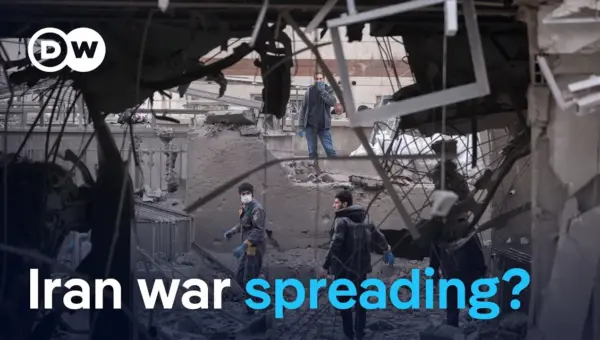
US Considers Ground Troops as Iran Conflict Intensifies
Middle East powers convene in Pakistan for peace talks as the month-long war intensifies. The US is reportedly considering ground troops amid escalating strikes on Iran, while experts caution against air power's political pitfalls and highlight the risks of a prolonged conflict.

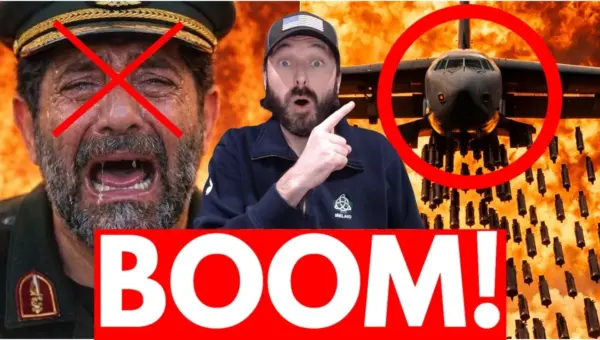
US Bombs Iran: Leaders Killed, Invasion Looms
The United States has launched powerful bombings against Iran, destroying key military targets and reportedly killing six senior leaders. With B-52 bombers involved and US ground troops moving into the region, a ground invasion appears imminent, signaling a dramatic escalation.