US Economic ‘Choke Points’ Reshape Global Order
The U.S. dollar's dominance grants America significant economic leverage through 'choke points,' but China is building parallel infrastructure as an insurance policy, not a replacement. A recent Supreme Court ruling curtails U.S. tariff powers, while Europe grapples with its position between global giants.

US Economic ‘Choke Points’ Reshape Global Order
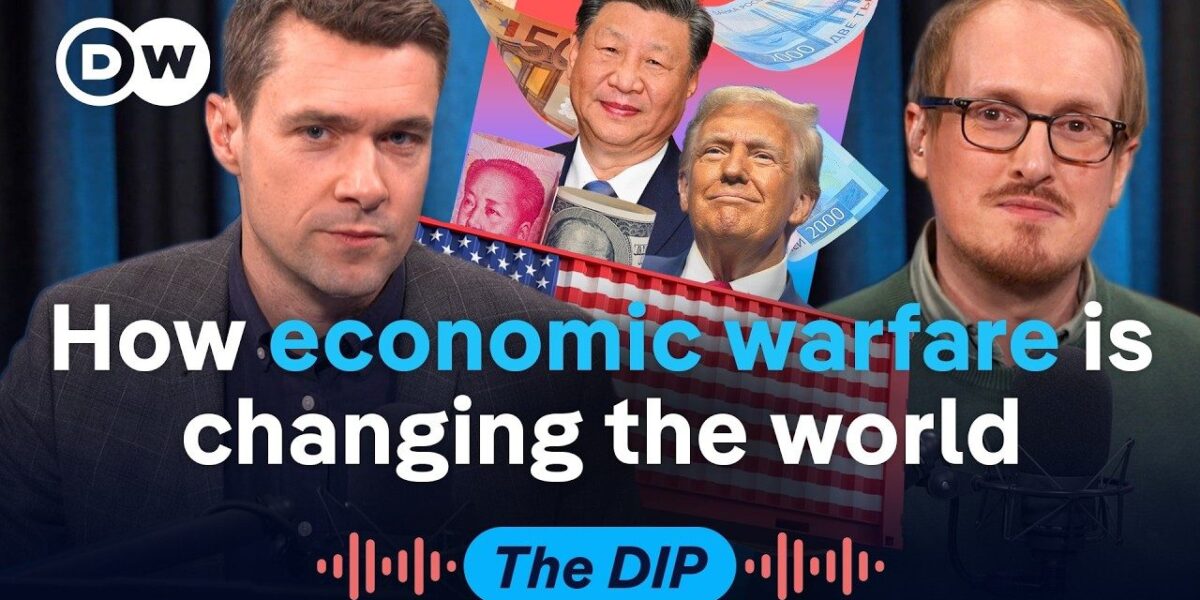
The United States wields significant economic power through its control over key global financial and trade infrastructure, often referred to as ‘choke points.’ This power, primarily derived from the U.S. dollar’s dominance, allows for coercive economic actions, but its effectiveness and the broader geopolitical landscape are being reshaped by evolving global dynamics, including China’s strategic development of alternative infrastructure. This analysis draws from insights shared by Edward Fishman, Director of the Greenberg Center for Geoeconomic Studies at the Council on Foreign Relations and author of ‘Choke Points,’ during an episode of The Dip Podcast.
Supreme Court Ruling Curtails Tariff Power
A recent Supreme Court ruling has delivered a significant blow to former President Trump’s economic strategy, particularly his reliance on tariffs. Trump viewed tariffs as a versatile tool, a ‘cure-all’ for economic issues and a primary means of generating government revenue. They were his go-to economic weapon for enforcing U.S. will on foreign nations, a strategy evident in actions like the proposed tariffs on Greenland. The Supreme Court’s decision substantially limits his ability to unilaterally impose tariffs, effectively circumscribing the ‘magic tariff Sharpie’ he could employ from the Oval Office.
Message to Moscow and Beijing Unclear
The implications of this ruling for global powers like Russia and China are not as direct as one might assume. Notably, Russia has not been a primary victim of U.S. economic coercion under the Trump administration; in fact, American allies have faced more economic threats. While significant sanctions were imposed on Russian entities like Rosneft and Lukoil, the frequency of broad sanctions packages against Russia has decreased compared to the period before its full-scale invasion of Ukraine. This has led to Russia being economically and militarily stronger than it would have been otherwise, despite being cut off from significant Western financing and technology since 2022.
With respect to China, the U.S. has also seen a pivot. Following an escalation last spring, including substantial tariffs, China’s retaliation with export controls on rare earth minerals altered the dynamic. This prompted a shift in U.S. policy from a hawkish stance to a more dovish approach, with considerable backtracking on economic pressure against Beijing.
The Dollar as the Ultimate Choke Point
Fishman emphasizes that economic tools are best understood not just legally but through the lens of ‘choke points’ – areas where one country holds a dominant position with few substitutes. While the U.S. controls the most critical choke points, others are held by different nations. The U.S. dollar stands out as the most potent choke point, involved in approximately 90% of foreign exchange transactions and serving as the default global medium of exchange, unit of account, and store of value. Despite the Supreme Court ruling affecting tariff powers, the President retains the ability to cut off any individual, company, or country from the dollar system with a stroke of a pen.
China’s Strategic ‘Shadow Infrastructure’
While China does not control the dollar, it possesses significant choke points in areas like rare earth mining and processing. It also holds potential leverage in semiconductors, with Taiwan’s TSMC being a key manufacturer of U.S.-designed chips. Furthermore, China has been developing alternatives, such as the digital renminbi, to facilitate trade independent of U.S.-influenced infrastructure. However, Fishman argues that China’s strategy is not to replace the dollar but to build ‘shadow infrastructure’ as an insurance policy. This parallel system would allow China to operate and scale rapidly in crisis scenarios, such as being cut off from the dollar during an invasion of Taiwan. He expresses concern that if the West fails to disrupt the growth of this infrastructure, China may be emboldened to take more aggressive actions.
“I actually don’t think China’s strategy is to replace the dollar. It’s really to provide an insurance policy. It’s it’s to sort of to build parallel infrastructure so that if there is a crisis like an inv Chinese invasion of Taiwan where maybe China is fully cut off uh from the dollar that they could scale up that parallel infrastructure rapidly.”
– Edward Fishman
Effectiveness of Economic Warfare
The success of economic warfare, or sanctions, is often debated. Fishman contends that a key challenge is the lack of clearly articulated goals. The efficacy of sanctions against Russia, for instance, depends entirely on the objective assigned. If the goal was to deter the invasion of Ukraine, sanctions were a failure. However, if the aim was to weaken Russia economically and militarily, they have had an impact. Before 2022, Russian state-owned enterprises were heavily reliant on dollar and euro-denominated debt and financed by Western institutions. Being cut off from these sources has undeniably weakened their economic and military capacity.
Europe’s Position Between Giants
Europe finds itself in a precarious position, caught between the economic power of the U.S. and China. Even its own initiatives, like sovereign cloud infrastructure, are dependent on U.S. AI stacks and Chinese-made chips. Fishman acknowledges the perceived bleakness of this situation but highlights Europe’s own considerable strength as a bloc, rivaling the U.S. economy. The primary challenge, however, is Europe’s difficulty in acting unilaterally due to the need for consensus among member states, unlike the U.S. or China.
Despite these hurdles, mechanisms like qualified majority voting for retaliatory sanctions and the concept of enhanced coordination among a vanguard of member states offer pathways for Europe to leverage its power. Fishman also cautions against equating economic security with self-sufficiency, deeming a scenario where every nation produces everything domestically as ‘hopeless.’ He also clarifies the concept of ‘weaponized interdependence,’ suggesting that states more typically weaponize dependence in areas of monopoly rather than interdependence itself. He points out that the U.S. is not solely dominant in its relationship with Europe; U.S. tech giants like Meta earn significant profits in Europe, giving Europe leverage.
The Achilles’ Heel: Political Will
Fishman identifies the ‘Achilles’ heel’ of American economic warfare not as a lack of offensive capabilities but a deficiency in political will to sustain economic downturns, such as a 2% stock market decline. He suggests that if European nations could achieve sufficient unity, they could potentially exploit this weakness.
The Future of the Global Economic Order
Looking ahead, the critical question for both the U.S. and Europe is whether they will allow a new global economic order to emerge haphazardly through uncoordinated acts of economic sanctions and industrial policy, or if the West will unite to actively shape the order they desire for economic security amidst heightened geopolitical competition. Fishman worries that this uncoordinated approach to economic warfare risks building an unwanted global economic order.
Source: China's secret weapon to dodge the dollar's influence | The Dip Podcast (YouTube)

Related Articles
Trump: Iran Strikes Ahead of Schedule, Expects ‘Great Deal for World’
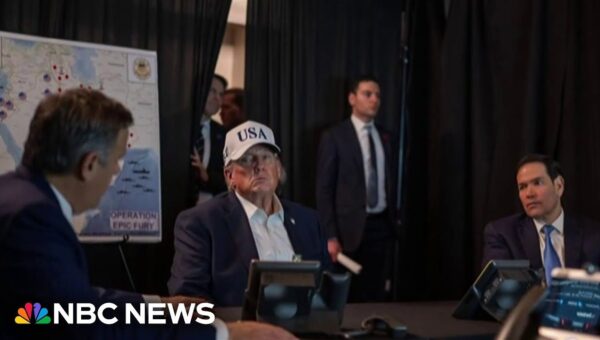
Three U.S. service members have been killed amid escalating conflict with Iran, President Trump confirmed. He stated that strikes are ahead of schedule, with senior Iranian leaders killed, and expressed optimism for a "great deal for the world" despite ongoing talks with Iranian officials.
Trump’s Putin Stance: US Strategy and Global Implications
Analysis suggests Donald Trump's approach to the Ukraine war involves pressuring Kyiv, but US involvement is crucial for resolution. China's influence and the 'MAGA' agenda's geopolitical implications are key factors.


US Strikes Iran: Mounk and Fukuyama Discuss Unpredictable Conflict
Leading political scientists Yascha Mounk and Francis Fukuyama analyze the recent US strikes on Iran, warning of unpredictable outcomes and internal instability. They question the objectives of the "war of choice" and its potential to destabilize the region, while also discussing the shifting global perceptions of Israel.