US, China Race for Lunar Riches: Who Will Strike Gold First?
The US and China are in a close race to establish a human presence on the Moon, driven by the potential for valuable resources like water ice and Helium-3. While the costs are immense, technologies developed for lunar operations, such as advanced cameras and memory foam, already benefit life on Earth.

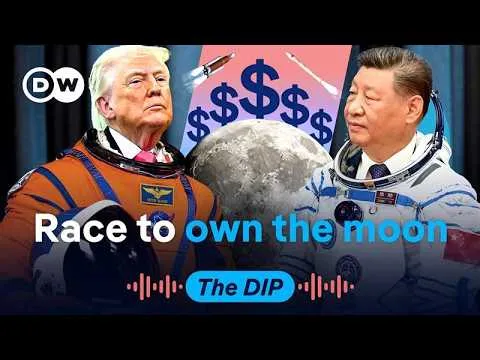
Moon Rush: Nations Vie for Cosmic Real Estate
The United States and China are locked in a high-stakes race to return humans to the Moon, not just for exploration, but for potential economic gain. This renewed focus on lunar missions, particularly around resource-rich areas, highlights the Moon’s growing importance as a frontier for future industries. The cost of sending even basic materials into space is immense, making the Moon’s resources, if accessible, incredibly valuable.
The High Cost of Reaching for the Stars
Getting to the Moon is not cheap. The historic Apollo missions cost U.S. taxpayers an estimated $300-350 billion in today’s money. The current Artemis program is already at $93 billion and is expected to climb higher. This significant investment raises questions about the economic justification for such ambitious space endeavors.
A Physicist’s Perspective on Lunar Ambitions
Philip Mezer, a physicist with 30 years of experience at NASA and now developing space mining technology, discussed the complexities of lunar missions. He noted that past U.S. moon missions faced budget cuts and shifting political priorities. “The presidential administration changes, they change their priorities,” Mezer explained. However, he sees a current convergence of goals, with a focus on the Moon as a stepping stone to Mars.
Lunar Geography: More Than Just Empty Space
While the Moon is vast, roughly the size of Africa, landing and operating there presents unique challenges. Unlike Earth, the Moon has no atmosphere, meaning spacecraft must use rocket engines for landing. This process kicks up lunar dust and soil, which can be accelerated to escape velocity by the rocket blast. “On the Earth, our intuition is that blast effects are localized, but on the moon, they’re not. They’re global,” Mezer stated. This means a single landing can affect a wide area.
The Allure of the Poles: Peaks of Eternal Light
Another major hurdle is the Moon’s extreme environment. It is tidally locked with Earth, meaning one lunar day lasts about 29.5 Earth days, with half of that being a frigid, dark night. This makes solar power unreliable. However, special locations near the poles, known as “peaks of eternal light,” offer nearly constant sunlight. These areas are also conveniently located near craters where ice has accumulated in perpetual shadow. Mezer called these spots “the most valuable real estate in the entire solar system” due to their energy potential and proximity to water ice, which can be converted into rocket fuel.
The Race: Steady Progress vs. Political Winds
When comparing the U.S. and China in the race to the Moon, Mezer highlighted China’s advantage of consistent, long-term planning. “They were able to set a goal and stick with it decade after decade,” he said. The U.S. system, influenced by public opinion and changing political administrations, can lead to more unpredictable progress. Despite this, Mezer believes the U.S. still holds an edge in aerospace innovation, allowing for “sprints” to catch up and potentially surpass China. He concluded that the race for human lunar return is currently very close.
Making Money on the Moon: Beyond the Initial Investment
Commercial opportunities on the Moon are still in their early stages and require massive upfront investment. Mezer identified key areas for potential profit: mining Helium-3 for use in fusion power on Earth, and extracting water ice to produce rocket fuel. This lunar-sourced fuel could be used to service satellites in Earth orbit, offering cheaper data, navigation, and communication services. A newer, exciting prospect is the idea of establishing data centers in space.
Lunar Mining: Scraping the Surface
Mining on the Moon won’t resemble deep underground operations on Earth. The Moon’s bedrock has been pulverized by billions of years of meteorite impacts, making it fractured and unstable for tunnels. Instead, operations will likely involve surface excavation, scooping up regolith (lunar soil) and processing it for valuable resources through chemical extraction.
Asteroid Mining: A Past Hype, Future Potential
Mezer addressed the often-hyped value of asteroids, clarifying that figures of trillions of dollars are often taken out of context. While asteroids contain vast amounts of valuable metals like platinum, the extreme cost of returning them to Earth makes it unprofitable compared to terrestrial mining. The real value, he explained, lies in using space resources *in* space. “There’s value to having things in space if you have a use for them in space,” he stated. Sending an ounce of water into space costs more than an ounce of gold, highlighting the economic benefit of in-situ resource utilization.
Rocket Fuel from Lunar Ice: A Game Changer
Producing rocket fuel from lunar ice is seen as a highly lucrative prospect, though it will require initial investment and operating at a loss. Launching fuel from the Moon offers a significant advantage over Earth launches. Because the Moon’s gravity is much lower, only 50% of the rocket’s mass is fuel, with the other 50% being payload. On Earth, fuel makes up 98% of the rocket’s mass. As robotics and AI advance, the cost of lunar operations could become only two to three times more expensive than on Earth, creating a massive profit margin compared to the 25-fold improvement in payload delivery.
Tangible Benefits for Earth: Space Spin-offs
The investment in space exploration yields significant benefits for everyday life on Earth. Technologies developed by NASA include the miniaturized CMOS camera chips found in smartphones, memory foam used in bedding and seating, and advanced heart pumps for patients with cardiac defects. The need to recycle water for astronauts, for instance, led to sophisticated purification systems. These innovations, often developed under extreme conditions, are spun off into commercial applications, providing consumers with advanced products without bearing the full research and development costs.
Source: China vs. the US: Who will cash in on the moon first? | The Dip Podcast (YouTube)

Related Articles


China Faces Tariff Threat Over Iran Arms Aid
President Trump is threatening China with a 50% tariff on all goods if Beijing provides military assistance to Iran. U.S. intelligence reports allege China is sending shoulder-fired missiles to Tehran. This move escalates U.S.-China tensions and has significant global economic and security implications.

NASA Aims for Moon Base, Eyes Mars After Artemis 2 Success
NASA's Artemis 2 mission successfully returned astronauts to Earth, paving the way for a permanent Moon base and future Mars missions. The program faces challenges like meteoroid impacts and radiation, requiring innovative habitat designs. International collaboration is key to this ambitious lunar future.

US Aims for Lunar Dominance with New Artemis Missions
NASA's Artemis program is charting a course for the Moon with upcoming missions III, IV, and V. These missions aim to test new lunar landers, return humans to the surface for the first time since 1972, and establish a foundation for sustained exploration.